












Agentic Operating System vs. AI Agents vs. Copilots
July 20, 2026
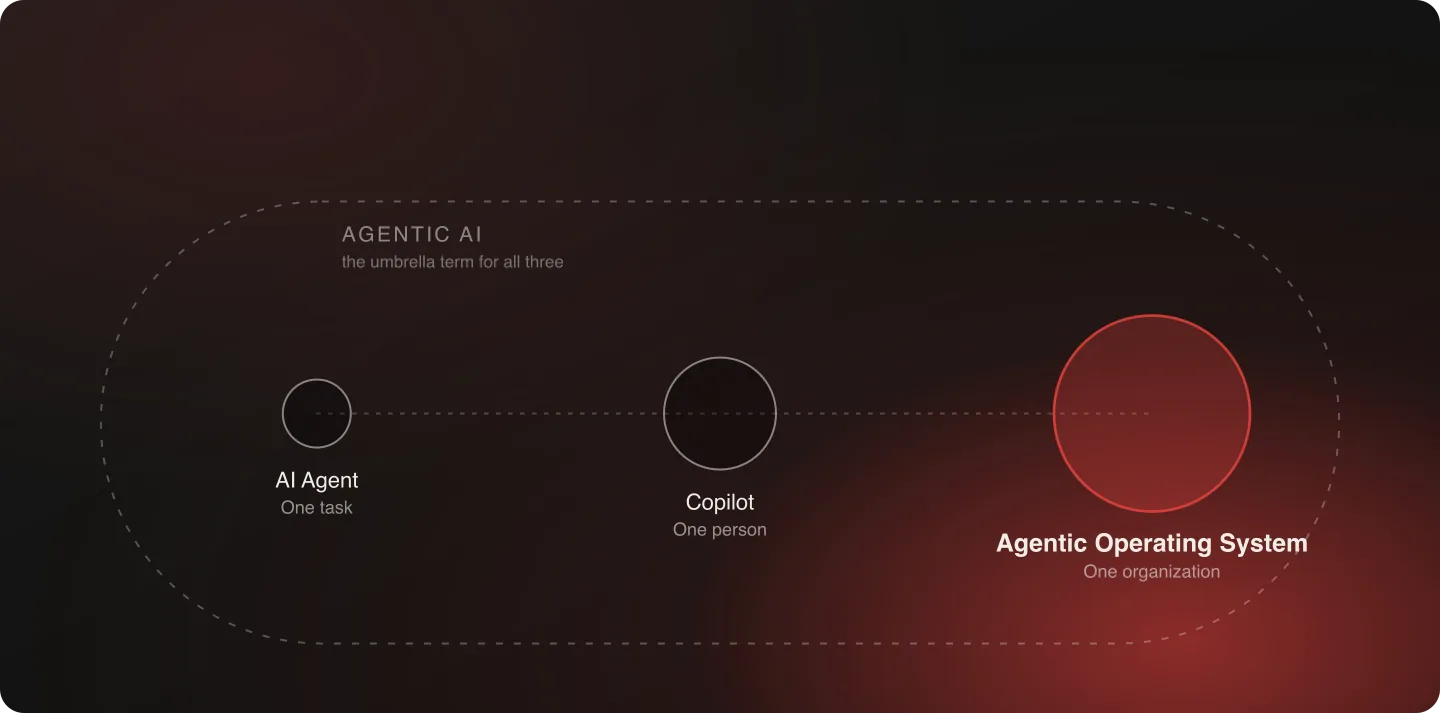
An AI agent completes a task when it’s asked and stops. A copilot assists one person on one task at a time. Agentic AI is the umbrella term for both, and for everything in between. An agentic operating system is software that orchestrates AI agents and human judgment to take delivery work from scope to shipped in weeks, not quarters. It runs an entire organization’s workflow, not one person’s task list.
The taxonomy, in order of scope
AI agent.
The smallest unit. Given a task and the tools to complete it, an agent executes and stops — write this function, summarize this document, draft this email. It has no awareness of what happens next unless something else tells it.
Copilot.
An agent (or several) wired into one person’s workflow, assisting them in real time — a suggestion as you type, an autocomplete, a drafted reply waiting for approval. It’s still scoped to one person, one task, one moment.
Agentic AI.
Not a product category — a description. Any system with autonomous, goal-directed AI behavior gets called “agentic AI” now, from a single customer-support bot to a fully orchestrated delivery organization. This is exactly why the term is everywhere and means almost nothing on its own: it describes a property, not a system.
Agentic operating system.
The largest unit, and a specific claim, not a description. An agentic operating system is software that orchestrates AI agents and human judgment to take delivery work from scope to shipped in weeks, not quarters. It doesn’t assist one person — it runs the sequencing of an entire organization: intake, discovery, solutioning, sprint, build, QA, and ship, with each stage’s output automatically becoming the next stage’s input. Anatta built one and runs the whole company through it, not just client-facing work.
The comparison, side by side
| AI Agent | Copilot | Agentic Operating System | |
|---|---|---|---|
| Scope | One task | One person, ongoing | An entire organization |
| Who operates it | Whoever issues the task | The individual it assists | Runs continuously, with human review and gating at every stage |
| Awareness | None beyond its own task | The one workflow it’s embedded in | Every stage, every project, every conversation, at once |
| Decision authority | None — executes what it’s told | Suggests; human accepts or edits | Proposes; a senior person approves |
| What it replaces | A single manual task | Manual drafting/searching for one person | The coordination gap between people, teams, and AI |
| Example | “Summarize this contract” | GitHub Copilot, an email autocomplete | Anatta’s Agentic Operating System |
Why the confusion is so persistent
“Agentic AI” is marketing shorthand for “AI is involved somewhere in this.” That’s true of a single chatbot and true of a company-wide orchestration system, which is exactly the problem — the term tells you almost nothing about what you’re actually being sold. When an agency says it’s “AI-native” or offers “agentic delivery,” the honest next question is: agentic at what scope? A single agent bolted onto an existing process is a different purchase than a system that runs the process itself.
How to tell which one you’re actually being offered
Ask any vendor using “agentic” language three things:
- What decides what happens next — a person, or the system? If a human still has to notice that one task finished and manually start the next, you’re looking at agents, not an operating system.
- What’s the blast radius of one AI action? One task, or a sequence spanning multiple people and stages?
- What’s explicitly never delegated? A vendor that can’t answer this hasn’t drawn the line — which usually means the line doesn’t exist yet in their system.
Anatta’s own answer to that third question is specific and public: security, compliance, final sign-off on requirements and architecture, creative approval, and the decision to ship are never delegated, on purpose. → See the full breakdown of what an agentic operating system is and isn’t.
Frequently Asked Questions
Is agentic AI the same as an AI agent?
No. “Agentic AI” describes a property — autonomous, goal-directed behavior — that can apply to something as small as a single task-completing agent or as large as a fully orchestrated delivery system. An AI agent is one specific, small implementation of agentic AI.
What’s the difference between a copilot and an agentic operating system?
A copilot assists one person on one task at a time, in real time. An agentic operating system runs the sequencing of an entire organization’s work — intake through delivery — with no single person required to carry it.
Is an AI agency the same thing as an agentic operating system?
Not necessarily. “AI agency” typically describes a firm that uses AI tools somewhere in its process. An agentic operating system is a specific architecture — a defined set of layers (orchestration, agent execution, human judgment, governance) working together continuously. A firm can call itself an AI agency without having built anything close to an operating system.
What should I ask a vendor who says they offer “agentic” delivery?
Ask what specifically decides what happens next in their process — a person or the system — and ask what they never delegate to AI. A vendor without a clear answer to the second question likely hasn’t drawn that line deliberately.
Curious what an agentic operating system looks like end to end? See the layers, the gates, and what never gets delegated.