












Shopify B2B on All Plans: What Moved, What Stayed Plus-Only, and Whether You Still Need Plus
August 6, 2026
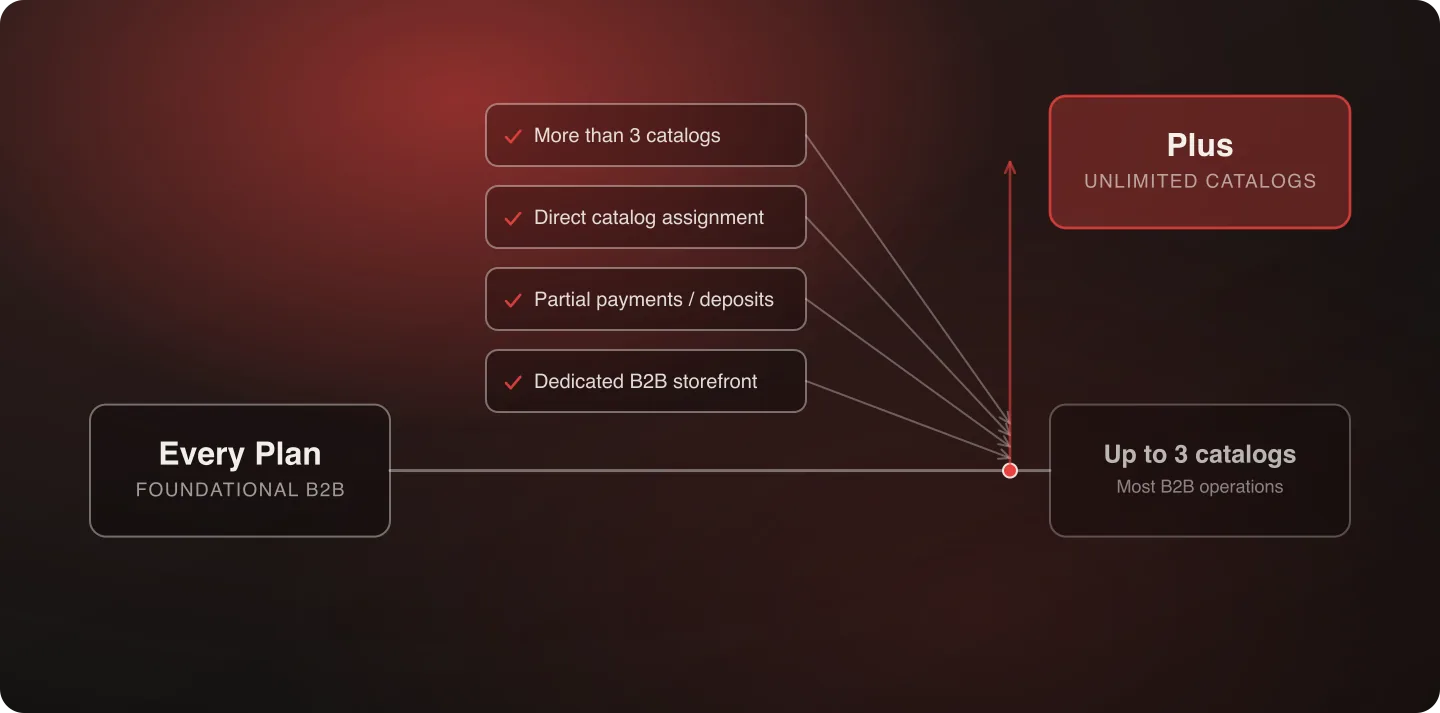
As of April 2, 2026, foundational B2B — company profiles, up to three catalogs, payment terms, volume pricing, vaulted cards — extended to Basic, Grow, and Advanced. Plus retains unlimited catalogs, direct catalog assignment to companies and locations, partial payments/deposits, and the dedicated B2B storefront. Whether you still need Plus is now a complexity threshold, not a binary — here's how to tell which side of it you're on.
Last verified: September 6, 2026.
Why Every Comparison Page You're Finding Is Out of Date
Most existing “Shopify B2B” content was written before April 2, 2026, when B2B functionality was Plus-exclusive. Any page still describing B2B as a reason to need Plus is describing a world that no longer exists — and this is one of the most common outdated claims we see on competitor comparison pages, since B2B was historically one of the strongest arguments for upgrading, and a lot of content built around that argument simply hasn't been revisited since the change. → See also Shopify's 2026 Deadlines for the full context of what else changed this year.
What Moved to Every Plan
- Company profiles — B2B customers can be set up as companies with associated contacts, replacing what used to require custom development or a third-party app to approximate on non-Plus plans
- Up to 3 catalogs — distinct product/pricing sets assignable to different company segments, enough for many B2B operations with a small number of customer tiers
- Payment terms — net-30, net-60, and similar terms rather than requiring payment at order time, a core B2B purchasing behavior that's now natively available regardless of plan
- Volume pricing — quantity-based price breaks, configurable per catalog
- Vaulted payment cards — saved payment methods for repeat B2B ordering, reducing friction on recurring orders
What's Still Plus-Only
- Unlimited catalogs (vs. 3 on other plans) — the single biggest constraint for B2B operations with many distinct customer segments; this is the ceiling most B2B-heavy merchants actually hit
- Direct catalog assignment to companies and locations — finer-grained control over which catalog which customer sees, which matters once a company has multiple locations that should see different pricing or product availability
- Partial payments and deposits — B2B orders requiring a deposit structure rather than full payment or full terms; common in industries with large custom or made-to-order B2B orders
- The dedicated B2B storefront experience — a more built-out, B2B-specific storefront presentation distinct from the standard consumer-facing storefront
The Real Decision: Is 3 Catalogs Enough?
This is the actual threshold question, and it depends entirely on how your B2B customer base segments:
- Fewer than 3 distinct pricing/catalog needs — Advanced's 3-catalog limit isn't a real constraint. B2B alone doesn't justify Plus in this scenario, regardless of how large the B2B revenue itself is.
- Exactly at or near 3 segments today, but growing — worth modeling forward 12–18 months, not just against today's segment count. Catalog needs tend to grow as B2B operations mature and add distinct customer tiers, so a decision that's correct today can become a constraint within a year.
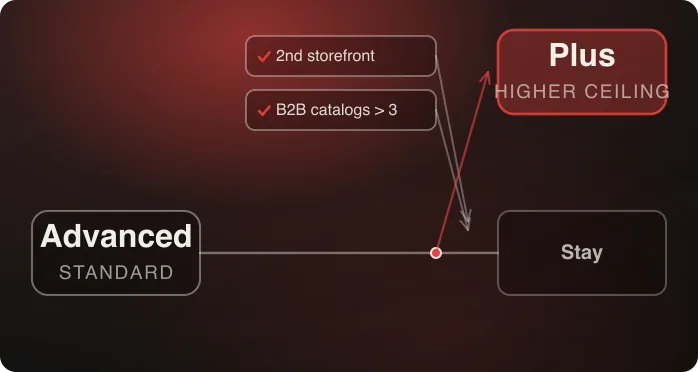
- More than 3 distinct segments, or segments requiring different catalogs per location within the same company — this is where Plus's unlimited catalogs and direct assignment become a real requirement, not a nice-to-have. A company with multiple locations that each need to see different pricing is a common real-world trigger for this.
- Deposit-based ordering is core to how you sell B2B — partial payments/deposits are Plus-only; if this is how your B2B customers actually order (common in made-to-order, custom manufacturing, or large-order industries), that alone can justify Plus regardless of catalog count.
Worked Scenarios
A wholesale apparel brand with 2 pricing tiers (standard wholesale, VIP wholesale). Comfortably within Advanced's 3-catalog limit. B2B alone doesn't justify Plus here — the broader Plus vs Advanced decision should be made on other factors.
A distributor with 5 regional pricing tiers and no deposit requirement. Exceeds the 3-catalog limit on catalog count alone. This is a case where Plus's unlimited catalogs directly solve a real constraint, independent of any other consideration.
A custom manufacturing B2B brand taking 50% deposits on large orders, with 2 pricing tiers. Under the catalog limit, but the deposit requirement is Plus-only. This is a case where a single specific capability (not overall complexity) is the deciding factor.
A B2B brand with 2 catalogs today, adding a new customer tier roughly every 8 months. Currently fine on Advanced, but worth modeling forward — at that growth rate, the 3-catalog ceiling is a near-term (not distant) consideration, and it's worth factoring the cost of a mid-year plan change into the decision now rather than treating today's snapshot as permanent.
If You Built a Workaround Before April 2026
Some Advanced-plan merchants built custom workarounds — apps or manual processes — to approximate B2B functionality before it was native. Post-April 2026, it's worth auditing whether that custom workaround can be retired in favor of native functionality, which usually reduces both cost and maintenance burden. This is a good moment to simplify, not just add native B2B on top of an existing workaround — running both a legacy workaround and the new native functionality simultaneously is unnecessary complexity that's easy to accumulate if this audit doesn't happen deliberately.
Common workarounds worth auditing: a third-party app providing company-account functionality, manually managed spreadsheet-based pricing tiers applied at order time, or custom development providing net-terms invoicing outside Shopify's native checkout.
What This Means for the Broader Plus Decision
If B2B was a significant part of why a brand was considering Plus, this change is worth pausing on before proceeding with an upgrade already in motion. It's not that B2B never justifies Plus — the worked scenarios above show real cases where it still does — but the reasoning needs to be specific to catalog count, per-location assignment, or deposit requirements now, rather than “we need B2B” as a blanket justification the way it may have been framed before April 2026. → For the full plan comparison, see Shopify Plus vs Advanced in 2026: The Decision, Not the Feature List.
Two More Worked Scenarios
A specialty foods B2B brand with 4 regional distribution partners, each needing different pricing due to local market conditions. This is 4 distinct catalog needs against a 3-catalog limit — a clear case for Plus on catalog count alone, independent of order volume or overall revenue size.
A B2B brand currently on Plus, primarily for B2B reasons, with exactly 2 pricing tiers and standard payment-at-order-time terms. Worth seriously re-evaluating. If B2B was the primary driver for the original Plus decision and this brand is now comfortably within Advanced's 3-catalog limit with no deposit requirement, the original justification for Plus may no longer hold — this is exactly the kind of decision worth re-running now that the underlying facts have changed, rather than continuing to pay for a tier whose original rationale has been superseded by Shopify's own platform change.
How This Affects Plus Renewal Conversations
For brands with an existing Plus subscription up for renewal, the B2B change is a legitimate factor to bring into that conversation — not as a threat, but as a genuine re-evaluation of whether the original reasons for choosing Plus still apply given what's changed on the platform since the last renewal. This is worth doing deliberately rather than defaulting to renewal on the same terms as before, particularly for brands whose B2B needs were the dominant factor in the original decision.
Migration Considerations If You're Moving Off a Custom Workaround
If you decide to retire a pre-April-2026 custom B2B workaround in favor of native functionality, treat this as a real migration project, not a simple toggle. Specifically:
- Data migration: company profiles, contact records, and negotiated pricing need to move from wherever they currently live (a custom database, a third-party app, a spreadsheet-driven process) into Shopify's native B2B structures
- Historical order data: confirm past B2B orders remain correctly associated with the right company records after migration, particularly if your workaround used a different customer-identification scheme than Shopify's native company model
- Customer communication: if the ordering experience changes visibly for B2B customers (a new portal, a different login flow, a different catalog presentation), they need advance notice, the same as the consumer-facing customer-accounts migration covered elsewhere in this series
- Parallel running period: consider running the old workaround and the new native functionality in parallel for a short window with a subset of accounts before fully cutting over, rather than migrating every B2B customer simultaneously
What This Doesn't Change
To be clear about the boundaries of this update: nothing about the April 2026 change affects the other Plus-exclusive capabilities unrelated to B2B — expansion stores, the deeper checkout customization ceiling, higher API limits, or the dedicated Merchant Success Manager. If any of those factored into your original Plus decision independent of B2B, this update doesn't change that part of the calculus at all. This is specifically a B2B-scoped change, not a broader re-opening of the whole Plus vs. Advanced question — though it's a legitimate prompt to re-run that broader analysis if B2B was doing a lot of the work in the original justification.
What to Do Next
- Map your actual B2B customer base against the catalog/segment question above, including a forward-looking view of growth, not just today's snapshot
- If you're currently on Plus primarily for B2B and you're clearly under the 3-catalog threshold with no deposit requirement, it's worth re-running the full Plus vs. Advanced decision — B2B alone may no longer justify the cost
- If you're on Advanced considering an upgrade for B2B reasons, confirm you're actually hitting a Plus-specific constraint (catalog count, direct assignment, deposits) rather than a general B2B capability that's now available to you already
- If you built a pre-April-2026 workaround, audit whether it can be retired now that native functionality covers the same need
- If Plus renewal is coming up and B2B was a major factor in the original decision, treat this as a deliberate re-evaluation point rather than an automatic renewal
Frequently Asked Questions
Do I still need Shopify Plus for B2B in 2026?
Not automatically. As of April 2, 2026, foundational B2B — company profiles, up to 3 catalogs, payment terms, volume pricing, vaulted cards — is available on Basic, Grow, and Advanced. Plus is still needed for unlimited catalogs, direct catalog assignment, and partial payments/deposits.
What's the actual threshold for needing Plus for B2B?
Primarily catalog count — if you need more than 3 distinct pricing/catalog structures, or deposit-based ordering, Plus becomes necessary. Below that, Advanced's native B2B functionality is likely sufficient, regardless of how large your B2B revenue is in absolute terms.
I already built a custom B2B workaround on Advanced — should I switch to native B2B now?
Worth auditing. Native B2B functionality as of April 2026 may let you retire a custom workaround, typically reducing both cost and ongoing maintenance, and avoiding the unnecessary complexity of running both simultaneously.
Is this the same B2B change as anything to do with checkout or customer accounts?
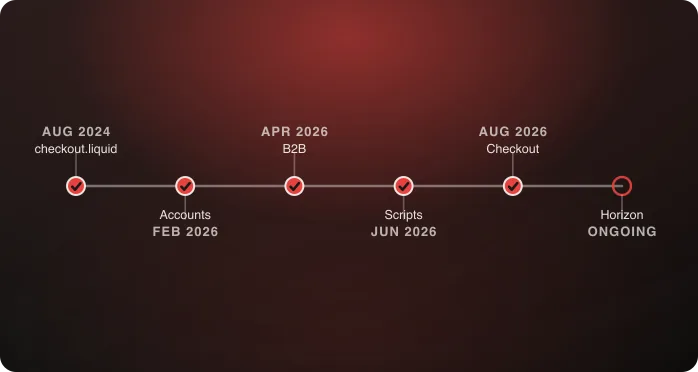
No — this is a separate change from the customer accounts, Scripts, and checkout.liquid deadlines covered elsewhere in this series. B2B extending to all plans doesn't remove any requirement; it just changes which plan you need for a given level of B2B complexity.
We're at 2 catalogs today but growing quickly — should we plan for Plus now?
Worth modeling 12–18 months forward rather than deciding purely on today's catalog count. If growth trends suggest you'll exceed 3 distinct pricing segments within that window, it's reasonable to factor that into the decision now rather than treating a plan change as a surprise later.
Should we bring up the B2B change during our Plus renewal conversation?
Yes, if B2B was a significant factor in your original Plus decision. It's a legitimate, genuine re-evaluation point given that the underlying platform capability has changed since that original decision was made — not something to raise as leverage, but a fair reassessment of whether the original justification still holds.
Does this change affect other Plus-exclusive features like expansion stores or API limits?
No — this is specifically scoped to B2B functionality. If other Plus capabilities (expansion stores, higher API limits, deeper checkout customization, dedicated support) factored into your original decision independent of B2B, this update doesn't change that part of the analysis.
Not sure if your B2B needs justify Plus? Talk to an architect.