












Shopify's 2026 Deadlines: Customer Accounts, Scripts, Checkout Extensibility and Horizon — What Changes and What to Do
July 27, 2026
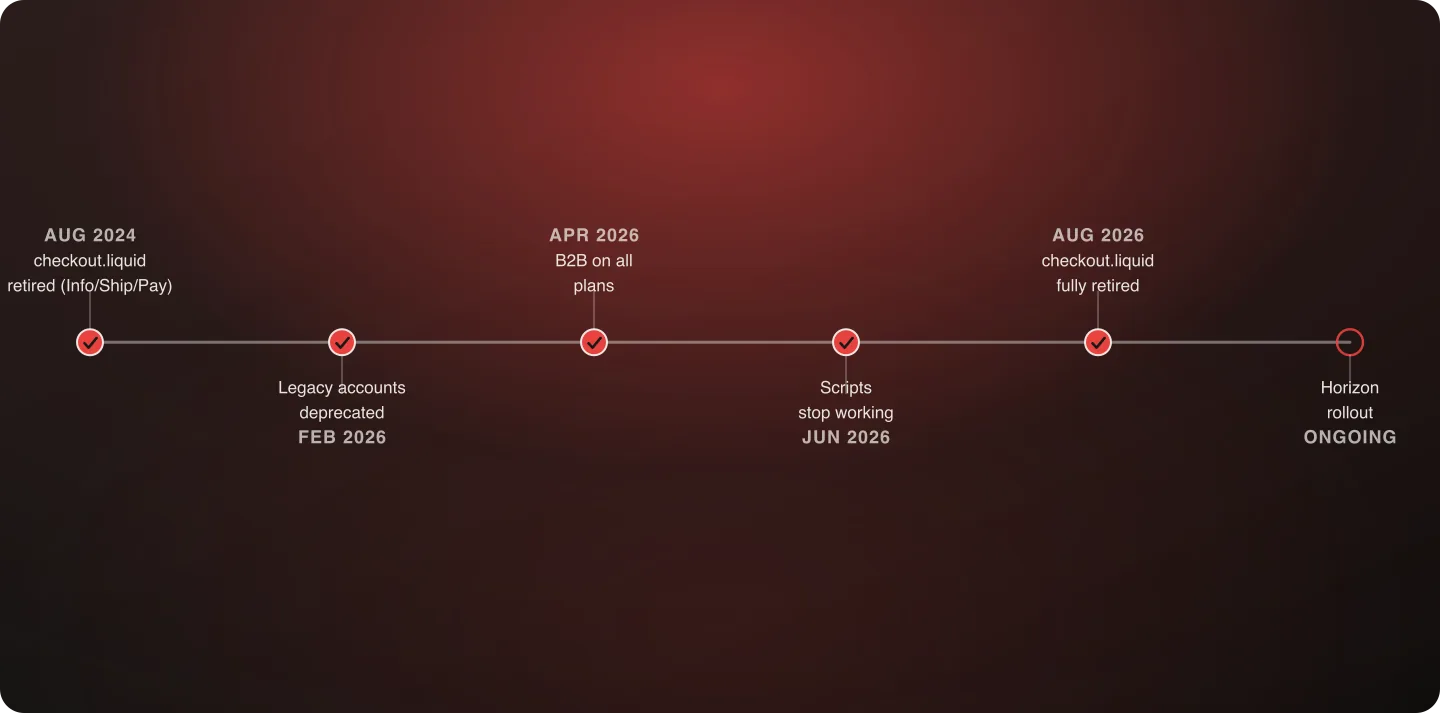
Shopify has forced four unrelated changes onto every merchant's roadmap in 2026: legacy customer accounts are deprecated (final sunset date still unannounced), Shopify Scripts stopped working June 30, checkout.liquid is fully retired as of August 26, and Horizon is the new theme architecture going forward. None of these are optional, and none of them are the same project. Here's the full timeline and what each one actually requires.
Last verified: September 6, 2026.
Most merchants encounter these four changes one at a time, as separate admin notifications, spread months apart — which makes it easy to miss that they're part of the same broader pattern: Shopify moving every customer-facing and merchant-editable surface toward a sandboxed, extension-based architecture. Understanding that pattern matters less than getting each individual deadline right, but it explains why this keeps happening and why it's worth building a standing habit around, not just clearing this year's list.
The Full Timeline
| Date | Change | Status (as of Sep 6, 2026) |
|---|---|---|
| Aug 13, 2024 | checkout.liquid retired for Information, Shipping, and Payment pages (all stores) | Passed |
| Jan 6, 2025 | Shopify began auto-upgrading legacy checkout pages | Passed |
| Aug 28, 2025 | checkout.liquid + additional scripts retired for Thank You/Order Status pages — Plus stores | Passed |
| Jan 2026 | Shopify began force-upgrading remaining legacy Plus checkout pages | Passed |
| Feb 26, 2026 | Legacy customer accounts deprecated — no new stores, no further updates | Passed. Final sunset date not yet announced |
| Apr 2, 2026 | Foundational B2B extended to Basic, Grow, and Advanced plans | Passed |
| Jun 30, 2026 | Shopify Scripts stop working entirely | Passed |
| Aug 26, 2026 | checkout.liquid + additional scripts retired for Thank You/Order Status pages — non-Plus stores | Passed 11 days ago |
| Ongoing | Horizon theme architecture rollout | Live now |
Four of these dates have already passed as of this writing. If your store hasn't addressed customer accounts, Scripts, or checkout.liquid, you're not early to this — you're already behind, and in the case of Scripts, running on logic that's stopped executing.
These Are Four Separate Projects, Not One
The single biggest mistake we see: treating “Shopify's changes” as one undifferentiated migration. They aren't related, they don't share a technical approach, and bundling them into one internal project usually means all four get done badly. Here's what's actually different about each.
1. Legacy Customer Accounts
What happened: As of February 26, 2026, legacy customer accounts (email + password login, Liquid-templated) are deprecated — no longer available to new stores, and Shopify has stopped shipping updates or technical support for them. The final sunset date hasn't been announced yet, which is precisely why waiting is the wrong move: there's no fixed deadline pressure yet, so most merchants aren't prioritizing it, and then the announcement lands with a fixed date and everyone scrambles at once.
What breaks: Any customized “My Account” experience built against the legacy Liquid templates (customers/account.liquid, customers/login.liquid). The new system uses passwordless email OTP login instead of email+password — a real change to the customer-facing login flow, not just a backend swap.
What Customer Account Extensions can and can't replicate: The new framework natively supports store credit, self-serve returns, and B2B account views — several things merchants used to build custom. What it doesn't hand you for free is bespoke visual design matching a highly customized legacy account section, or any business logic that was hard-coded directly into the old Liquid templates rather than driven by an app. If your legacy account pages were mostly stock with light styling, the migration is close to automatic — Shopify's shopify-account web component will auto-redirect stores without legacy files to the new system. If you built custom loyalty displays, order-history formatting, or B2B-specific account views directly into the old templates, that logic needs to be rebuilt as Customer Account Extensions before a hard sunset date lands.
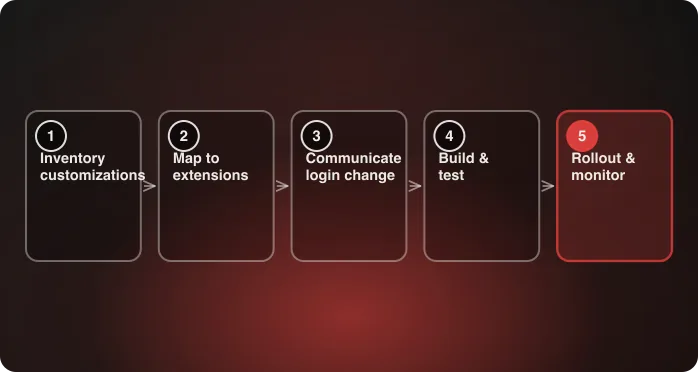
What to do now: Audit what's actually customized on your account pages today, categorize each customization as “stock behavior” (migrates automatically) or “custom-built” (needs rebuilding), and start with anything customer-facing and revenue-adjacent — B2B account views and loyalty displays first, cosmetic styling last. → For the full audit and rebuild plan, see Shopify Legacy Customer Accounts Are Deprecated: The Migration Plan for Plus Stores.
2. Shopify Scripts → Shopify Functions
What happened: Shopify Scripts — the mechanism for custom discount, shipping, and payment logic — stopped working completely on June 30, 2026. This is fully passed; anything still running as a Script simply isn't executing anymore.
What breaks: Any custom logic built in the Script Editor: automatic discounts, custom shipping rate logic, payment method filtering. This is a separate deadline from checkout.liquid — treating them as one project is the second most common mistake we see.
What a real rewrite looks like: Scripts ran merchant-editable Ruby, evaluated live in the checkout. Functions run server-side, sandboxed, deployed through an app rather than pasted into an editor. A common example: a “spend $100, get free shipping” Script becomes a Shipping Discount Function that reads cart total and returns a shipping-rate override — same outcome, different execution model, and it has to be built, tested, and deployed rather than edited in place. The same is true for tiered volume discounts, buy-one-get-one logic, and payment-method restrictions by cart contents — each of these was a common Script pattern, and each now needs its own Function.
What to do now: This is the one deadline on this page where “still to do” often looks identical to “quietly broken and nobody noticed yet” — discount logic failing silently doesn't throw an error a merchant necessarily sees. Audit in this order: (1) test every automatic discount that existed before June 30 by actually adding qualifying items to a cart, don't just check that the discount rule still exists in the admin; (2) test custom shipping rates the same way, live, not from documentation; (3) check payment method availability against cart contents if you had any filtering logic; (4) once you've confirmed what's actually broken, prioritize rebuilding revenue-affecting logic (discounts, shipping) ahead of anything cosmetic. → For the full audit process and the Script-to-Function mapping table, see Shopify Scripts to Functions: The Post-Sunset Audit.
3. checkout.liquid → Checkout Extensibility
What happened: This one shipped in stages, and the Plus/non-Plus distinction matters:
- Aug 13, 2024: checkout.liquid retired for Information, Shipping, and Payment pages — every store, Plus or not
- Aug 28, 2025: checkout.liquid and additional scripts retired for Thank You and Order Status pages — Plus stores
- Aug 26, 2026: the same Thank You/Order Status retirement — non-Plus stores, passed 11 days before this was last verified
What breaks: Anything living in the “additional scripts” field on Thank You/Order Status pages. In practice, that field usually held one of three things: conversion tracking pixels (Meta, Google Ads, TikTok), a tag-manager container loading multiple third-party scripts at once, or custom post-purchase upsell logic hand-coded into the page. All three need a new home.
The four building blocks that replace it:
- Checkout UI extensions — render custom components at specific checkout locations (order summary, delivery address, payment section). This is what most custom fields, upsells, and trust badges move to.
- Shopify Functions — server-side business logic: discount validation, shipping method customization, payment method rules. Not visual — this is where checkout decisions get made.
- Checkout Branding API — styling: colors, fonts, logo placement, layout. Handles what used to be CSS overrides directly in checkout.liquid.
- Web Pixels — the direct replacement for tracking scripts. Every conversion pixel that lived in “additional scripts” needs to move here specifically; this is usually the highest-volume, lowest-complexity part of the migration.
What to do now: If you're on Plus, this deadline passed over a year ago — if customizations haven't been rebuilt, Shopify has already force-upgraded you and removed them, which means the fastest path is checking what's currently missing rather than what's about to break. If you're non-Plus, this just passed; same situation is now current for you. Either way, start with Web Pixels — tracking loss is the most commonly missed piece because it doesn't visibly break the storefront, it just quietly stops reporting conversions. → For the full migration process and a worked example, see Checkout Extensibility Migration Guide.
4. Theme Architecture: Horizon
What happened: Horizon is Shopify's current theme architecture direction — not a hard deadline in the same sense as the three above, but an active, ongoing shift that affects every new build and eventually every existing store's long-term theme strategy. It's built around an expanded sections-and-blocks model and deeper metaobject support than the previous default (Dawn), giving merchants more native flexibility without custom theme code.
How to think about timing: This isn't a “drop everything” deadline like Scripts or checkout.liquid, but it changes the calculus on any theme decision made from here forward. Three situations where the decision is different:
- Already planning a re-theme for other reasons (rebrand, performance, a new collection layout) — evaluate against Horizon now rather than rebuilding on the outgoing default.
- Stable theme, no re-theme planned — no urgency. Dawn-based themes aren't being deprecated on a fixed date the way checkout.liquid was.
- Heavily customized legacy theme with real performance or maintenance problems — worth a real evaluation of whether a Horizon-based rebuild solves the underlying problem better than patching the current theme again.
→ Migrating to Shopify Horizon: What Changes, What Breaks, What It Costs — Anatta's dedicated Horizon migration page, with published pricing and guarantees. For how Horizon stacks up against Dawn or a custom build, see Horizon vs. Dawn vs. Custom Theme: A Decision Framework.
B2B: The Change That Cuts the Other Way
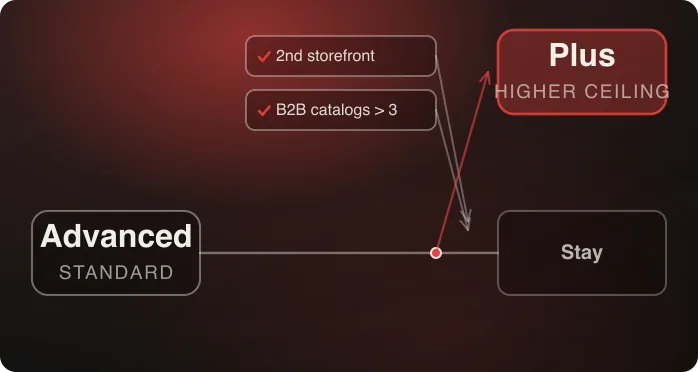
Unlike the four deadlines above, this one doesn't force action — it removes a reason you might have thought you needed Plus. As of April 2, 2026, foundational B2B — company profiles, up to three catalogs, payment terms, volume pricing, vaulted cards — extended to Basic, Grow, and Advanced plans. Plus retains unlimited catalogs, direct catalog assignment, partial payments/deposits, and the dedicated B2B storefront.
If B2B was the reason you were planning a Plus upgrade, that calculus changed in April, and it's worth re-running the decision rather than assuming your pre-April conclusion still holds. The real question now is a complexity threshold, not a binary: three catalogs is genuinely enough for a lot of B2B operations, and genuinely not enough the moment you have distinct pricing tiers for more than three customer segments. → See Shopify B2B on All Plans for the full breakdown, and Shopify Plus vs Advanced in 2026: The Decision, Not the Feature List for how this fits the broader plan decision.
Why This Keeps Happening (and Why It'll Keep Happening)
Shopify ships fast, and mandatory migrations are the cost of that pace. The pattern is consistent across all four changes above: an announcement, a passed deadline most merchants weren't tracking, and then discovering something silently broke. None of this is unique to 2026 — it's the standing cost of building on a platform that moves this quickly, and it's worth building an internal habit of checking Shopify's changelog quarterly rather than waiting to be surprised by the next one.
What This Actually Costs in Effort, Not Just Dollars
None of these four migrations are large in the way a full replatform is, which is exactly why they're easy to underestimate. Rough effort bands, in order of what we typically see:
- Web Pixels migration (part of checkout.liquid) — smallest lift, often a day or two once you know what pixels existed
- Scripts → Functions — scales with how many distinct pieces of logic you had; one discount rule is a small job, five interacting discount/shipping/payment rules is a real project with its own testing cycle
- Customer account rebuilds — depends entirely on how customized the legacy experience was; stock accounts are nearly free, a custom B2B account view is a multi-week rebuild
- Horizon migration — the largest of the four when undertaken, comparable to a standard re-theme rather than a quick patch
The dollar cost follows the same pattern — these are advisory bands, not quotes, since actual cost depends on your specific customizations. The mistake we see most often isn't underestimating any single one of these; it's assuming that because none of them are individually as large as a full replatform, none of them need a dedicated testing cycle. Every one of these touches checkout, discounts, or login — the three places a silent bug costs real revenue before anyone notices.
The Mistake We See Most Often
Merchants treat these four changes as IT housekeeping and assign them to whoever has spare capacity, rather than treating them as what they actually are: changes to revenue-critical surfaces (checkout, discounts, account login) that happen to arrive as mandatory platform maintenance instead of a chosen project. The team that rebuilds a Scripts-based discount rule as a Function without load-testing it against a real Black Friday-scale cart volume is a more common failure mode than teams simply not doing the migration at all. Being told about a deadline is not the same as being staffed and tested for it.
How These Deadlines Interact
Treating these as four separate workstreams doesn't mean treating them as four separate testing cycles if their timing overlaps. If you're already doing a Horizon migration, that's the moment to also confirm your Scripts-to-Functions rebuild and checkout.liquid migration are both clean — you're already doing full-site regression testing for the re-theme, and checkout logic gets touched by theme changes more often than merchants expect (a new theme can change how discount codes surface, how shipping options render, or how a custom account link is positioned). Bundling the QA pass is cheaper than running it four separate times. The one combination to avoid bundling: don't let a Horizon migration timeline become the reason a Scripts or checkout.liquid fix gets delayed — those two are already overdue regardless of what else is on the roadmap.
What to Do This Week
- Check your admin for Shopify's personalized upgrade reports — for customer accounts and checkout.liquid, Shopify surfaces exactly what's affected on your specific store, and this is faster than auditing from scratch.
- Audit for silent breakage first, not last. Scripts-based discount and shipping logic fails quietly — no error message, just a discount that stopped applying. Actually test a cart with qualifying items rather than checking that the rule still exists in the admin.
- Separate these into four workstreams, not one “Shopify updates” project. Different systems, different owners, different testing — a single combined ticket tends to mean the least urgent of the four (usually Horizon) gets the most attention because it's the most visible, while Scripts and checkout.liquid — both already overdue — get deprioritized.
- Build in the 2–3 month buffer Shopify itself recommends for customer accounts, since the final sunset date could land with less runway than you'd like, and “later in 2026” could mean weeks, not months, once it's announced.
- If a Horizon migration is already on the roadmap, fold the other three into the same QA cycle rather than treating theme work and checkout/account work as unrelated.
Go Deeper on Each of These Deadlines
Each deadline above has its own dedicated guide — the full audit process, the rebuild plan, and the decision framework for the calls that aren't forced:
- Shopify Legacy Customer Accounts Are Deprecated: The Migration Plan for Plus Stores
- New Customer Accounts vs. Legacy: What Changes for Login, Passwords, Apps and Order History
- Shopify Scripts to Functions: The Post-Sunset Audit
- Checkout Extensibility Migration Guide: Moving off checkout.liquid
- Shopify Plus Checkout Customization in 2026
- Horizon vs. Dawn vs. Custom Theme: A Decision Framework for Plus Brands
- Shopify B2B on All Plans: What Moved, What Stayed Plus-Only
Frequently Asked Questions
What happens if I miss the checkout.liquid deadline?
Shopify automatically upgrades the affected pages and removes any customizations built with checkout.liquid, additional scripts, or script tags on the affected pages. For Plus stores this happened starting January 2026 for stragglers; for non-Plus stores this is the current situation as of August 26, 2026.
Is there a hard deadline for legacy customer accounts yet?
No — Shopify deprecated legacy customer accounts on February 26, 2026, but has not yet announced the final sunset date, only confirming it will come “later in 2026.” Don't wait for the announcement to start planning; Shopify itself recommends building in 2–3 months of buffer once the date lands.
Are Shopify Scripts and checkout.liquid the same deadline?
No, and this is the most common confusion. Shopify Scripts (discount, shipping, and payment logic) stopped working entirely on June 30, 2026. checkout.liquid (the page templating and customization layer) has separate, staggered deadlines — 2024 and 2025 for most surfaces, and August 26, 2026 for non-Plus Thank You/Order Status pages. Treat them as two separate audits.
Do I need Shopify Plus for B2B now?
Not necessarily. As of April 2, 2026, foundational B2B extended to Basic, Grow, and Advanced. Plus still offers unlimited catalogs, direct catalog assignment, and partial payments/deposits — whether you need those specifically is now the real question, not whether you need B2B at all.
What's Shopify Horizon, and do I have to migrate now?
Horizon is Shopify's current theme architecture direction. Unlike the other deadlines here, there's no forced cutover date for existing stores — but any new build or major re-theme should be evaluated against Horizon rather than the previous default.
How do I know if something already broke without me noticing?
Check Shopify's personalized upgrade reports in your admin, and specifically test any automatic discounts, custom shipping rules, or payment-method logic that was built before June 30, 2026 — Scripts-based logic fails silently rather than throwing a visible error.
Not sure what's already broken on your store? Talk to an architect.

Related