












Shopify Plus vs Advanced in 2026: The Decision, Not the Feature List
July 24, 2026
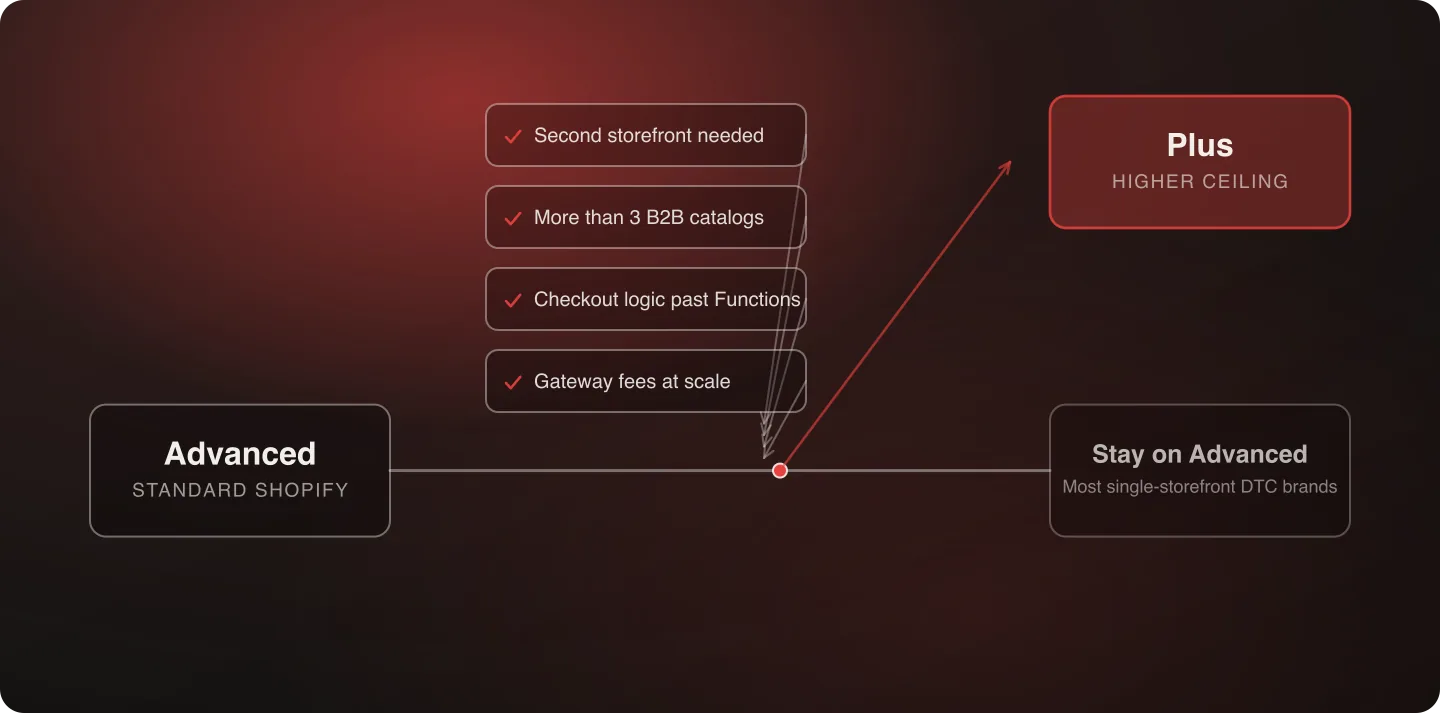
Advanced is the right plan for most single-storefront DTC brands. Plus becomes worth it at specific thresholds: a second storefront, catalog-level B2B complexity, checkout logic Functions alone can't handle, or third-party gateway fees eating into your margin at scale. Below those thresholds, Plus buys very little beyond a bigger invoice. Here's the math, done properly, and what changed in 2026 that most comparison pages haven't caught up to.
Last verified: September 6, 2026.
What Changed in 2026 (and Why Most Plus vs Advanced Content Is Already Wrong)
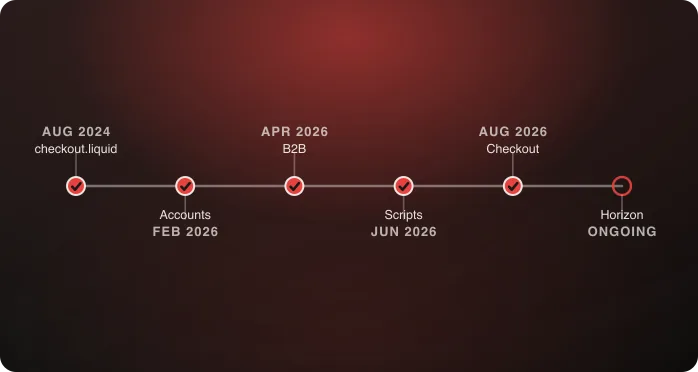
Three changes landed on Shopify Plus in the last several months. Any comparison page that doesn't account for all three is running on stale information, which describes most of what currently ranks for this query. → These three are part of a broader set of mandatory 2026 platform changes; see Shopify's 2026 Deadlines for the full timeline, including legacy customer accounts and Horizon.
| Change | Date | What It Means for This Comparison |
|---|---|---|
| Foundational B2B extended to Basic, Grow, and Advanced | April 2, 2026 | The single biggest reason people used to cite for needing Plus, "B2B requires Plus," is no longer categorically true. Advanced now includes company profiles, up to three catalogs, payment terms, volume pricing, and vaulted cards. |
| Shopify Scripts sunset | June 30, 2026 | Checkout logic moved to Shopify Functions for everyone. Any page still describing Scripts as a Plus advantage is describing a feature that no longer exists. If you haven't audited what silently broke, see the post-sunset audit. |
| checkout.liquid sunset (non-Plus thank-you/order-status pages) | August 26, 2026 | Checkout customization on non-Plus plans is now Functions plus checkout UI extensions plus the branding API, a real capability, not the gap it used to be. See the migration guide and what's still Plus-only. |
The practical result: several of the "reasons to choose Plus" that populate page one of this search result are either outdated or actively wrong. That's the gap this page exists to close.
The Real 2026 Delta: What Plus Actually Gets You
| Capability | Advanced | Plus | Who This Actually Matters To |
|---|---|---|---|
| B2B catalogs | Up to 3 | Unlimited, with direct catalog assignment to companies/locations | Wholesale operations with more than a handful of distinct customer segments |
| B2B payments | Payment terms, volume pricing | Everything in Advanced, plus partial payments and deposits | B2B brands taking large orders with deposit-based terms |
| Checkout customization | Functions + UI extensions + branding API | Everything in Advanced, plus deeper checkout UI extension points | Brands with checkout logic too complex for the standard extension points |
| Storefronts | 1 | Multiple, via expansion stores | Multi-region or multi-brand operations |
| Staff accounts | Limited | Unlimited | Larger internal teams needing individual logins |
| API rate limits | Standard | Higher | High-transaction-volume stores hitting Advanced's ceiling |
| Admin structure | Single store | Organization-level admin across stores | Multi-storefront operations needing centralized control |
| POS | Standard | POS Pro included | Omnichannel brands with meaningful in-person volume |
| Support | Standard | Dedicated Merchant Success Manager | Brands that have outgrown standard support SLAs |
| Launchpad (scheduled automation) | No | Yes | Brands running frequent flash sales or scheduled launches |
Read this table honestly: most single-storefront DTC brands need real answers to maybe two or three of these rows. That's the actual test, not whether Plus has more features (it always will), but whether your operation needs the specific features Advanced lacks.
The Break-Even, Done Properly
Every break-even calculation on page one of this search result makes one of two mistakes: double-counting third-party gateway fees, or ignoring the app-consolidation offset that comes with Plus. Both errors push the math in opposite directions, which is part of why the "conventional wisdom" number is unreliable regardless of which way it's wrong.
Error 1: double-counting gateway fees. If you use a third-party payment gateway, Shopify charges a per-transaction fee on top of your gateway's own rate, and on Plus that fee is lower than on non-Plus plans. Some comparisons count the full gateway rate as a Plus cost and separately count the transaction-fee savings as a Plus benefit. Pick one framing and use it consistently. Don't count the same dollar twice in opposite directions.
Error 2: ignoring app consolidation. Plus includes native capabilities (B2B, POS Pro, higher API limits, Launchpad) that Advanced brands often pay third-party apps to approximate. A real break-even has to net out what you'd stop paying for apps you no longer need. Most comparisons skip this entirely, which overstates Plus's net cost.
Worked example: $12M GMV, single storefront, no B2B
- Base cost difference: Plus's base fee vs. Advanced's, annualized.
- Gateway fee delta: at $12M in volume through a third-party gateway, the lower Plus transaction fee saves real money — model this against your actual gateway rate, not a generic assumption.
- App consolidation: minimal at this size. A single-storefront DTC brand at $12M rarely needs the multi-store or B2B capabilities Plus adds, so there's little offset to claim.
- Read: at this profile, Plus is very likely not worth it unless a specific Advanced limitation is actively costing you (see the decision scenarios below).
Worked example: $40M GMV, B2B-heavy, considering a second storefront
- Base cost difference: same delta as above, now a smaller percentage of revenue.
- Gateway fee delta: larger absolute savings at this volume.
- App consolidation: likely meaningful. B2B app subscriptions, a multi-store workaround, POS software, and API-limit workarounds could all be replaced by native Plus capability.
- Read: at this profile, the math usually favors Plus. The capability gap (B2B catalogs, multi-store admin, checkout depth) is doing real work, not just adding a bigger invoice.
The honest bottom line: the break-even isn't a single number you can quote, it's a calculation that depends entirely on your gateway rate, your app stack, and whether you actually need the capability rows in the table above. Anyone quoting you a flat break-even figure without asking about those three things is guessing.
Why the Pricing You're Finding Online Is Inconsistent
This section covers pricing only as far as it bears on the Plus-vs-Advanced decision. For the full breakdown, base rate by contract term, the variable fee, and where the real negotiating room is, see Shopify Plus Pricing: The Full Cost Breakdown.
Search this topic and you'll find real disagreement. One recent example we found while researching this page: an automated pricing tracker claimed Shopify's Plus pricing cap dropped 93.8% in a single month, citing a "changelog" that, when actually checked, was about adding bank accounts for multi-currency payouts, completely unrelated to pricing. That's not a one-off. A lot of "Plus pricing" content online is either scraped by tools that don't verify what they're citing, or describing Shopify's separate Enterprise tier (a different classification, generally for brands well above $300M in GMV) as if it were standard Plus pricing.
What's actually true, in general terms: Shopify Plus has a published base rate by contract term (3-year vs. 1-year), plus a variable fee that applies above a revenue threshold. Beyond that, Plus pricing has real negotiating room — contract term, the variable rate itself, and migration credits (typically a few months waived during the migration period) are all things we've seen move in real conversations with Shopify.
What's rarely stated publicly: Shopify has an incentive structure where a merchant willing to provide marketing value back (case studies, testimonials, willingness to adopt more of Shopify's own services like B2B or POS) can negotiate more favorable terms. The more of your GMV and services usage you're willing to commit to Shopify, generally, the more room there is to negotiate the rate down.
What to ask your Shopify rep directly, since none of this is published:
- What's the actual variable rate at our GMV, and where's the threshold it kicks in?
- Is a migration credit available, and for how long?
- Does our willingness to participate in case studies or adopt additional Shopify services (B2B, POS) affect the offer?
- What does the 3-year term actually lock in, and what's the real cost of breaking it early?
Four Decisions
Single-store DTC brand at $12M
Advanced almost certainly wins. Model your specific gateway fee delta before assuming otherwise, but absent a B2B or multi-storefront need, the capability gap doesn't justify the cost gap.
Multi-region brand needing three storefronts
Plus wins on the expansion-store capability alone, independent of the rest of the math. This is a capability Advanced doesn't have at any price.
B2B-heavy brand with ~200 accounts and customer-specific pricing
Genuinely close now, post-April 2026. Advanced's 3-catalog limit is the real constraint. If 200 accounts need more than 3 distinct pricing/catalog structures, that alone can justify Plus.
High third-party-gateway-dependency brand
Model the transaction-fee delta carefully at your real volume before deciding. This is the scenario most likely to have a break-even that surprises you in either direction.
When Plus Won't Fix Your Problem
An operations or ERP problem misdiagnosed as a platform problem
If checkout is fine but fulfillment, inventory sync, or order routing is broken, Plus doesn't touch any of that. You'll spend the upgrade budget and still have the same operational gap.
A conversion problem misdiagnosed as a checkout problem
Plus's checkout customization depth is real, but if the actual issue is page speed, product presentation, or funnel drop-off upstream of checkout, that's a CRO and architecture problem Plus doesn't solve by itself.
A theme-architecture problem that follows you across the upgrade
If your current theme is poorly built, upgrading the plan without addressing the architecture just moves the same problem onto a more expensive plan.
What the Upgrade Actually Costs Beyond the License
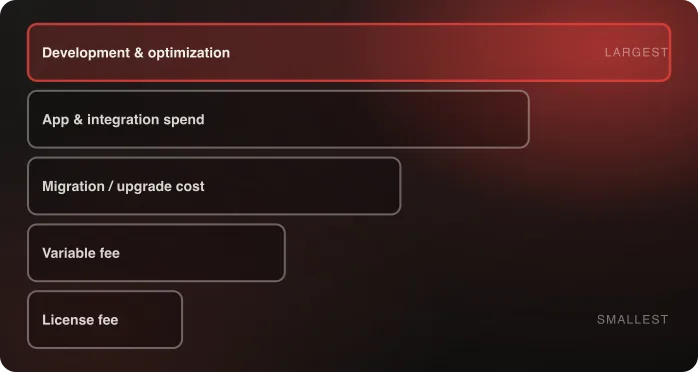
The plan fee is the smallest number in a real Plus migration. Budget for:
- Migration effort: moving from Advanced to Plus is usually lighter than a full replatform, but still real work: theme adjustments, app reconfiguration, staff training on new capabilities.
- Checkout rework if you're carrying Scripts debt: anyone who built custom checkout logic on the now-retired Scripts needs that rebuilt on Functions regardless of which plan they're on, but it's often bundled into a Plus upgrade conversation.
- Integration rework: if you're adding B2B, POS, or multi-storefront capability, the integrations connecting to your ERP/OMS need to account for the new complexity. That's the same systems replatform and integrations discipline that underlies any Shopify migration, Plus or otherwise.
- Testing: anything touching checkout needs full regression testing before go-live, no exceptions.
Anatta's Nuts.com migration, a custom platform moved to Shopify Plus, cut custom code by 85% and reduced total cost of ownership 28% in year one, 41% in year two. That's a full replatform, not an Advanced-to-Plus upgrade, but it's the clearest public evidence of what "the license fee is the smallest number" actually looks like in practice. You can read the full Nuts.com case study for the specifics.
If you're weighing an upgrade and want a straight assessment of whether the value is there, chat with our team or see how our Shopify Plus agency work scopes migrations like this beyond the license fee.
Frequently Asked Questions
Is Shopify Plus worth it?
For most single-storefront DTC brands without B2B or multi-region needs, no. Advanced now covers most of what used to require Plus, especially since B2B extended to all plans in April 2026. Plus becomes worth it at specific thresholds: multiple storefronts, catalog-level B2B complexity, or checkout logic beyond standard extension points.
When should I upgrade to Shopify Plus?
When you hit a specific capability wall Advanced can't clear: needing more than 3 B2B catalogs, needing a second storefront, or needing checkout customization beyond what Functions and UI extensions support on Advanced. Revenue alone isn't the trigger; the capability gap is.
How much does Shopify Plus cost in 2026?
Plus has a published base rate that differs by contract term (3-year vs. 1-year), plus a variable fee above a revenue threshold. Beyond the base rate, real negotiating room exists on term length, the variable rate, and migration credits, ask your Shopify rep directly, since most of this isn't publicly documented.
Does Shopify Advanced support B2B now?
Yes. As of April 2, 2026, foundational B2B, company profiles, up to three catalogs, payment terms, volume pricing, vaulted cards, extended to Basic, Grow, and Advanced. Plus retains unlimited catalogs, direct catalog assignment, and partial payments/deposits. See Shopify B2B on All Plans for the full breakdown and the catalog-count threshold that actually decides it.
What's the real break-even between Plus and Advanced?
There isn't a single number, it depends on your third-party gateway rate, what apps you'd stop paying for once you have native B2B/POS/Launchpad, and whether you actually need the capabilities Plus adds. Anyone quoting a flat break-even without asking about your gateway rate and app stack is guessing.
What does upgrading to Plus cost beyond the license fee?
Migration effort, checkout rework if you're carrying old Scripts-based logic, integration updates for any new capability (B2B, POS, multi-store), and full regression testing. The license fee is typically the smallest line item in a real upgrade.

“Following Anatta’s work, our conversion rate went from 4.1% to 6.2%, which is insane in the e-commerce industry.”
Tran Ngo, VP Digital & Growth
Read now
Weighing a Move to Shopify Plus? See how Nuts.com cut custom code 85% and TCO 41% in year one.

Related