












Shopify Plus Pricing: The Full Cost Breakdown
September 6, 2026
Shopify Plus has a published base rate that varies by contract term (roughly $2,300/month on a 3-year term, $2,500/month on 1-year), plus a variable fee — around 0.35–0.40% — that applies above a revenue threshold near $800K/month. Beyond that, real negotiating room exists on term length and the variable rate. The license fee is rarely the biggest number in a real Plus budget.
Last verified: September 6, 2026.
The Base Rate
Shopify Plus's published starting structure differs by contract length: roughly $2,300/month on a 3-year term, or $2,500/month on a 1-year term. The longer commitment buys a lower monthly rate — a straightforward tradeoff between commitment length and cost, worth weighing against how confident you are in a 3-year platform decision.
The Variable Fee — the Part Most Pricing Content Gets Vague About
Above a revenue threshold in the neighborhood of $800,000/month in GMV, Shopify Plus adds a variable fee, generally cited around 0.35–0.40%. This is the piece of Plus pricing that scales with your growth rather than staying fixed — worth modeling explicitly against your actual or projected GMV rather than treating the base rate as the whole cost.
What we can't tell you, and why. The exact variable rate for your specific account, and the exact threshold that applies to your specific deal, are things a Shopify rep will confirm in a live pricing conversation — they're not uniformly published, and they can move based on your negotiation (see below). Any page claiming to know your exact number without knowing your account is guessing.
Real Negotiating Room — Described Generally, Not With Specific Figures
Beyond the base structure, Shopify Plus pricing has genuine negotiating room: contract term length, the variable rate itself, and migration credits (a number of months typically waived during the migration period) are all things that move in real conversations. What's rarely stated publicly: Shopify has an incentive structure where a merchant willing to provide marketing value back — case studies, testimonials, willingness to adopt more of Shopify's own services (B2B, POS) — can negotiate more favorable terms. Generally, the more of your GMV and services usage you're willing to commit to Shopify, the more room exists to negotiate the rate down.
What to actually ask your Shopify rep, since none of this is published:
- What's the actual variable rate at our GMV, and where's the threshold it kicks in?
- Is a migration credit available, and for how long?
- Does willingness to participate in case studies or adopt additional Shopify services affect the offer?
- What does the 3-year term actually lock in, and what's the real cost of breaking it early?
Why this negotiation dynamic isn't usually mentioned in pricing content. Most Plus pricing guides present the base rate and variable fee as if they were fixed, published facts — closer to how a retail price works than how an enterprise SaaS contract actually gets negotiated. The reality is closer to any other enterprise software deal: list price is a starting point, not a final number, and the actual terms depend on what you're both bringing to the table. Treating the published-sounding figures as non-negotiable costs you leverage you'd otherwise have.
The Enterprise Tier Prices Very Differently
Everything above describes standard Shopify Plus. Shopify's separate Enterprise full-platform tier — an enhanced contract sitting above standard Plus, generally relevant once a brand is operating at roughly $300M+ in GMV — is priced on an entirely different, contract-negotiated basis with no comparable public benchmark. If you're evaluating whether you need standard Plus or the Enterprise tier specifically, see the full three-tier breakdown.
Why the License Fee Is Rarely the Real Number to Budget Against
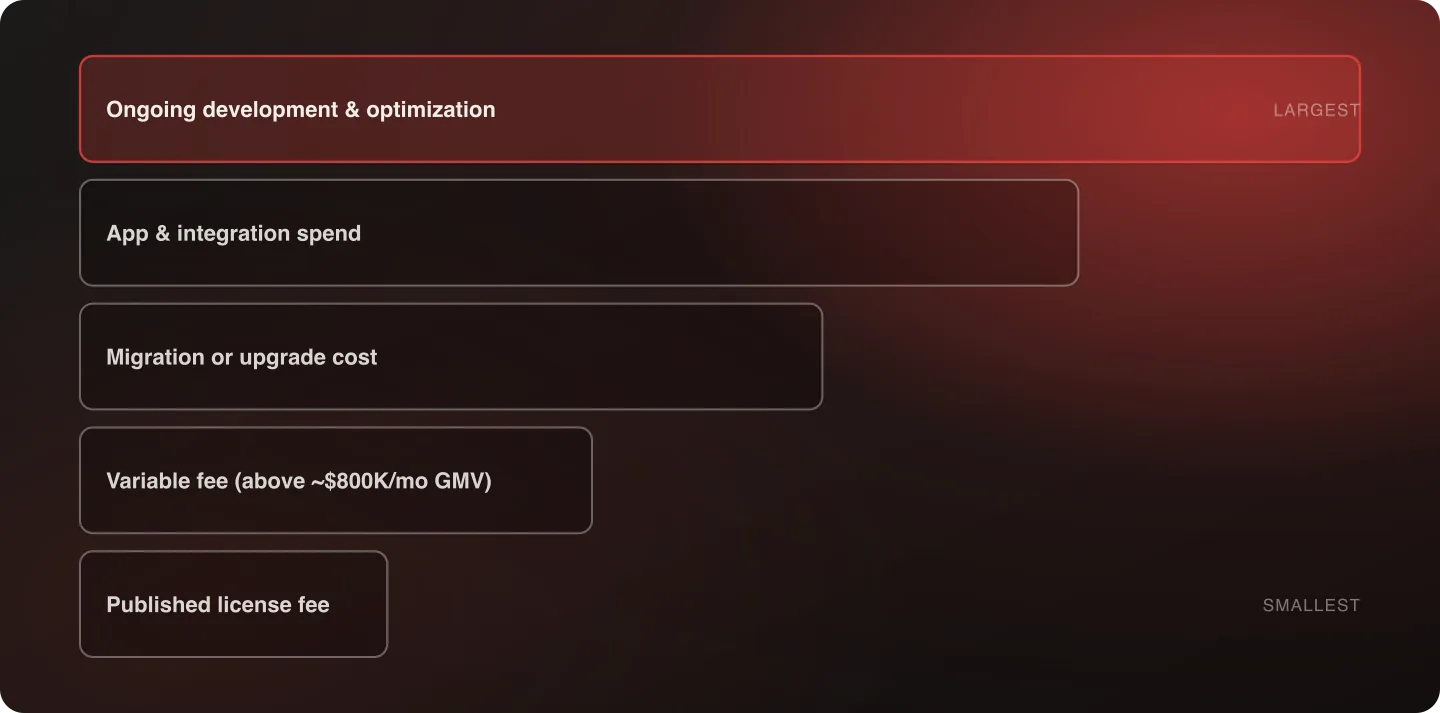
The published base rate and variable fee are the smallest inputs in a real Plus budget once you account for:
- Migration or upgrade cost — moving onto Plus, whether from another platform or upgrading from Advanced, is real implementation work, not a switch you flip
- App and integration spend — Plus's native capabilities reduce some third-party app spend, but rarely all of it
- Ongoing development and optimization — the license fee doesn't include a team building and maintaining your storefront
A useful reframe: ask any pricing comparison for total cost of ownership over a real time horizon (12–36 months), not the sticker price alone. See the full Plus vs. Advanced decision, including a proper break-even walkthrough, if the plan you're actually weighing is Plus against Advanced rather than Plus's price in isolation.
Why this reframe matters most when a competitor's pitch leads with a lower number. A vendor or competing platform quoting a lower headline price is answering a narrower question than the one that actually matters. The right comparison is always total cost over the period you'll actually run the platform, inclusive of migration, integration, and ongoing development — not the number that fits neatly on a comparison slide.
Is Shopify Plus Worth It?
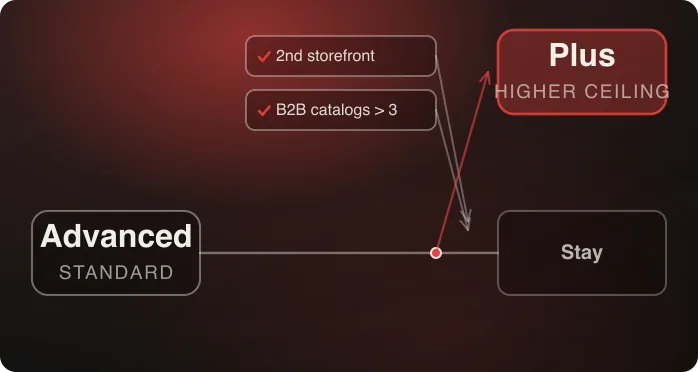
For most single-storefront DTC brands without B2B or multi-region complexity, no — Advanced now covers most of what used to require Plus, especially since B2B extended to all plans in April 2026. Plus becomes worth it at specific thresholds: a second storefront, catalog-level B2B complexity beyond Advanced's 3-catalog limit, checkout logic beyond standard Functions and UI extension points, or third-party gateway fees at a scale where Plus's lower rate genuinely moves the math.
When Should You Actually Upgrade?
Not at a specific revenue number — despite how often "upgrade at $1M" gets repeated as guidance. The real trigger is hitting a genuine capability wall on your current plan: a B2B catalog need beyond 3 catalogs, a checkout customization need beyond what Advanced's Functions support, or a multi-storefront requirement Advanced can't meet at any price. Revenue alone doesn't create the need; the capability gap does.
Frequently Asked Questions
How much does Shopify Plus cost in 2026?
A base rate of roughly $2,300/month (3-year term) to $2,500/month (1-year term), plus a variable fee around 0.35–0.40% above roughly $800K/month in GMV. Real negotiating room exists on term length, the variable rate, and migration credits — none of this is fully published, so confirm current numbers directly with a Shopify rep.
Is the license fee the real cost of Shopify Plus?
No — it's typically the smallest number in a real Plus budget once migration/upgrade cost, app and integration spend, and ongoing development are counted. Model total cost of ownership over 12–36 months, not the sticker price alone.
Is Shopify Plus worth it?
For most single-storefront DTC brands without B2B or multi-region needs, not automatically — Advanced now covers much of what used to require Plus. Plus becomes worth it at specific capability thresholds, not at a specific revenue number.
When should I upgrade to Shopify Plus?
When you hit a genuine capability wall Advanced can't clear — B2B catalog limits, checkout customization needs, or a multi-storefront requirement — not at a specific revenue milestone.
Is Shopify Plus pricing negotiable?
Yes, within real limits — term length, the variable rate, and migration credits are all things that move in practice. What Shopify accepts in exchange for a better rate (marketing participation, adopting more Shopify services) isn't published but is a real part of the conversation.
Is Shopify Enterprise priced the same way as Plus?
No — Shopify's separate Enterprise full-platform tier is priced on an entirely different, contract-negotiated basis with no comparable public benchmark, generally relevant only at much larger GMV scale than standard Plus.
Talk to an architect about what Plus would actually cost you.

Related