



















Agentic AI10 minute read
Agentic Delivery on a Fixed-Date Shopify Theme Migration
Most Shopify theme migrations are template work. A Horizon migration is more than that — a rebuild, not a theme swap — and this post is about the heaviest version of it: a re-theme that arrives with a rebrand and a catalog restructure attached, on a launch date set when the project began and not open to negotiation. On Dropps’ four-week Horizon rebuild, the new product architecture turned scents into variants and replaced count-based sizes with a quantity selector, so subscriptions, reviews, redirects and analytics all had to be remapped alongside the theme. Anatta’s estimate going in was that the theme build itself would be roughly a week’s work. The larger risk was everything around it. The site shipped on the date.
The rest of this is about how Agentic Delivery by the Anatta Operating System (AOS) handled that work. AOS runs delivery as a loop — intake, discovery, solutioning, sprint, build, QA and ship, each launch feeding the next round of discovery — and this engagement joined it once scoping was done. For the project’s results, the Dropps case study is the account of record; this is the view from inside the loop.
Last verified: 21 September 2026. This describes a system in active development; it names what has and hasn’t been measured, and will be revisited as that changes.
On a Shopify Theme Migration, the Date Is the Constraint
A theme migration almost always arrives with a date attached — a rebrand announcement, a peak season, a contract ending — and the date rarely moves. That turns scope into the variable, which makes scope decisions constant. The thing most likely to sink the project is not a hard engineering problem. It is the lag between a decision being made and the work reflecting it.
Two things tested that on this engagement. Partway through the build, a second design variation arrived and sent completed work back for rework. And most of the launch-readiness work sat with a small client team that got smaller when its head of eCommerce left mid-project. Neither moved the launch date. What follows is what the system did while it held — and, further down, what it didn’t.
Where the Scope Lived
In most agencies the scope of a project lives in three places at once: a signed statement of work, a project board, and the heads of the two or three people who have been on every call. The three drift apart from the first week, and nobody sees the drift until something lands wrong.
On this engagement the requirements document became the single source for the scoped work. People wrote and revised it; the system’s job was to carry each revision through to the tasks. It went into the system at the end of July — a couple of weeks before development began in mid-August — and was revised eight times before final sign-off, each revision reconciled against the tasks already derived from it. Sixty-nine tasks came out of it directly — sixty-two delivered, seven cancelled as the scope firmed up — inside an engagement that tracked 157 items in total, the rest being the bugs and chores any build produces, raised by people as they found them.
Getting there took most of August. Work logged earlier in a conventional issue tracker ran alongside the document until early August, when the team was told to treat the old tracker as though it no longer existed; the last of that work was moved across about two weeks before launch. For part of the build, then, the drift described above was still possible. What changed is that there was a single place it was being drained into.
What happened when the spec changed
Here is one instance, concretely. A task covering product, subscription, review and content migration was generated from the requirements document. When the document changed, the task was rewritten against it automatically, and the rewrite recorded its reason: the plan now used an existing subscription-migration script, took a different path on review consolidation, and dropped a block of discount scope. Seventeen minutes later the same task was broken into seven sequential pieces, each with an hour estimate.
Requirement changes, task follows, reason recorded, work re-sequenced — no status meeting, no change-request email, no one reconstructing in November why the scope moved in August. The record answers it.
The late design change was the same kind of event at a larger size. On a single day in late August, once the second variation was approved, the rework went onto the board as fourteen tasks — one for each section already built: homepage, navigation, product card, collection and product pages, cart, blog and the rest, each pointing at the approved designs. All fourteen shipped inside the original window. The rework was itemized against what existed instead of prompting a redrawn plan, which is what let it sit on the board as ordinary work.
Launch Readiness, Run as Work Instead of Meetings
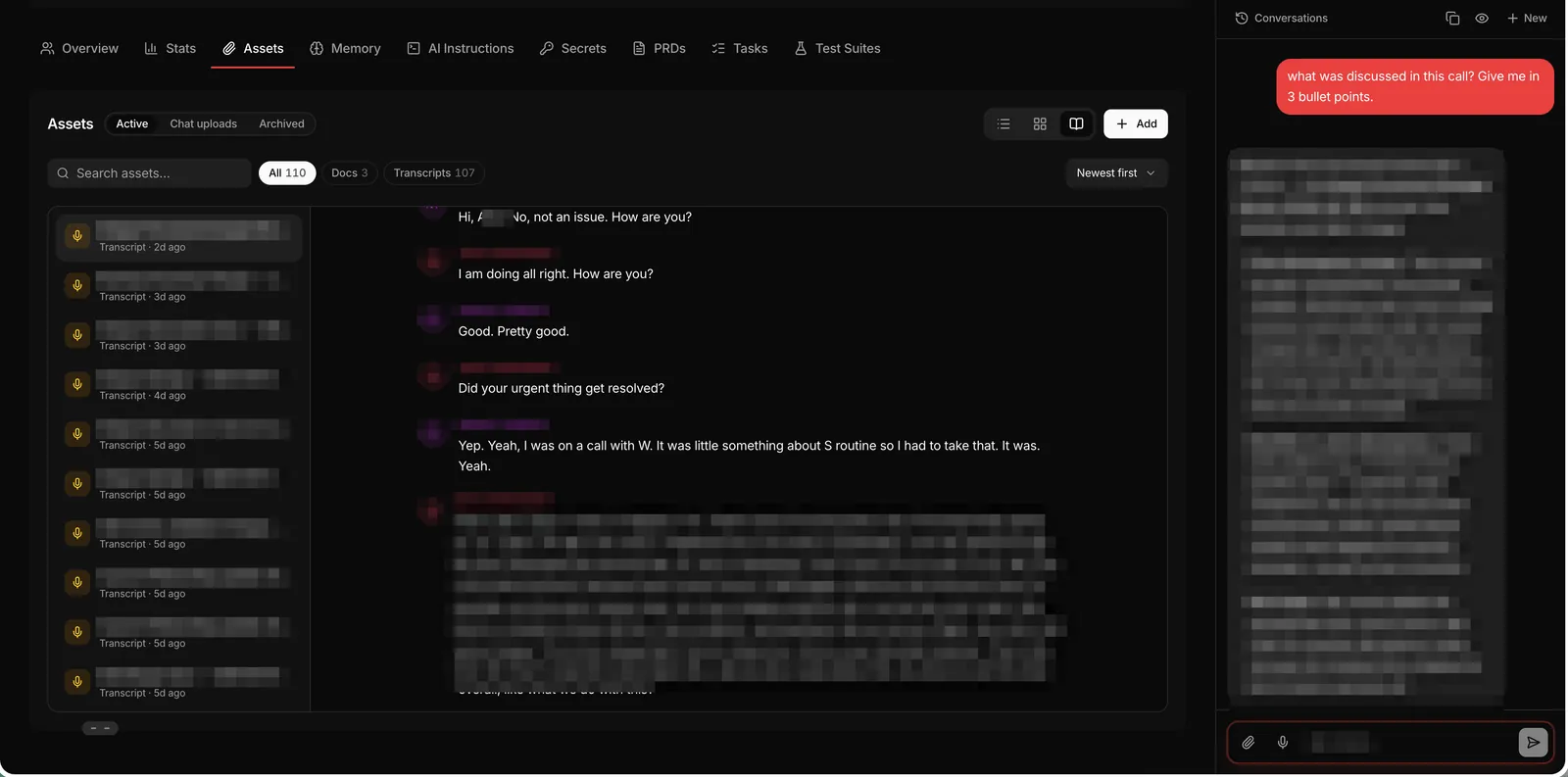
The published account is blunt about where the project was won: not the theme, but the subscription and review migrations, the redirect map and the analytics remap. Each is a dependency chain with a client-side link in it — a sign-off, a sync, a setting only the client can change.
By launch week, the engagement’s record held a twelve-step launch-day runbook with an owner against every step, and a running list of what was waiting on the client: collection sign-offs, a review-platform sync, a consent-banner change, each with a name beside it. That is the list the engagement lead worked from after the client’s head of eCommerce left. Stepping into a launch-owner role is a human decision, and a person made it — but they stepped into a known list, not an archaeology project.
The board did the same for the build’s own loose ends. On the first of September, a QA engineer logged a cart error that appeared when a shopper changed variant on the product page. It was on the board with an owner the day it was found, and closed on the ninth, six days before launch. Nothing exotic — just nothing left waiting for someone to remember it.
QA Against a Moving Target
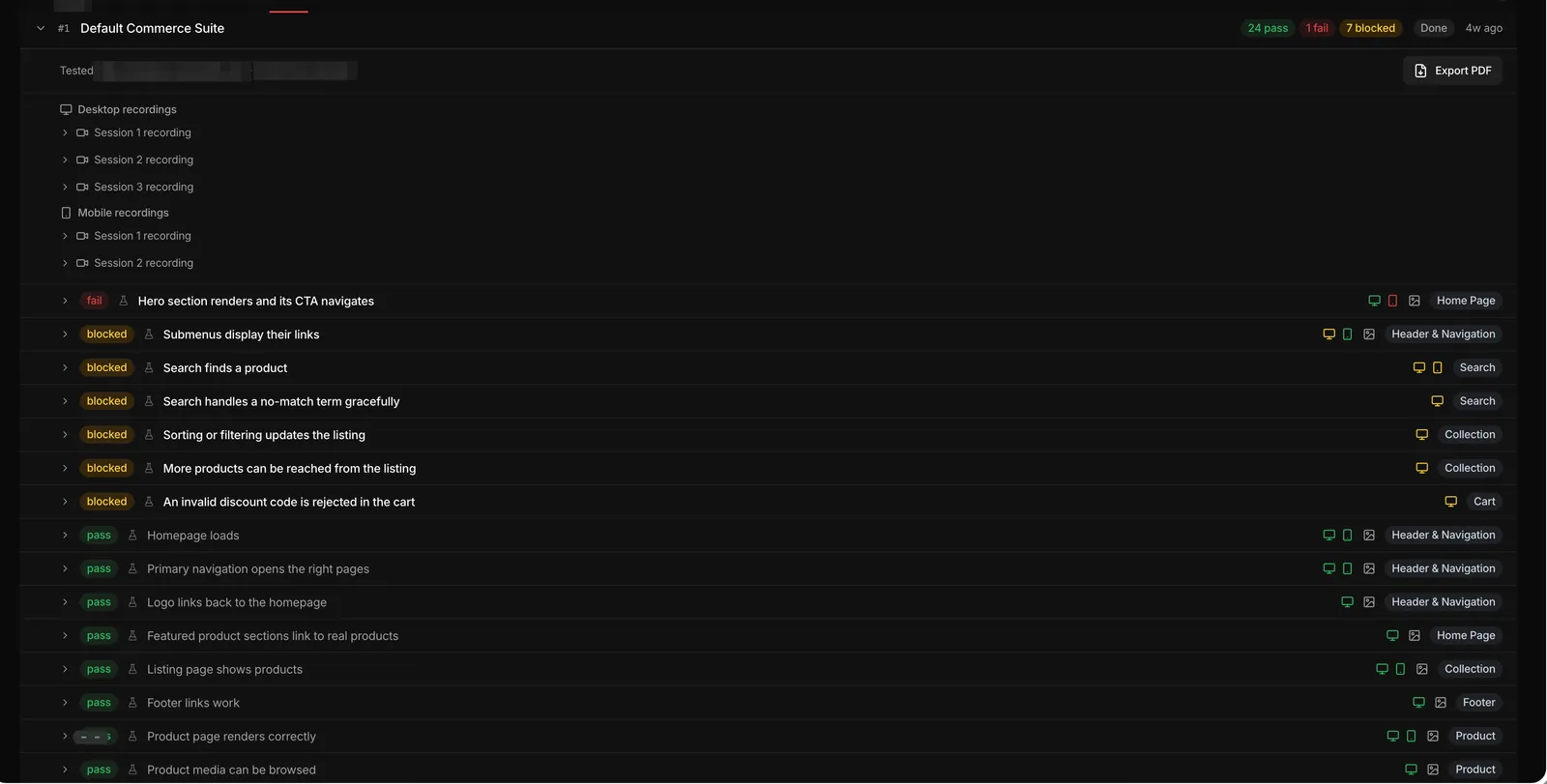
A re-theme rebuilds every template at once, which makes regression broad and repetitive: the same journeys, re-run against a storefront that changed again this morning. That volume is what agentic execution is good for. On this engagement the agent-run suites were pointed at the store itself and wrote up what they found on both viewports; the two screenshots below are from those runs. One practical catch worth knowing: pointing a suite at an unpublished theme needed a store connection set up first — a small piece of setup, but one to plan for before the build starts. The same suites run on live stores after launch; a QA coverage plan shows which journeys they would cover on yours.

Free, no call required
Curious what this means for your roadmap?
Get a free read of what your agency shipped in the last 90 days.
What Launch Fed Back
Launch was the end of the four weeks, not of the loop. The quantity selector was built to be toggled so its effect on average order value could be tested after go-live, the volume-discount program was queued to move to a cart-level implementation, and the UX audit’s deferred opportunities became a backlog instead of a forgotten appendix. The day after launch, a requirements document for the next phase of work went into the system — the same mechanism that carried the build, pointed at what comes after it.
Where the Humans Stay
Some decisions are never delegated, and on a fixed-date migration they are the ones the date puts pressure on:

- The spec itself. People write, revise and approve the requirements document. The system carries each revision into the work; it does not decide what the scope is.
- Security, permissions and compliance. App permissions, third-party scripts and anything that touches checkout or subscriptions change during a migration like this one. In Anatta’s process those changes go through a person, not around one.
- The governing trade-off. Stated up front on this engagement: functionality first, pixel-perfect fidelity second. That is a commercial judgment, and it let everything downstream be triaged the same way.
- What ships incomplete, and contested UX calls. Deferring design polish past launch, or building the new quantity selector to be toggled because earlier testing suggested it might cost average order value, are human calls with revenue attached.
- The decision to launch. Made by a person, every time.
The loop doesn’t remove the human from the project. It removes the part of the human’s week that was spent finding out what happened.
What This Doesn’t Show
Four limits, because the argument is worth less without them:
- The scoping predates the system. The original scoping happened before the engagement moved onto the system, so none of this describes how the project was sold or first shaped.
- The client never worked inside the system. They worked over Slack and email, as most clients do, and the benefit reached them second-hand, as updates assembled from the work.
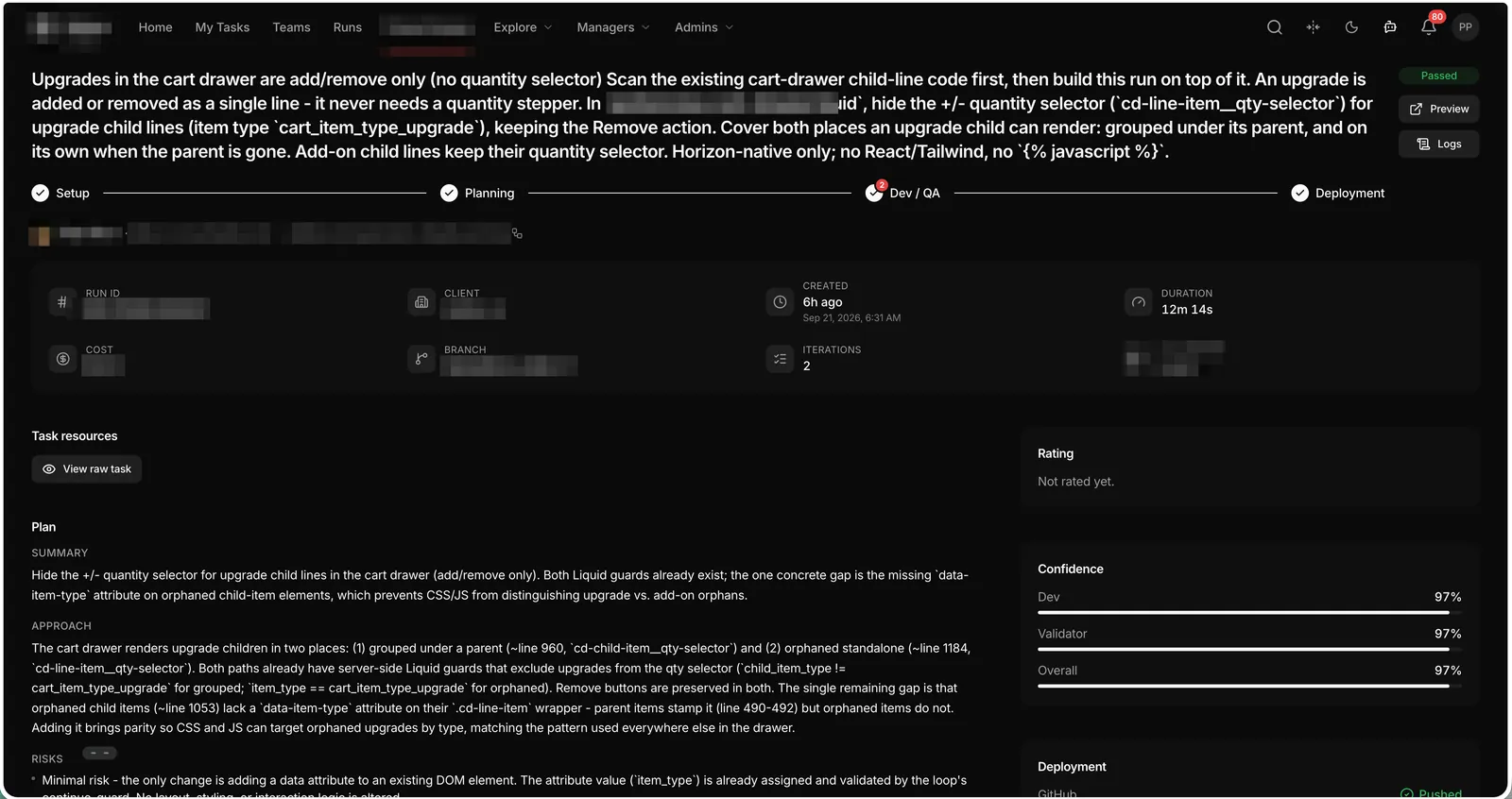
- The build estimate was never settled against a build time. The one-week estimate is the one the case study records. On this store — a rebuild over years of existing hand-built sections — the theme-generation runs didn’t hold up, and engineers built the theme with AI coding assistance instead; that is one engagement’s fallback, not a verdict on the layer, which runs in production on other engagements (the implementation run pictured above is one). And because the build was tracked as dozens of section-level tasks, there is no single duration to set against the estimate.
- There is no measured before-and-after. The four-week development window is published and real, but how much of it the operating system is responsible for is not established — the case study credits the two-stream structure and the functionality-first rule too — and that figure belongs in print once it has been measured.
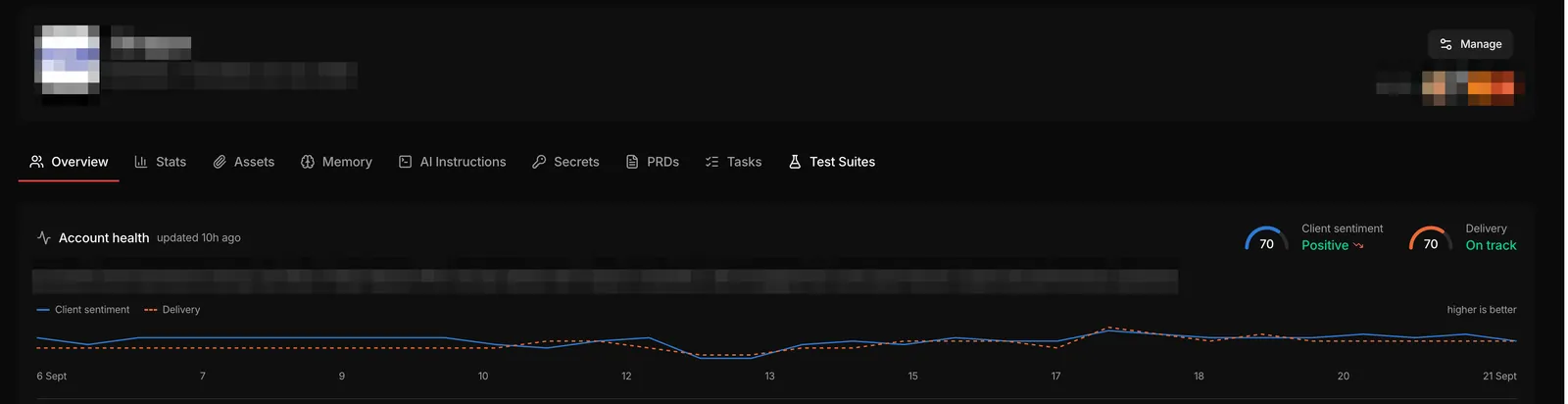
The screenshots are real frames from the system, with client details, identifiers and conversation content pixelated. One is cut to two stacked bands to keep a storefront out of view, and the implementation run is from a different engagement.
Scoping a Horizon migration of your own? Start with the 5-Day Horizon Readiness Audit. If you run a subscription brand, the subscription guide covers the part of a Horizon migration most likely to surprise you.
Related Horizon reading: how we document, build and verify a Horizon migration, how to document what your theme does, what a Horizon migration costs and Shopify Horizon, explained.
Frequently Asked Questions
Does an agentic operating system replace the delivery team on a theme migration?
No — but it carries more than the coordination layer. The system does real delivery work: it derives and re-sequences tasks from the spec, runs the QA suites against the store, and writes code in implementation runs — though on the engagement described here the theme itself was built by engineers, as the limits above say. What stays with people is the judgment and the approvals: the spec itself, the trade-offs, the security review, what ships incomplete and the decision to launch — and nothing the system builds ships without a person signing it off.
Do AI agents write the theme code unsupervised?
The writing is unsupervised; the shipping is not. An implementation run plans, builds and QAs its own work, and it ends as a branch waiting for review — merging and going live sit with a person, every time. On this engagement the theme itself was built by engineers with AI coding assistance, with agent-run suites testing it against the store.
How long does the theme build take on a Horizon migration?
Anatta’s own guidance on how long a Horizon migration takes puts the build at one to three weeks inside a four-to-eight-week project, and treats a whole migration quoted under two weeks for a mature store with suspicion. On the engagement described here, the build was estimated at the bottom of that range going in, and the development window around it ran four weeks. The build is rarely where the time goes.
Does this only apply to Shopify theme migrations?
No. The loop is the same whatever the work; it runs Anatta’s sales, delivery and support. A fixed-date theme migration is simply the clearest case for it, because it compresses every stage into a few weeks. For the category definition, see what Agentic Delivery is.
Free, no call required
What would Agentic Delivery have shipped on your account?
Send us the last 90 days of what your current agency shipped. We'll show you what actually shipped, what it should have taken, and what's missing.
Related Reading
-
 Shopify Platform Changes
Horizon vs. Dawn vs. Custom Theme: A Decision Framework
Horizon, Dawn, or a fully custom theme — the right choice depends on how much native flexibility you need versus how much bespoke functionality you're building regardless. Here's the decision framework.
Jamie Smith Director of Technical Solutions -
 Agentic AI
Agentic Delivery vs. AI Agents vs. Copilots
An AI agent is an app. A copilot is an app that helps you type. Agentic Delivery is the operating system that connects them for Shopify builds.
Jacob Pomplun Chief Executive Officer - Explore the service
Services & Solutions
Agentic commerce, explained
How AI agents discover, compare and buy for shoppers, where it is live on Shopify, and what a brand should fix first.