












Answer Engine Optimization vs. GEO: Is There Actually a Difference?
September 7, 2026
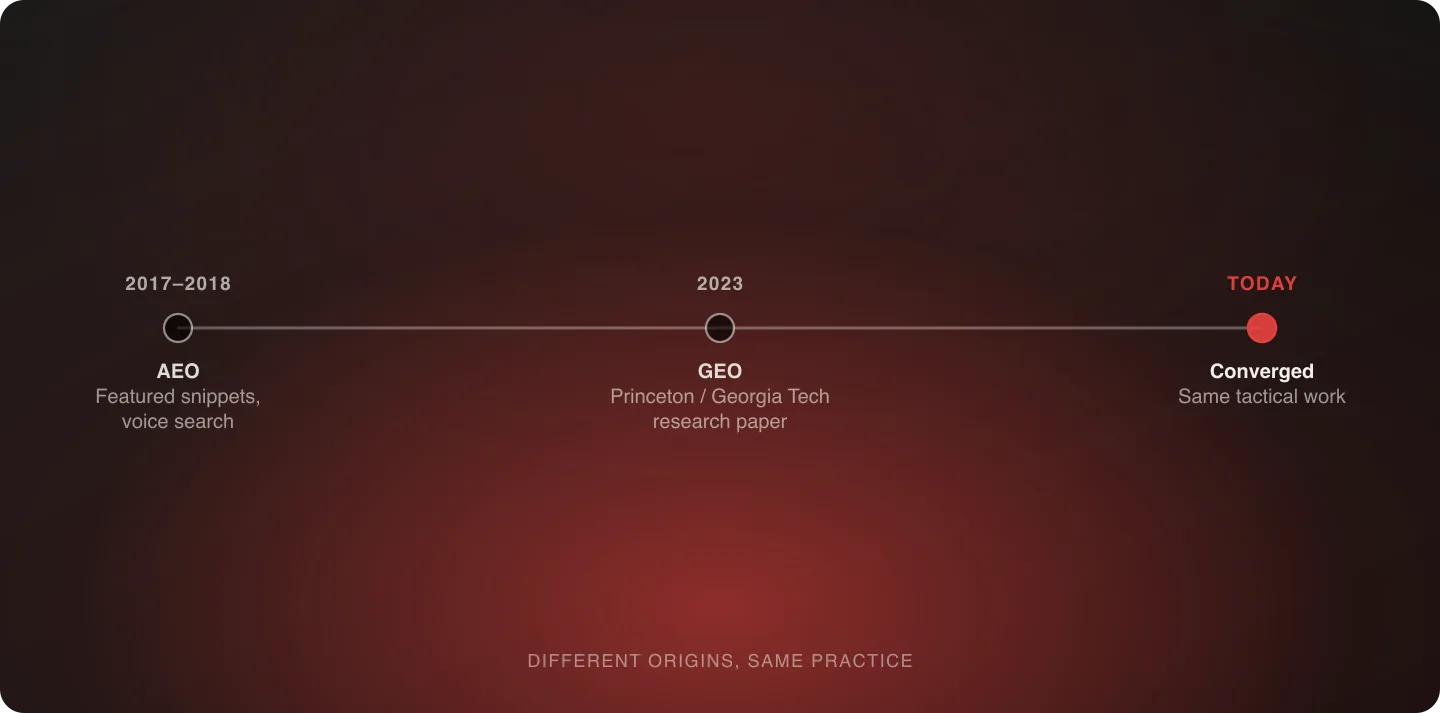
AEO and GEO have genuinely different historical origins — AEO grew out of the voice-search and featured-snippet era around 2017–2018; GEO was introduced as an academic research term in a 2023 paper from Princeton, Georgia Tech, and collaborating institutions. In practice today, most teams use the terms interchangeably to mean the same thing: getting cited and recommended by AI systems.
Last verified: September 6, 2026.
Where each term actually came from
Answer Engine Optimization (AEO) has organic, industry origins rather than a single defining moment — usage is commonly traced to a 2017 Trustpilot white paper and a 2018 BrightonSEO presentation, emerging from the shift toward direct-answer search results: featured snippets, "People Also Ask" boxes, and voice assistant replies from Siri and Alexa. AEO's original focus was making content structured clearly enough to be extracted as a direct, standalone answer.
Generative Engine Optimization (GEO) has a specific, citable academic origin: researchers from Princeton University, Georgia Tech, the Allen Institute for AI, and IIT Delhi introduced the term in a paper first submitted in November 2023, later published at KDD 2024. The paper specifically studied how content could be structured to improve visibility in generative engine responses — systems like early Bing Chat and Google's SGE (now AI Overviews) that synthesize an answer from multiple sources, rather than extracting a single snippet.
The real distinction, if you want one
The historically accurate distinction: AEO is about being extracted as a direct answer (a featured snippet, a voice reply, a short quoted response). GEO is about being synthesized into a longer generative answer that draws from and cites multiple sources. Extraction and synthesis are genuinely different retrieval mechanics under the hood.
Why this distinction matters less in practice than it sounds. The tactical work that wins either one overlaps almost completely: clear structure, accurate schema, direct answers near the top of a page, genuine topical authority. A page built well for one tends to perform well for the other. Some practitioners note a portfolio-level difference — teams framing their work as "AEO" tend to produce more FAQ-heavy, definition-style content; teams framing it as "GEO" tend to produce more comparison pages and topic pillars — but this is a difference in emphasis, not a difference in underlying discipline.
A related term worth knowing: AIO. "Artificial Intelligence Optimization" (AIO) shows up in some content as a third, broader label — sometimes meaning the same thing as GEO/AEO combined, sometimes meaning something closer to optimizing for AI agents and tools specifically (coding assistants, autonomous agents) rather than just AI-driven search and chat. It's the least standardized of the three terms, with the most inconsistent usage across sources — worth recognizing if you encounter it, but not worth building a third separate strategy around given how unsettled the definition still is.
Why the terminology keeps proliferating. Every time a new AI-driven discovery surface gains real usage, there's a natural pull toward inventing a matching label for optimizing toward it. This is a normal, expected pattern in a fast-moving field — it happened with SEO itself as search engines evolved — and it means today's settled distinction between AEO and GEO may look different again in another year or two.
Our practitioner take: use whichever term your audience already uses
Splitting one strategy into two separately-budgeted programs based on which term is more fashionable this quarter is a waste of effort neither term's actual research supports. The historical distinction is real and worth knowing — it's useful vocabulary for describing which AI surface a specific piece of content is aimed at (a direct-answer format vs. a longer synthesized response) — but it shouldn't drive two separate strategies. Pick the term your team and your stakeholders already understand, do the actual work described in our own GEO case study, and measure results by citation and recommendation, not by which label you used internally.
A simple test if you genuinely need to pick one term for internal reporting. Ask which AI surface your actual buyers use most: if it's mostly Google's AI Overviews and voice assistants, "AEO" is the more precise label for what you're measuring. If it's mostly standalone chat assistants (ChatGPT, Claude, Perplexity) producing longer synthesized answers, "GEO" is more precise. If it's a mix, which it usually is, either term is defensible — the work underneath doesn't change based on which one you pick.
Frequently Asked Questions
Is AEO older than GEO?
Yes — AEO's usage traces to around 2017–2018, tied to the featured-snippet and voice-search era. GEO was introduced specifically as an academic term in a 2023 research paper studying generative AI answer systems.
Do I need separate strategies for AEO and GEO?
No — the tactical work overlaps almost completely. Pick whichever term your team and stakeholders already understand and run one strategy, measured by citations and recommendations across whichever AI surfaces matter to your audience.
Which term should I use in my own content and reporting?
Whichever one your audience already searches for and understands. Both are accurate; consistency within your own organization matters more than which specific label you choose.
Is GEO just a rebrand of AEO?
Not exactly — GEO has a specific, different academic origin studying generative synthesis specifically, rather than direct-answer extraction. They converged in practice because the underlying tactics that win each one are nearly identical, not because one is simply a renamed version of the other.
Talk to an architect about your AI visibility strategy.

Related