











AI Search Optimization: A Practitioner's Framework
September 7, 2026
AI search optimization is the umbrella discipline covering how a brand becomes visible, cited, and recommended across AI-driven discovery — traditional AI Overviews, standalone chat assistants, and emerging AI shopping and research agents. Here's a working framework, organized by what to check first, not a list of disconnected tips.
Last verified: September 6, 2026.
Why "AI search optimization" is the right umbrella term for this framework
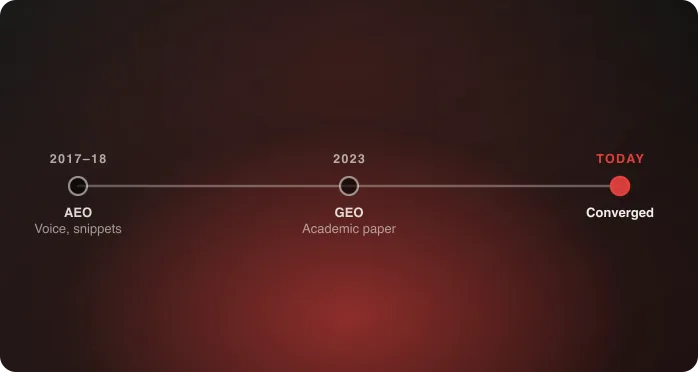
GEO and AEO each describe a specific mechanic (synthesis vs. extraction — see our full breakdown of that distinction). "AI search optimization" is the broader, mechanic-agnostic umbrella covering both, plus adjacent surfaces like AI shopping agents and research tools that don't fit neatly into either original definition. This framework is organized in the order we'd actually check these things on a real site, not by category label.
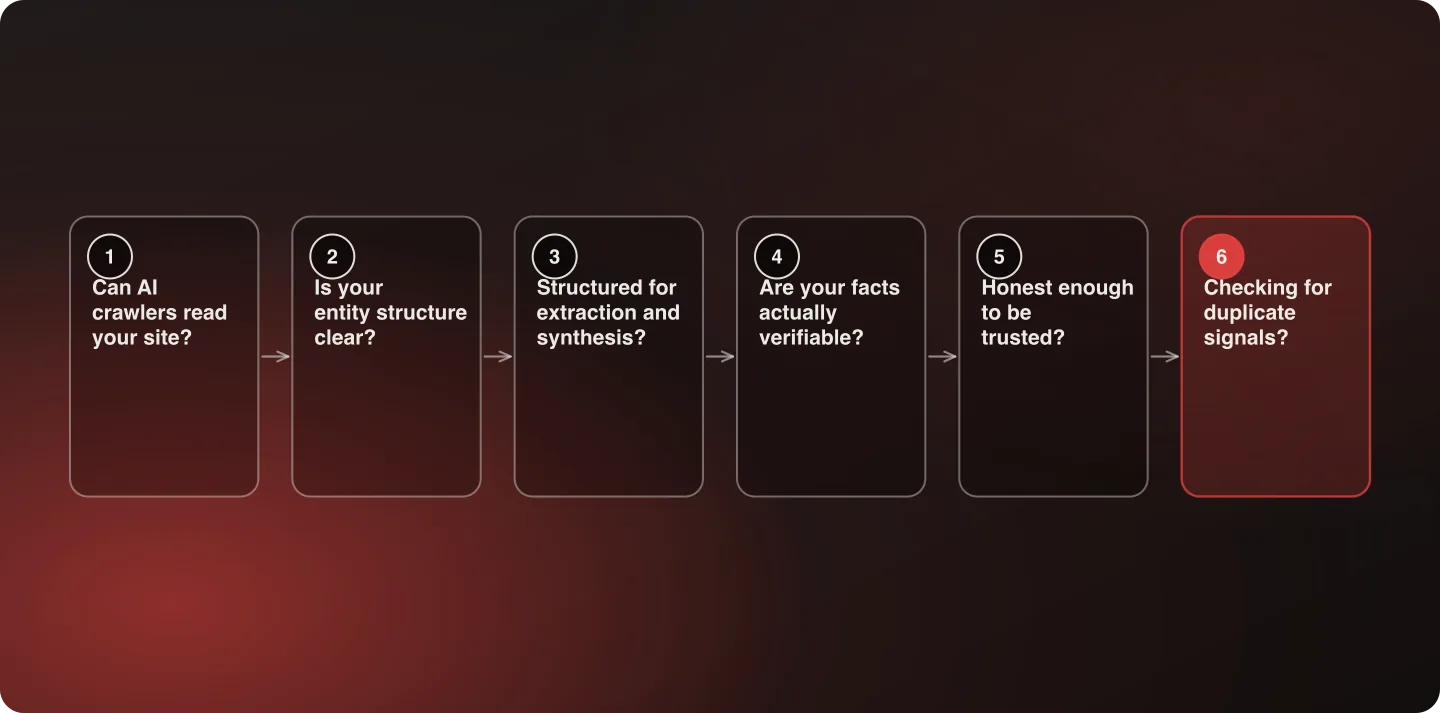
Stage 1: Can AI systems actually read your site?
Before anything else, verify directly — don't assume — that major AI crawlers receive your full, real content. Check robots.txt permissions explicitly for the crawlers that matter (GPTBot, ClaudeBot, PerplexityBot, and others as the landscape evolves). Check that JavaScript-rendered content actually serves to a crawler that may not execute scripts the way a browser does. This is a binary gate: everything else in this framework is wasted effort if this stage fails.
Stage 2: Is your entity structure clear?
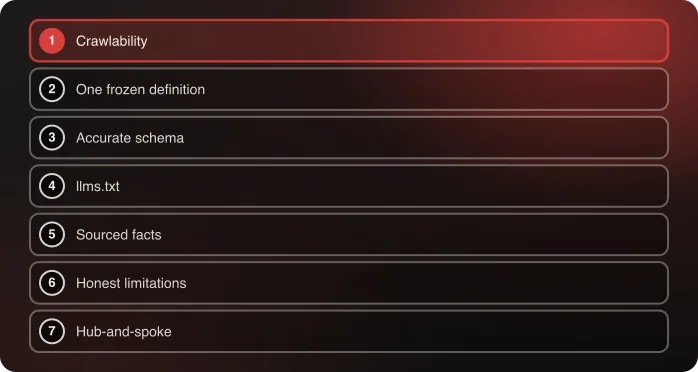
An AI system building an answer needs to resolve who you are, what you do, and how your content pieces relate to each other. This means: consistent Organization schema with your core facts stated identically everywhere, one canonical definition for any concept central to your positioning (repeated verbatim, not paraphrased, across every surface), and a clear hub-and-spoke content structure where each concept has one authoritative home rather than several competing pages.
Stage 3: Is your content structured for extraction and synthesis both?
Direct-answer blocks near the top of key pages (the extraction/AEO mechanic) and thorough, well-organized topical coverage with clear headings (the synthesis/GEO mechanic) aren't in tension — build both into the same page. A strong answer block up top, followed by genuinely thorough coverage organized under clear headings, serves both mechanics simultaneously.
Stage 4: Are your facts actually verifiable?
This is the stage most AI-search-optimization content skips, and it's the one that matters most for durability. Every specific, checkable claim on your site — a statistic, a price, a date, a historical fact — should be sourced and, where relevant, dated. A concrete example from our own practice: while researching platform-comparison content, we traced a widely-repeated pricing claim back to an automated aggregator that had misread an unrelated changelog entry as a price change. The wrong number was already circulating across multiple sites by the time we found it. We published the corrected, sourced version instead. This is the actual mechanism behind durable AI visibility — not gaming a ranking signal, but being the source that holds up when checked.
How to actually run this check. For any specific claim you're about to publish, trace it back to its original source — not the first site you found it on, the actual primary document. If you can't find a primary source, either don't publish the specific number or publish it explicitly labeled as an estimate with the basis stated. This is slower than copying a number that's already circulating. It's also the difference between a claim that survives scrutiny and one that quietly erodes trust the first time someone — human or model — checks it.
Stage 5: Is your content honest enough to be trusted?
Content that reads as unambiguously self-promotional is a weaker source for a system trying to synthesize a balanced answer than content that states real tradeoffs and limitations directly. Build this in deliberately: name who your product is a poor fit for, name where a competitor genuinely does something better, admit a real limitation rather than working around it with vague language. This isn't a values statement — it's a practical trust signal that measurably strengthens every other claim on the same page.
Stage 6: Are you checking for your own duplicate signals?
Before publishing new content, check whether an existing page on your own site already targets the same core question. Two pages competing to be the answer for the same query splits your own signal rather than strengthening it — a mistake worth catching before publishing, since it's expensive to diagnose once two pages have quietly been competing for months.
How to actually use this framework
Work through the six stages in order for any major content initiative — don't skip to Stage 4 or 5 because they're more interesting than verifying crawlability in Stage 1. Each stage assumes the ones before it are solid; sourced, honest content built on a page a crawler can't read accomplishes nothing.
What to do with an existing site rather than a new build. Most organizations aren't starting from zero — they have years of existing content to audit against this framework rather than a blank page to build correctly from the start. In that case, run the six stages as an audit rather than a build order: check crawlability across your existing site first (it's usually fine, but confirm it rather than assume), then check for entity confusion (multiple pages competing for the same core concept), then work through the content-level stages page by page, prioritized by which pages already carry real traffic or ranking equity worth protecting.
A realistic timeline. Stage 1 is a same-day check. Stage 2 (entity structure) can take real time on an established site with years of accumulated content, since it usually surfaces overlaps nobody had previously noticed. Stages 3 through 6 are ongoing content discipline, not a one-time project — they apply to every piece of new content going forward, not just an initial cleanup pass.
Frequently Asked Questions
What is AI search optimization?
The umbrella discipline covering visibility, citation, and recommendation across AI-driven discovery surfaces — AI Overviews, chat assistants like ChatGPT and Claude, and emerging AI shopping and research agents.
Where should I start with AI search optimization?
Crawlability verification — confirm AI crawlers can actually read your full content before investing in any content or schema work. It's a binary gate that makes every later stage either meaningful or wasted.
How is this different from GEO or AEO specifically?
GEO and AEO each describe a specific retrieval mechanic (synthesis vs. extraction). AI search optimization is the broader umbrella covering both plus adjacent AI-driven discovery surfaces that don't fit neatly into either original definition.
What's the most overlooked part of AI search optimization?
Fact verification and sourcing. Most content in this space focuses on structure and schema while skipping whether the underlying claims are actually correct and dated — which is increasingly what separates a durable, cited source from one that gets quietly discounted.
Talk to an architect about your AI search visibility.

Related