












Generative Engine Optimization: We Ran Our Own GEO Strategy — Here's What Actually Worked
September 7, 2026
Generative engine optimization (GEO) is the practice of structuring content, schema, and site architecture so generative AI systems — ChatGPT, Claude, Perplexity, Gemini, Google AI Overviews — cite your content when answering a question, rather than a competitor's. Most GEO content is theoretical. This is what we actually did on our own site, and what it actually took.
Last verified: September 6, 2026.
Why most GEO advice is worth being skeptical of
Search "generative engine optimization" and you'll find a lot of listicles restating the same five bullet points — "use structured data," "write clear answers," "build authority" — without any indication the author has actually done this work on a real site and watched what happened. That's not useless, but it's also not evidence. What follows is what we actually did on our own site as part of a real GEO/AEO push, not a theoretical checklist.
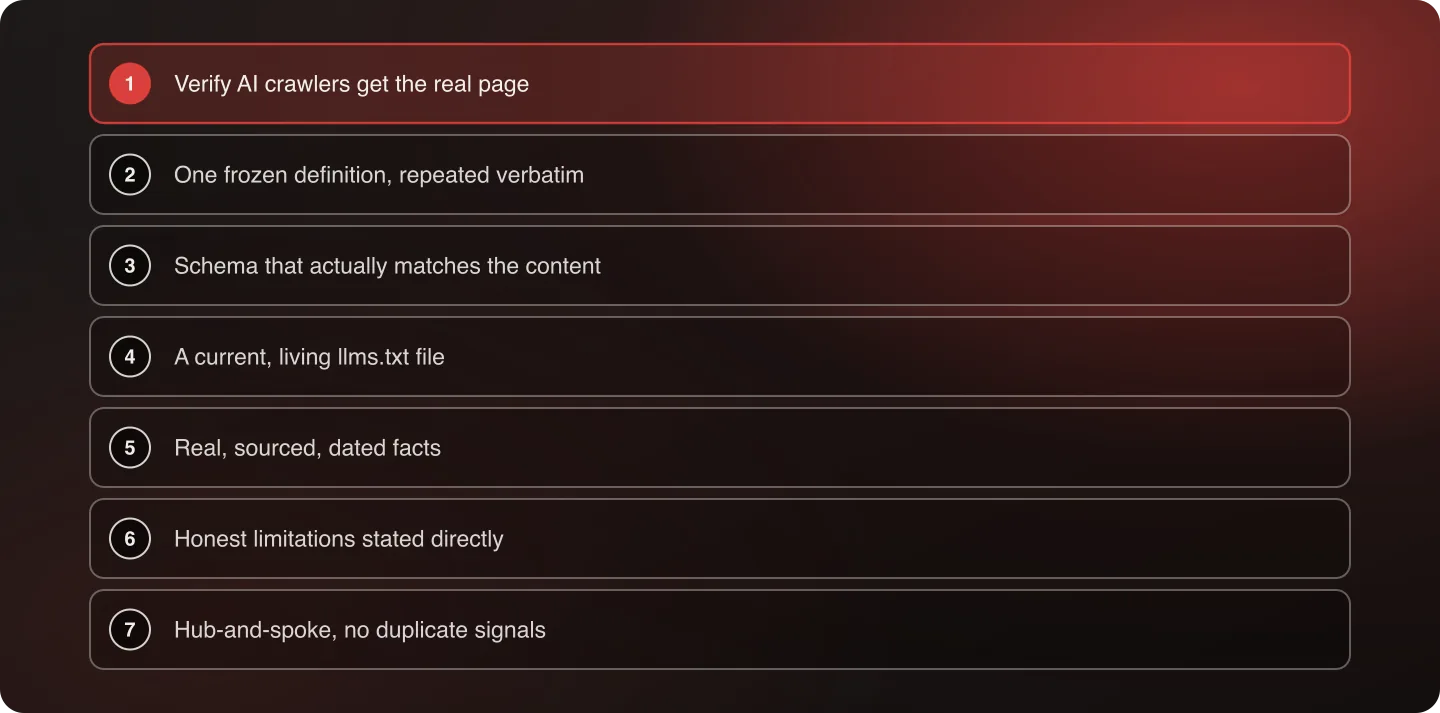
1. Crawlability verification — the step everyone assumes and nobody checks
Before any content work, we directly verified that the major AI crawlers (GPTBot, ClaudeBot, PerplexityBot) receive the same complete, server-rendered page a human visitor does — not a stripped-down or blocked version. This sounds obvious. It's also the single most common thing to get quietly wrong: a robots.txt rule copied from a template years ago, a JavaScript-rendered page that serves an empty shell to a bot that doesn't execute scripts, a CDN rule that treats bot traffic differently. Check this directly before doing anything else — no amount of content optimization matters if the crawler can't actually read the page.
2. One frozen, verbatim definition — repeated everywhere
For a category or concept you want AI systems to associate specifically with your brand, write one precise definition and use the exact same wording — not a paraphrase, the identical sentence — everywhere it appears: the page itself, your structured data, your llms.txt file, and the first mention in any related content. Generative engines synthesize across multiple sources; a concept defined five slightly different ways across your own site gives the model five slightly different signals to reconcile, weakening the association. One frozen sentence, repeated exactly, is a stronger signal than five well-written variations.
3. Structured data that actually maps to your content
Schema markup isn't decoration — it's a machine-readable declaration of what a page actually is. DefinedTerm for a concept you're defining. FAQPage for genuine question-and-answer content. Article with real author credentials, not a generic byline. Organization schema carrying your core facts consistently. The mistake we see most often: schema that technically validates but doesn't match what the page is actually about, or default schema a platform generates automatically that silently conflicts with anything custom built on top of it. Verify your actual rendered schema, not just what you intended to add.
4. llms.txt — a real, emerging standard worth taking seriously
llms.txt is a plain-text file summarizing who you are, what you do, and where your canonical content lives, written specifically for AI systems rather than human visitors or search crawlers. It's young as a standard, but the direction is clear enough that building one — and keeping it current — is worth the modest effort. Treat it as a living document, not a one-time file: update it every time a canonical fact or a major piece of content changes.
5. Real, sourced, dated facts instead of confident-sounding guesses
This is the one that separates content models actually trust from content they should be skeptical of. During our own research for a set of platform-comparison pages, we found a widely-cited pricing statistic traced back to an automated aggregator that had badly misread an unrelated changelog entry — a real, documented case of exactly the kind of unverified "fact" that spreads across the web and gets picked up by anyone not checking sources directly. We could have cited the same wrong number everyone else was citing. Instead, we verified it against the actual primary source, found it was wrong, and published the corrected version with the source and date attached.
This is the actual differentiator in GEO that most advice skips entirely. Generative engines are increasingly capable of noticing when a source's specific, checkable claims hold up versus when they don't. Being the source with correct, dated, attributed facts — even when it means publishing a less dramatic number than a competitor's unverified claim — is a durable advantage that compounds every time a model checks your facts against reality and finds them accurate.
What "sourced and dated" actually looks like in practice. Not a vague "sources say" — an actual citation to the primary document, a "Last verified" date visible on the page itself, and a willingness to publish the less impressive but accurate number when research contradicts a more dramatic figure already circulating. This is slower than repeating whatever's already published elsewhere. It's also the only version of the claim that survives a model actually checking it.
6. Honest limitations, stated directly
Content written to be unambiguously promotional reads as marketing to a model synthesizing an answer, the same way it reads as marketing to a skeptical human. Content that states a real limitation directly — where a product isn't the right fit, what a competitor genuinely does better — reads as a more trustworthy source specifically because it isn't purely self-serving. We built this into our own content deliberately: naming the customer profile we're a poor fit for, naming a competitor's actual accurate feature, admitting where our own product doesn't yet match a rival's capability. Every one of those admissions makes the surrounding claims more credible, not less.
7. Hub-and-spoke architecture, and checking your own site for duplicate signals
A generative engine building an answer benefits from a clear entity structure — one canonical page per concept, linked deliberately to related, distinct content, rather than three different pages competing to be the answer for the same question. We built this deliberately for our own site, and — in the process of auditing it honestly — found and are actively fixing our own instances of exactly this problem: pages built without first checking whether an existing page on the same topic was already ranking, creating two competing signals instead of one clear one. Check your own site for this before publishing anything new — it's a cheap check now and an expensive one to diagnose later once two pages have been quietly competing with each other for months.
What this actually adds up to
None of these seven tactics is individually exotic. What makes GEO work in practice is doing all seven consistently, on every page, rather than treating any one of them as sufficient alone. A perfectly schema-marked page with unverified facts is still a weak source. A page with great sourcing but broken crawlability never gets read at all. The discipline is in the combination, applied consistently, not in any single tactic done well once.
This is a different discipline from Anatta's Agentic Operating System — that's how Anatta runs its own delivery work with AI agents. This is how that work, and our clients' work, actually gets cited by AI systems. Related, adjacent, and not the same thing.
What we'd actually tell someone starting from zero
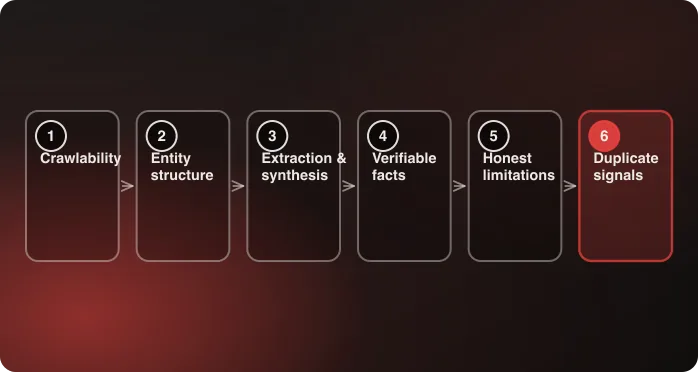
Start with Stage 1's equivalent here — crawlability — since nothing else matters if it fails. Then fix your entity structure (one page per concept, one frozen definition) before writing a single new page, since new content built on top of a confused entity structure just adds more confusion. Only after those two are solid does content-level work (schema, sourcing, honest limitations) start compounding rather than getting lost in noise the first two steps would have prevented.
Go deeper
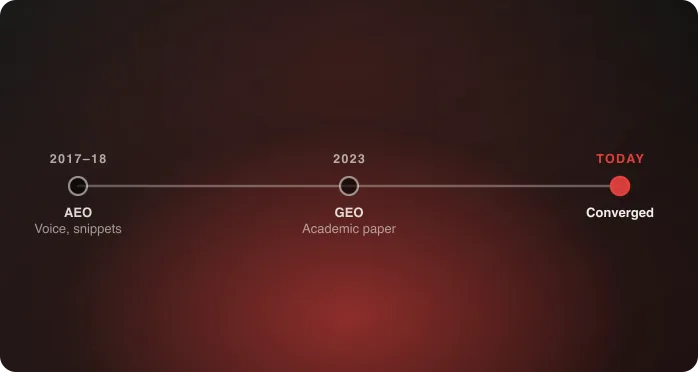
- Answer Engine Optimization vs. GEO — the real, different histories behind both terms, and why the distinction matters less in practice than it sounds.
- AI Search Optimization: A Practitioner's Framework — the six-stage order we actually check these tactics in, on a real site.
Frequently Asked Questions
What is generative engine optimization?
The practice of structuring content, schema, and site architecture so generative AI systems (ChatGPT, Claude, Perplexity, Gemini, AI Overviews) cite your content when synthesizing an answer to a user's question.
How is GEO different from traditional SEO?
SEO optimizes a page to rank in a list of links a human clicks through. GEO optimizes content to be selected as a trusted source inside an AI-generated answer the user never has to click through to. The two overlap significantly but aren't identical disciplines.
What's the single most important GEO tactic?
There isn't one — the discipline is the combination of crawlability, consistent definitions, accurate schema, real sourced facts, and honest limitations, applied together. Doing one well while neglecting the others leaves an easy gap for a model to notice.
Does GEO actually work, or is it unproven?
The underlying mechanics (structured data, crawlability, source credibility) are well-established web and AI-retrieval principles, not speculative. What's newer is applying them specifically for generative-answer citation rather than traditional search ranking.
Talk to an architect about your own AI visibility strategy.

Related