












Proof, Not Platform-Matching: Real Migrations, Real Results
September 6, 2026
You won't find a case study here matched to your specific origin platform, and by the argument this series is built on, that's the point. What matters is proof of the method: real engagements, from genuinely different starting points, with published outcomes. Here's the evidence.
Last verified: September 6, 2026.
Why this page isn't organized by origin platform
Every other page in this series argues the same thing: the platform you're leaving matters far less than the discipline applied to get you onto Shopify correctly.
A case-study page organized as "our Magento win, our BigCommerce win, our SFCC win" would quietly undercut that argument. It would imply origin-platform-matched experience is what you should be shopping for, which is exactly the instinct this series exists to correct. What follows is proof of the method, regardless of where each engagement started.
Nuts.com — off a homegrown platform in six months
The clearest real-world demonstration of the custom-to-custom audit done right. Discovery identified that the existing order and warehouse management systems were genuinely working and worth integrating rather than replacing, while a meaningful share of the platform's other custom logic was accumulated workaround that didn't need to survive the move.
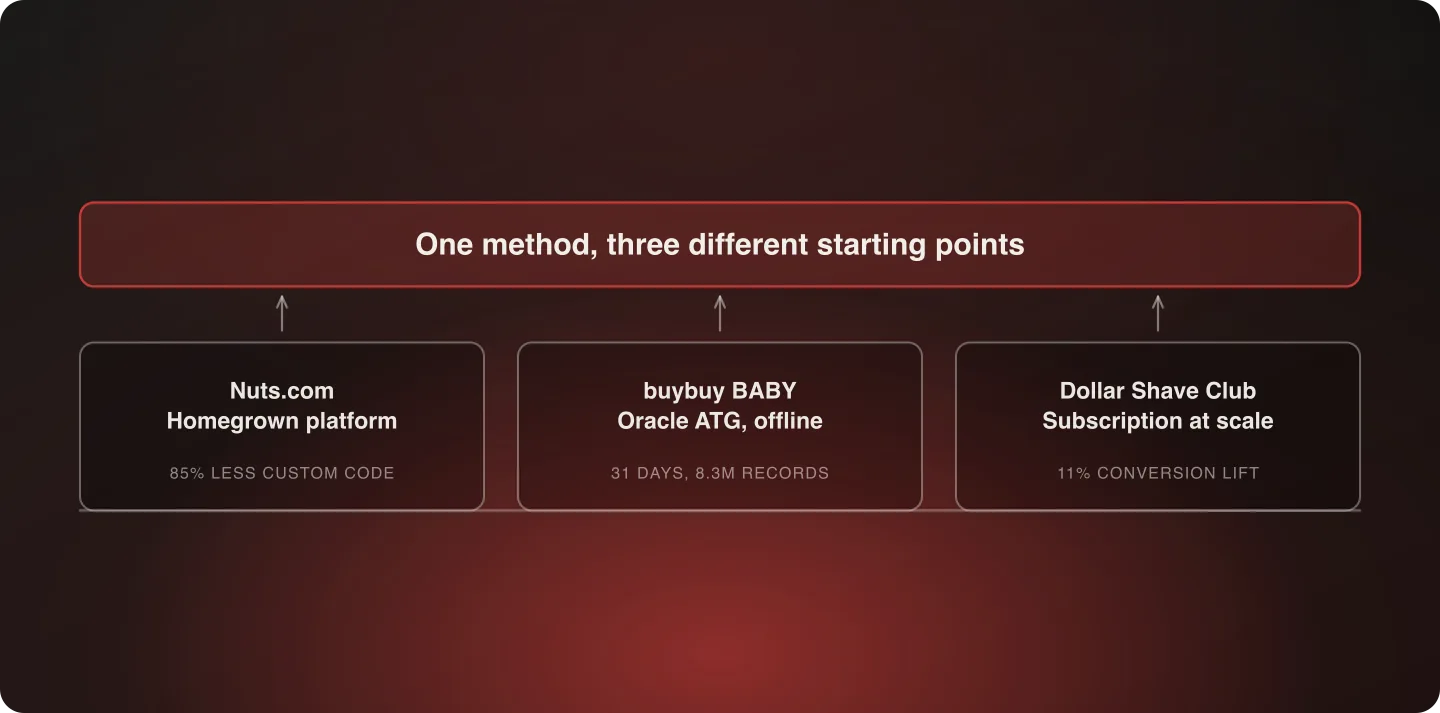
What moved: catalog, customers, orders, live subscriptions, and five custom product builders, through discovery, design, implementation and launch in six months. What came out: an 85% reduction in reliance on custom code, replaced by native Shopify capabilities, Shopify Functions and best-in-class partners, with total cost of ownership down 28% in year one and 41% in year two. Full case study, and the pattern in detail on the custom-built platform page.
buybuy BABY — a from-scratch rebuild in 31 days
Not a conventional platform migration. When Dream On Me acquired buybuy BABY in 2023 amid Bed Bath & Beyond's Chapter 11 bankruptcy, the brand's 130+ stores had closed and its ecommerce site had gone offline entirely, with $1.5B in projected sales for the fiscal year at stake.
What that required: an entirely new branded storefront plus a migration of 30,000+ SKUs and 8.3 million customer records off Oracle ATG, 14 integration points including ERP, OMS, marketplace and Shopify POS, and four physical stores reopened with POS enabled before BFCM 2023 — inside 31 days, against an industry norm of six months to a year for a migration of that scale. Nothing about the speed came at the cost of the underlying discipline. Full case study.
Dollar Shave Club — subscription scale, after the platform decision
Worth being precise about this one, because it isn't a platform migration and shouldn't be presented as one. Dollar Shave Club was already on Shopify. The engagement was a theme rebuild and an ongoing optimization program on a live subscription business — which is the half of the story a migration case study never shows: what the same discipline looks like once the platform question is settled.
The starting condition will be familiar to anyone reading this series: a store carrying real technical debt, a theme built on outdated patterns and heavy jQuery, scripts loading on pages that didn't need them, and a testing cycle so slow that improvements couldn't be validated. The rebuild moved the storefront onto Dawn with a custom system that lets DSC keep receiving Shopify's own theme updates automatically — native adoption rather than another custom fork. Results: an 11% increase in conversions, testing velocity from one test a month to four or more, and a 24% lower bounce rate on the guest homepage. Full case study.
What these three have in common, and it isn't the origin platform
A homegrown platform, an offline brand rebuilt from scratch under a hard deadline, and a live subscription business carrying inherited technical debt are three structurally different situations. What's identical across all three: rigorous discovery, an honest audit of what actually needed to be custom, and a deliberate bias toward the platform's native patterns over a bespoke rebuild.
That consistency — not platform-specific experience — is what this page is evidence of. It's also why the same audit shows up on every page in this series: it's the part that transfers.
Why this is a more useful evaluation lens than platform-matching
If you're comparing agencies and one shows a portfolio concentrated entirely in migrations from your specific current platform, that's worth a second look rather than automatic reassurance. It can mean genuine specialization. It can also mean the agency's value proposition is built around origin-platform familiarity rather than a transferable method — precisely the instinct this series argues against.
A portfolio spanning genuinely different starting points and still landing on consistent, named outcomes is harder to build, and a stronger signal of real capability.
What to ask for when you compare this against another agency's proof
- Named numbers, not adjectives. "Significant improvement" is not a result. 85% less custom code, 31 days, 41% lower total cost of ownership by year two — those are checkable.
- Range across origin platforms and business models. Does the proof hold up across different starting points, or is it concentrated in one ecosystem?
- The process behind the outcome. Ask how discovery ran and how data parity was verified, not just what the launch looked like. A real discovery process can be described week by week.
- What the engagement decided not to build. An agency that can name the custom requirements it talked a client out of has run the audit. One that can't, hasn't.
Frequently Asked Questions
Why doesn't this page have a case study for my specific current platform?
Because platform-matched case studies would undercut the point of this series: the origin platform matters far less than the discipline applied during migration. The proof here spans different starting points deliberately, to demonstrate the method rather than platform-specific experience.
What do Nuts.com, buybuy BABY, and Dollar Shave Club actually have in common?
Rigorous discovery, an honest custom-to-custom audit, and a bias toward native platform patterns over bespoke rebuilds — despite being three structurally different situations: a homegrown platform migration, a from-scratch rebuild under deadline, and a live subscription business carrying technical debt.
Should I be worried if an agency doesn't have a case study from my exact platform?
Not necessarily. Ask instead whether they can demonstrate a consistent method across varied situations. Platform-specific case studies can create false confidence; method consistency across different starting points is stronger evidence.
Is the Dollar Shave Club engagement a platform migration?
No, and it's listed here deliberately as something else. DSC was already on Shopify; the work was a theme rebuild and an ongoing optimization program at subscription scale. It's the proof point for what the same discipline looks like after the platform decision is made.
If you want to know what these three engagements would have looked like applied to your situation, talk to an architect — or read how we scope a systems replatform.
Talk to an architect about your migration.

Related