












Custom-Built Platform to Shopify Migration
September 4, 2026
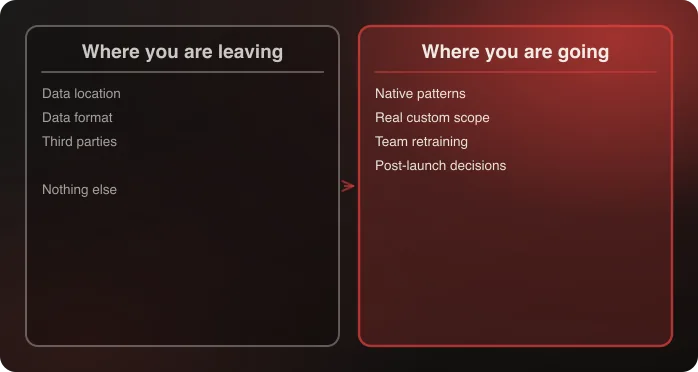
Migrating from a fully custom-built platform is where the destination-over-origin thesis matters most, because there's no vendor documentation and no established pattern to lean on — every custom platform is genuinely different. The discipline of separating real requirements from accumulated workarounds is the entire project here, not a phase of it.
If the trigger was a key engineer leaving, or a dependency that can no longer be patched safely, that's the version of the deprecation trigger that homegrown platforms get instead of a vendor announcement.
Last verified: September 6, 2026.
Why custom-built migrations are categorically different
There's no shared Magento data model or SFCC cartridge system to reference. A homegrown platform's data structure, business logic, and integration landscape are unique to that specific build, which means the extract step requires real discovery work rather than reference to a documented schema.
That's why the destination-over-origin thesis bites hardest here rather than least: with no vendor documentation to lean on, the only stable reference point in the whole project is Shopify's own capability set.
It also means the usual shortcut fails. On a vendor platform, an experienced team can predict where the difficult parts will be before looking. On a custom platform, that prediction is worthless, and substituting confidence for investigation is the most common way these projects get mis-scoped at the proposal stage.
The signal that it's time to leave
Custom-built systems accumulate liability in a recognizable pattern: the original developers who understood the logic have moved on, documentation is thin or nonexistent, and every change requires archaeology before implementation.
If that describes your situation, it's worth naming directly. The custom platform itself has become the workaround-generating machine that the custom-to-custom trap warns about — at the level of the entire business rather than individual features. Every new requirement gets built around what nobody dares change, and the set of things nobody dares change only grows.
Why the custom-to-custom trap is the central risk here
Every piece of a custom-built platform was, by definition, built custom. There's no native version to compare against for anything, which makes it dangerously easy to treat the entire existing system as the requirements spec by default, simply because no external benchmark suggests otherwise.
The audit matters more here than for any other origin platform. For every piece of custom functionality, ask directly whether it addresses a genuine, current business need, or whether it was built to solve a problem specific to constraints that existed years ago and may no longer apply. The second category is usually larger than anyone expects, because a homegrown platform accumulates constraints faster than a vendor platform does — every architectural decision is load-bearing for whatever got built on top of it next.
Nuts.com as the direct proof point
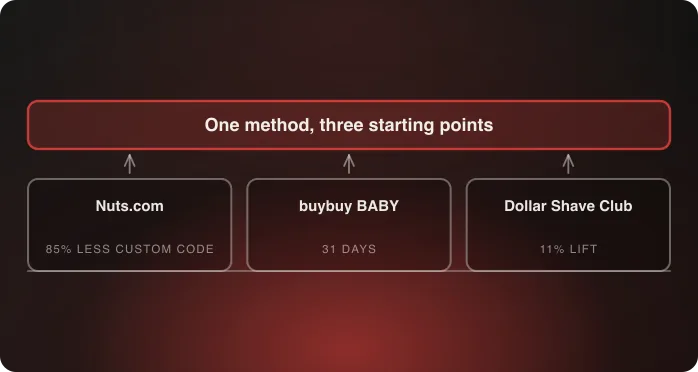
Nuts.com's migration was from a custom-built platform — the clearest real-world example of this exact pattern. Discovery surfaced that the existing order and warehouse management systems were genuinely working and worth integrating rather than replacing, while a meaningful share of the platform's other custom logic was exactly the kind of accumulated workaround this page describes.
The scope was not small: catalog, customers, orders, live subscriptions, and five custom product builders all moved, through discovery, design, implementation and launch in six months. The result was an 85% reduction in custom code without losing operational capability, and total cost of ownership down 28% in year one and 41% in year two — because the audit separated the two categories correctly rather than because the business got simpler.
The risk pattern specific to custom-built platforms
Unlike the other four platforms in this series, there's no single company's security or pricing history to point to — every custom build is different. But a well-documented industry pattern applies broadly to homegrown ecommerce platforms:
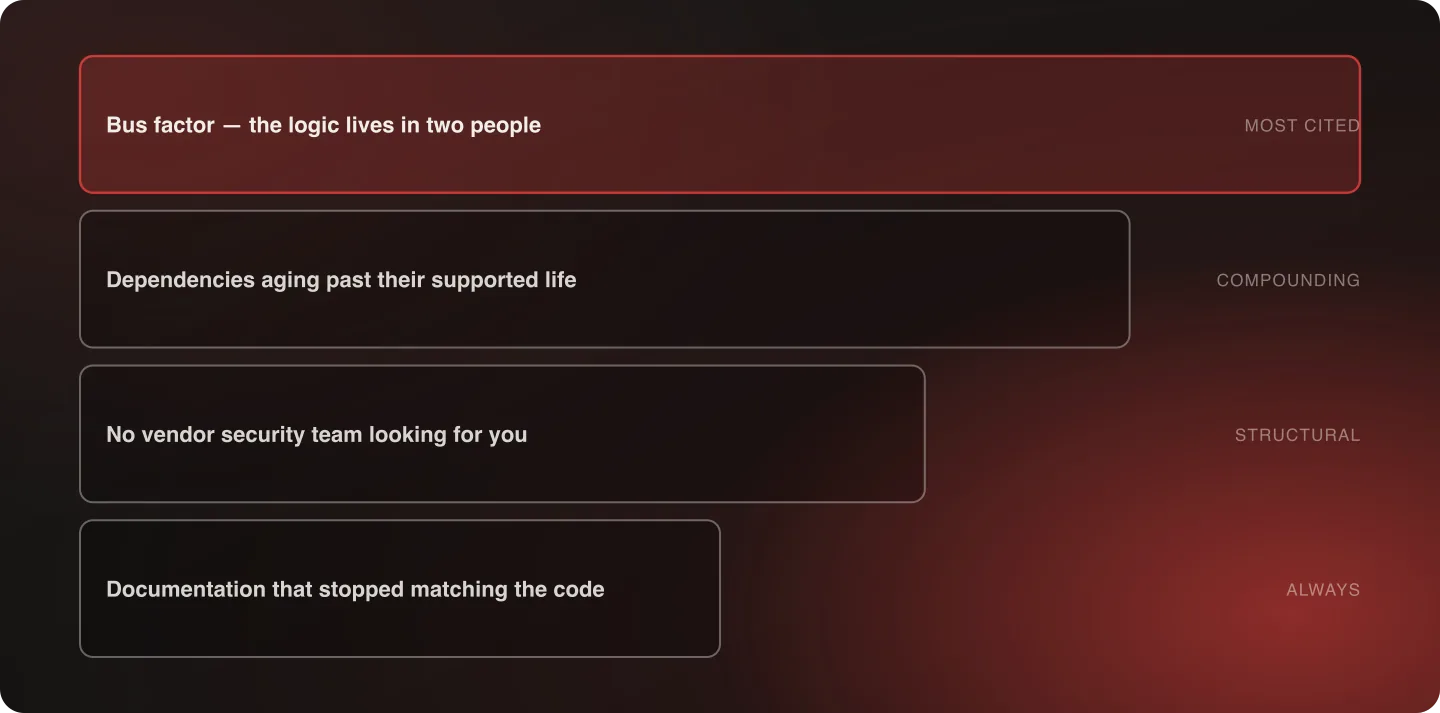
- Bus factor. When a platform's critical logic lives in the knowledge of one or two original developers rather than in documentation, the departure of those specific people — a resignation, a reassignment, a retirement — can leave a business genuinely unable to safely modify its own system. This is among the most commonly cited risks in custom software maintenance literature, and it compounds every year documentation fails to catch up.
- Unpatched, aging dependencies. A custom platform relies on underlying frameworks, libraries, and server software that need their own security patching, independent of any custom code written on top. Without a vendor pushing mandatory updates, patching is entirely an internal responsibility, and it's a well-documented pattern that dependencies which aren't visibly broken quietly age past their supported lifecycle.
- No vendor security team. A platform like Magento or Shopify has a dedicated security research function actively looking for vulnerabilities in the core platform. A custom-built system has no equivalent unless the business specifically staffs and funds one, which means the business bears the full burden of discovering its own vulnerabilities before an attacker does.
- Documentation that stopped matching the code. Not a risk on its own, but the multiplier on the other three. Every one of them is survivable with accurate documentation and considerably worse without it.
If any of these sound familiar, that's the signal worth acting on — not a specific incident date, but the structural risk of a system with no vendor accountability behind it. The five real reasons merchants actually migrate covers this pattern alongside the other four triggers.
What discovery actually looks like here
Expect this phase to take real, dedicated time — not because Shopify expertise is complicated, but because understanding a genuinely unique system requires direct investigation rather than reference to known patterns.
Concretely, that means interviewing the people who operate the system day to day rather than only reading whatever documentation exists, tracing data flows by observation where documentation is silent, and cataloging every integration point before deciding what to extract. This is the one origin platform where "understanding your current system" is a real and necessary cost. The goal of that understanding is still to inform what to extract and what to leave behind, not to inform a faithful rebuild. The week-by-week walkthrough shows the shape.
Who should lead discovery on a custom-built migration
Not whoever is most familiar with the old system's code. That familiarity usually comes bundled with the same blind spot that created the custom-to-custom trap in the first place: years of living inside a system's workarounds makes them hard to recognize as workarounds.
Pairing someone who understands the business's actual operational needs with an architect who understands Shopify's current native capability produces a much cleaner audit than either perspective alone. The person who knows the old code is essential to the extract step and unreliable as the sole judge of what should survive it.
Frequently Asked Questions
Is migrating from a custom-built platform harder than from Magento or BigCommerce?
Discovery takes longer, since there's no external documentation for a unique system. The underlying method — extract, audit, adopt native patterns, load with parity testing — doesn't change.
How do I know if our custom platform's logic is worth preserving?
Ask whether each piece addresses a genuine, current business need or solves a problem specific to constraints that may no longer apply. Nuts.com's migration is a real example of that audit done well.
Should we replace our custom ERP or OMS too, or just the storefront platform?
Not by default. If it's genuinely working, integrate it rather than replace it. That was a central decision in Nuts.com's migration and a major contributor to its reduced custom-code footprint.
What if the people who built our platform have already left?
That's the bus-factor risk, and it's the most commonly cited reason homegrown platforms become unsafe to modify. It makes discovery slower and more observational, and it makes the case for moving stronger rather than weaker.
If your platform is one nobody left can safely change, talk to an architect — that's the situation a systems replatform is scoped for.
Talk to an architect about your custom platform migration.

Related