












Shopify Plus vs. BigCommerce Enterprise in 2026: An Honest Comparison
August 31, 2026
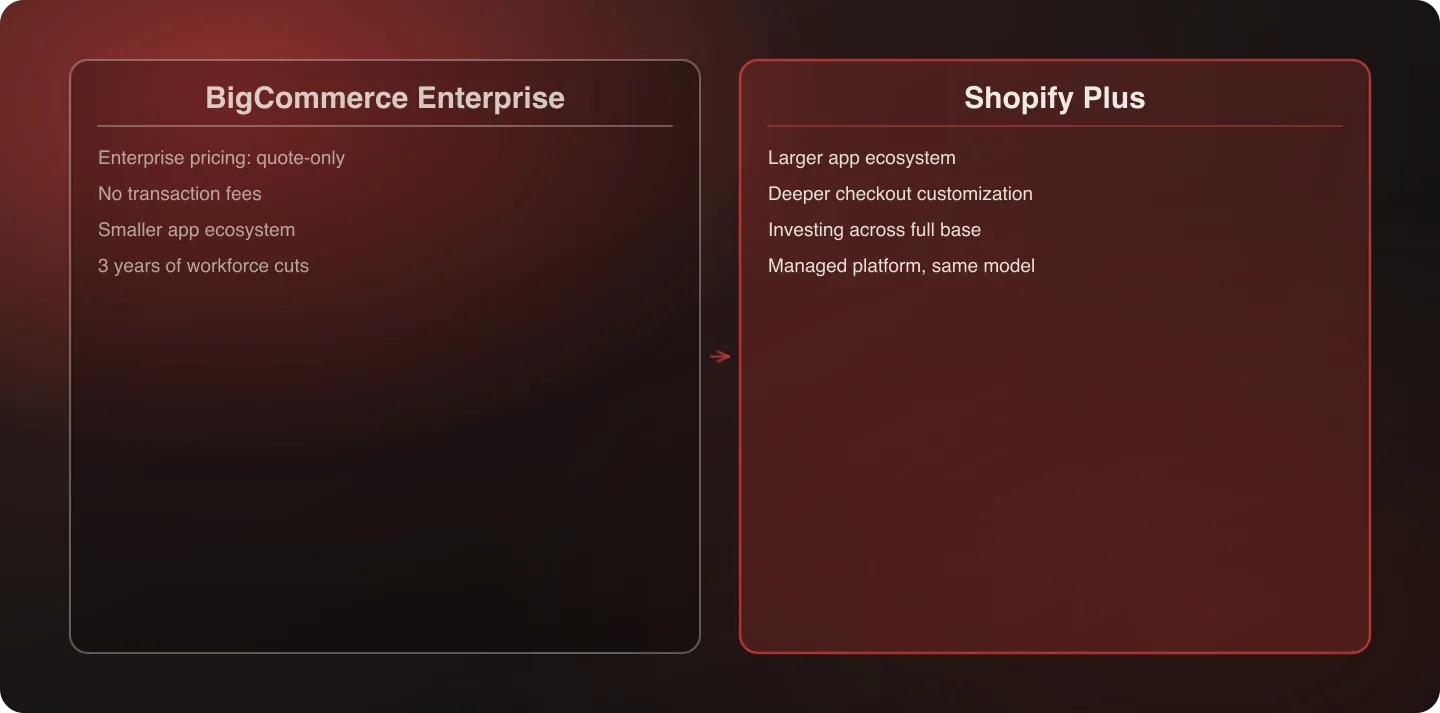
BigCommerce Enterprise and Shopify Plus are both managed SaaS platforms — a more comparable operating model than the Adobe Commerce comparison. BigCommerce doesn't publish Enterprise-tier pricing at all, and reliable independent estimates don't exist; what's publicly known is BigCommerce's lower-tier pricing (up to $299/month) and that Enterprise is quote-only above that.
Last verified: September 6, 2026.
A Note on Pricing for This Specific Comparison
Unlike the Adobe Commerce comparison, where multiple independent sources converge on a usable estimate, BigCommerce Enterprise pricing has no reliable public benchmark. The only figures circulating online trace back to a single aggregator site whose own pages contradict each other — one lists “$1,000–$15,000/month,” another says pricing is fully custom with true cost running 70% above any quoted figure. Given that inconsistency, this page won't cite a specific range for BigCommerce Enterprise. If cost is central to your evaluation, get a direct quote and treat any number you find published elsewhere with real skepticism.
What's Actually Comparable: Both Are Managed Platforms
This is the most operationally similar comparison in this cluster — both platforms bundle hosting and infrastructure into the subscription, unlike the Adobe Commerce comparison's fundamentally different operating model. The real differences are in ecosystem maturity, checkout customization depth, and company trajectory.
Ecosystem and app maturity. Shopify's app ecosystem is substantially larger by any measure — more third-party apps, more established integration patterns with common enterprise systems, and a deeper pool of experienced developers and agencies familiar with the platform. BigCommerce's ecosystem is real but smaller, which matters most for merchants with specific, less-common integration needs where Shopify's larger ecosystem is more likely to already have a proven solution.
Checkout customization. Shopify's Checkout Extensibility framework, following the retirement of checkout.liquid, gives Plus merchants meaningfully deep native checkout customization. BigCommerce's checkout customization model is real but has historically been considered less flexible for complex, non-standard checkout logic — worth confirming against your specific requirements rather than assuming either platform's current capability without checking.
BigCommerce's Recent Company Trajectory Is Worth Knowing
Separate from platform capability, BigCommerce has undergone three consecutive years of workforce restructuring, and its own public statements describe a deliberate strategic pivot toward its largest enterprise accounts, explicitly deprioritizing smaller merchants.
| When | What Happened |
|---|---|
| December 2022 | A 13% workforce reduction |
| 2023 | A further roughly 7% reduction |
| September 2024 | Another round of cuts, including discontinued software development projects |
This doesn't mean BigCommerce doesn't work for existing customers — but a pattern of cost-cutting and narrowing strategic focus is a reasonable factor in a long-term platform decision, independent of feature comparison. See our BigCommerce vs. Shopify comparison for the broader platform context.
Why this matters more for a new evaluation than for an existing customer. If you're already on BigCommerce and it's working, this trajectory is worth monitoring, not necessarily acting on immediately. If you're evaluating BigCommerce Enterprise as a new platform choice, the same trajectory is a more direct factor — you'd be signing a multi-year relationship with a vendor that has, by its own public statements, been narrowing investment outside its largest accounts for three consecutive years. Ask directly during any sales conversation whether your account size and growth trajectory places you inside or outside the segment the company has said it's prioritizing.
Where Each Platform Genuinely Wins
BigCommerce Enterprise's real strengths: no transaction fees on any plan (a genuine, structural cost advantage over Shopify's fee on non-Shopify-Payments transactions), and a composable/open-SaaS architecture BigCommerce has invested in as a differentiator.
Shopify Plus's real strengths: a substantially larger app and partner ecosystem, deeper checkout customization through Checkout Extensibility, and — per the trajectory point above — a platform vendor currently investing across its full customer base rather than narrowing focus to its largest accounts only. See the full Shopify Plus pricing and capability breakdown if you're weighing Plus specifically.
Frequently Asked Questions
Is BigCommerce Enterprise cheaper than Shopify Plus?
There's no reliable way to answer this — BigCommerce doesn't publish Enterprise pricing, and the only figures circulating online come from a single source that contradicts itself. Get a direct quote rather than relying on a published estimate for this specific comparison.
Does BigCommerce charge transaction fees like Shopify?
No — BigCommerce charges no transaction fees on any plan, which is a genuine structural cost difference from Shopify's fee on transactions not processed through Shopify Payments.
Is BigCommerce a financially stable company to build on?
BigCommerce has undergone three consecutive years of workforce restructuring (2022–2024) and has publicly stated a strategic pivot toward its largest enterprise accounts. This is worth factoring into a long-term platform decision alongside feature comparison.

“Following Anatta’s work, our conversion rate went from 4.1% to 6.2%, which is insane in the e-commerce industry.”
Tran Ngo, VP Digital & Growth
Read now
Talk to an architect about your BigCommerce Enterprise evaluation.

Related