












Shopify Plus vs. Magento / Adobe Commerce in 2026: Cost & Capability Compared
September 1, 2026
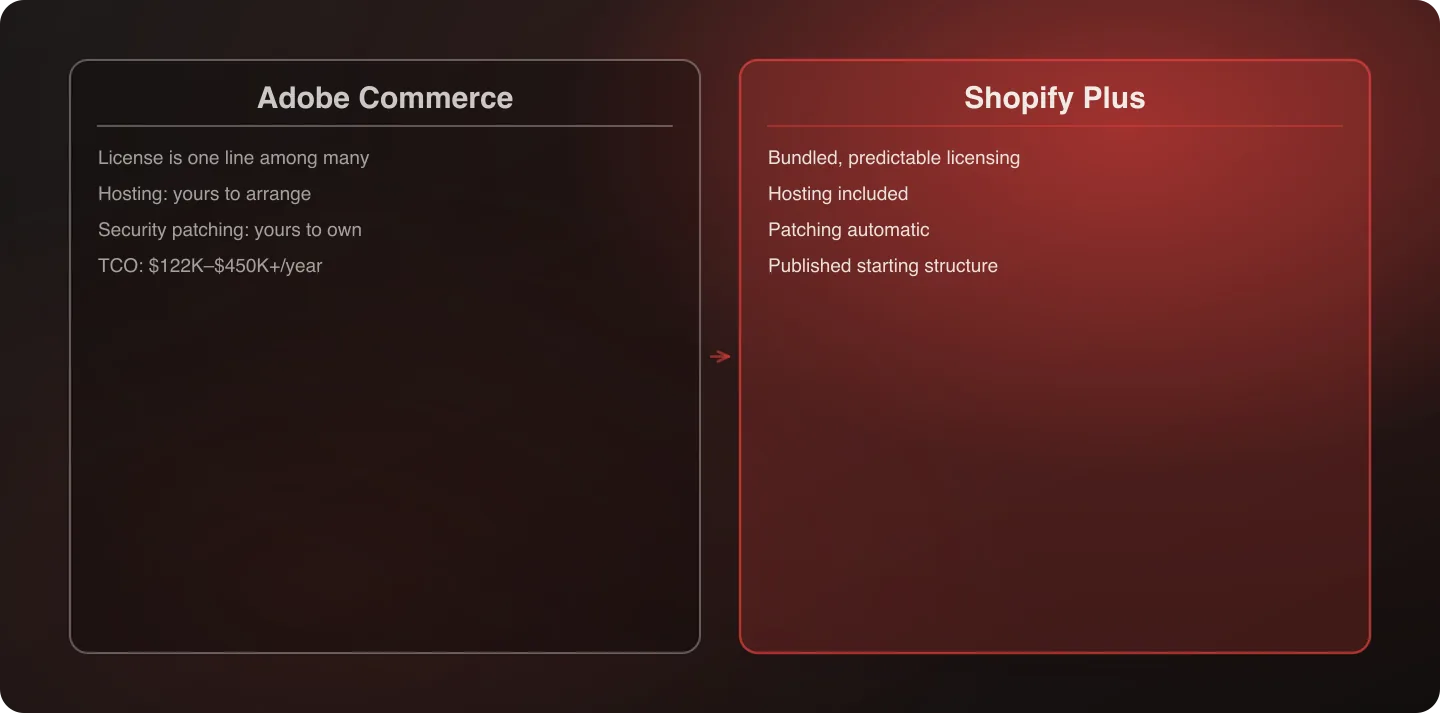
Shopify Plus and Adobe Commerce (formerly Magento Commerce) solve the same enterprise problem with opposite operating models — Shopify Plus is a managed SaaS platform with predictable licensing; Adobe Commerce is a licensed platform you (or a hosting partner) operate, with cost that scales less predictably. Industry estimates put Adobe Commerce's real total cost of ownership at $122,000–$450,000+/year once hosting, implementation, and maintenance are counted — several times the license fee alone.
Last verified: September 6, 2026.
The Core Difference: Managed Platform vs. Licensed Platform You Operate
This is the decision underneath every other comparison point. Shopify Plus bundles hosting, security patching, and platform updates into one predictable relationship. Adobe Commerce separates the license from everything required to actually run it — hosting, ongoing security maintenance, and infrastructure scaling are your responsibility (or your hosting partner's), even on Adobe Commerce Cloud, where hosting is bundled but the underlying operational model is still fundamentally different from Shopify's.
What the Pricing Actually Looks Like — and Why It's Structured So Differently
Adobe Commerce doesn't publish list pricing. What exists instead is a body of converging estimates from multiple independent partners and agencies — not a single source; this range holds across several published breakdowns.
| Cost Component | Industry Estimate |
|---|---|
| On-premises license | Roughly $22,000/year at the low end, scaling to $125,000+/year for stores above ~$25M in GMV |
| Adobe Commerce on Cloud (PaaS) | Roughly $40,000/year at the low end, scaling to $190,000+/year at higher GMV, with hosting bundled in |
| Total cost of ownership | Commonly cited in the $122,000–$450,000+/year range for a serious deployment, once hosting (where not bundled), implementation, extensions, and ongoing maintenance are included |
| License share of total spend | Typically only 20–40% of actual annual spend — the rest is infrastructure, development, and maintenance |
Shopify Plus, by contrast, has a published starting structure — a base fee that differs by contract term (3-year vs. 1-year), plus a variable fee above a revenue threshold. See the full Plus pricing breakdown for specifics.
Why this comparison is genuinely hard to make apples-to-apples. Adobe Commerce's cost model has more moving, negotiable parts — hosting provider choice, extension licensing, implementation scope — than Shopify Plus's does. A fair comparison isn't “which number is smaller,” it's total cost of ownership over a real time horizon, including the operational burden a licensed platform puts on your own team that a managed platform absorbs.
A worked illustration of why TCO, not license fee, is the real comparison. Two merchants both quoted a $40,000/year Adobe Commerce Cloud license might have dramatically different real annual costs depending on extension count, custom development needs, and whether they've budgeted for the security and performance maintenance a managed platform would otherwise absorb automatically. The license fee is genuinely the wrong number to anchor a comparison on — it's routinely a minority share of what a serious deployment actually costs in a given year.
What “operational burden” actually means in practice. On Adobe Commerce, someone — internal staff or a retained partner — owns monitoring for security patches, testing and applying platform updates, and troubleshooting infrastructure issues when they arise. On Shopify Plus, these happen automatically as part of the platform relationship. This isn't a minor convenience difference; it's a recurring staffing or vendor-retainer cost that needs to be modeled explicitly when comparing the two platforms' real economics.
Where Each Platform Genuinely Wins
Adobe Commerce's real strengths: deep native B2B tooling with a long track record, extensive customization depth for businesses with genuinely complex, non-standard commerce logic, and native integration with Adobe's broader Experience Cloud stack if you're already invested in that ecosystem.
Shopify Plus's real strengths: predictable, bundled operational cost; a maintenance model where security patching and platform updates happen automatically rather than requiring your own team's ongoing attention; and, as of the past two years specifically, a native capability set (Checkout Extensibility, Shopify Functions, B2B extended to all plans) that has closed much of the gap that used to favor Adobe Commerce on complex requirements.
The Feature-Parity Trap Is Highest Risk on This Specific Comparison
Per the feature-parity trap, Magento/Adobe Commerce implementations are, as a category, more heavily customized than almost any other platform in this comparison set — Magento's ecosystem encouraged extensive custom development for years. If you're evaluating a move away from Adobe Commerce, the honest audit of what's genuinely required versus what's an inherited workaround matters more here than on almost any other comparison, since the temptation to spec “replicate everything our Magento instance does” is strongest exactly where the platform has the deepest customization history.
What this looks like specifically for a real Adobe Commerce audit. Common candidates for the audit: custom pricing/promotion rules built as Magento extensions (check against Shopify's current Functions and discount capabilities before assuming a rebuild is needed), custom B2B account logic (check against Shopify's native B2B, extended to all plans as of April 2026), and custom checkout modifications (check against Checkout Extensibility's current capability, which has expanded substantially since checkout.liquid's retirement). In each case, a meaningful share of what was genuinely necessary custom work on Magento may not be necessary on Shopify — but only an honest, specific check confirms that, not an assumption in either direction.
What's Actually Been Driving Adobe Commerce Evaluations Lately
Beyond general cost comparison, real, dated events are pushing merchants to evaluate alternatives right now: Magento 1 reached end-of-life in 2020, the 2024 CosmicSting vulnerability affected an estimated 75% of installations, and security researcher Sansec has tracked 70,000+ compromised Magento/Adobe Commerce stores over time. See our Magento vs. Shopify comparison for the broader platform context.
Frequently Asked Questions
Is Adobe Commerce more expensive than Shopify Plus?
Usually yes, once total cost of ownership is counted rather than license fee alone — industry estimates put Adobe Commerce's real annual cost at $122,000–$450,000+ once hosting, implementation, and maintenance are included, versus Shopify Plus's more bundled, predictable cost structure. Neither publishes exact pricing, so any specific comparison should be verified against current quotes.
What is Adobe Commerce, and how is it different from Magento?
Adobe Commerce is the current name for what was Magento Commerce/Magento Enterprise, following Adobe's acquisition and rebrand. Magento Open Source remains a separate, free, self-hosted product distinct from the paid Adobe Commerce tier.
Does Adobe Commerce have better B2B features than Shopify?
It has a longer track record, but Shopify's native B2B functionality (extended to all plans as of April 2026) has closed much of that gap for most use cases. Whether Adobe Commerce's deeper B2B tooling justifies its higher operational cost depends on genuinely complex requirements, not B2B in general.
Why doesn't Adobe publish Adobe Commerce pricing?
Costs are quote-based and tied to GMV, deployment model, and negotiated terms — Adobe has never published a public list price, which is why third-party estimates, not official figures, are the best available benchmark.

“Following Anatta’s work, our conversion rate went from 4.1% to 6.2%, which is insane in the e-commerce industry.”
Tran Ngo, VP Digital & Growth
Read now
Talk to an architect about your Magento/Adobe Commerce evaluation.

Related