












The Real Reasons Merchants Actually Migrate to Shopify
September 4, 2026
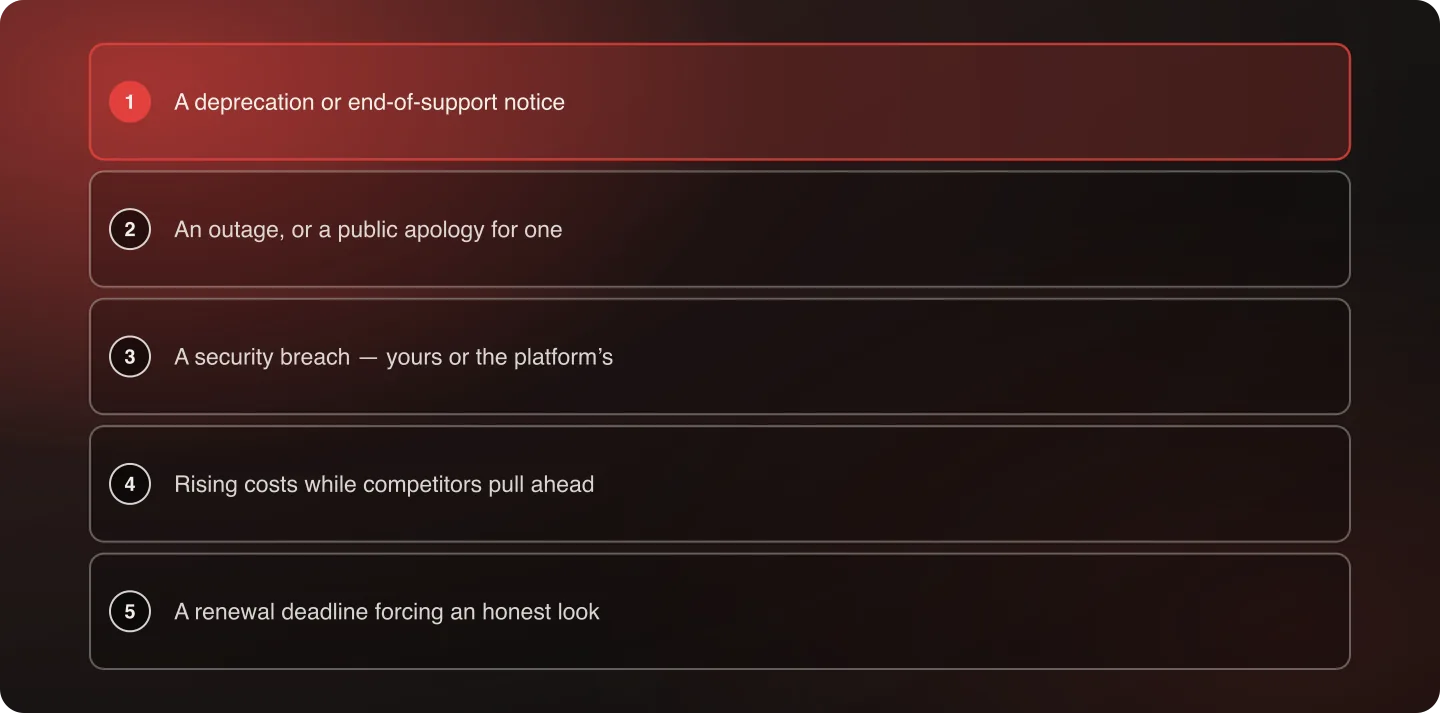
Merchants rarely start evaluating a new platform because of a calm, scheduled technology review. They start because something made staying feel risky — a deprecation notice, an outage, a breach, a rising bill, or a renewal deadline forcing an honest look at costs. Recognizing which one just happened to you changes what you should do next.
Last verified: September 6, 2026.
Why this matters more than it sounds
Most migration content assumes a reader calmly and proactively evaluating platforms on a regular cadence. That is not who is actually reading it. The real reader just had something happen — and what happened determines both the urgency of the decision and, often, what actually needs solving. Fear is a legitimate and common starting point for this conversation, not something to be talked out of. The mistake is letting fear drive a rushed, under-scoped decision instead of a fast but disciplined one.
Almost no migration content is written for this reader. Search "Magento to Shopify migration" or "BigCommerce alternatives" and nearly everything assumes you're already sold on leaving and just need the how. Almost none of it asks what brought you to the search bar. That's a missed opportunity for the content and a real problem for the reader, because the trigger often changes what to prioritize in the migration itself. Someone motivated by a security breach has a different set of urgent questions than someone watching a slow-building cost trend, even though both may end up on the same destination platform.
The five moments that actually trigger a migration search
1. A deprecation or end-of-support notice
Your platform announces a feature is being cut, a version is being sunset, or an integration you depend on is losing support. This is the closest thing to a forced decision point — the platform is telling you something is changing, and you didn't get a vote.
What to do: don't just replace the deprecated piece in place. Use the forced moment to ask the larger question of whether the platform is still the right long-term home, since a vendor that deprecates one thing you depend on will eventually deprecate another. The specific gap in front of you is rarely the most expensive part of this trigger; the pattern behind it is.
2. An outage, or a public apology for one
Your platform goes down, or has a bug significant enough that the vendor has to acknowledge it publicly. Even a short outage during a peak moment reveals something easy to ignore during normal operation: how exposed you are to a single vendor's infrastructure decisions, and how little recourse you have when something breaks.
What to do: treat this as a signal to evaluate resilience and vendor accountability specifically, not just as a bad day to move past. Ask what recourse you actually had during the outage, what the vendor committed to afterwards, and whether that is acceptable as an ongoing risk rather than a one-off.
3. A security breach
A leak or breach — yours, or a widely publicized one on the same platform — raises a question that is hard to un-ask once asked: is staying worth the risk. Several of the origin platforms in this series have a documented, dated record here, which is why each platform page carries its own sourced account rather than a general warning.
What to do: this is the trigger most likely to produce a rushed, fear-driven decision, and it is exactly the moment to slow down slightly rather than speed up. A breach-driven migration executed carelessly can introduce new security gaps during the transition itself. Evaluate calmly and move deliberately — but don't talk yourself out of the underlying concern just because the initial panic fades.
4. Rising costs while competitors pull ahead
Your platform's costs keep climbing — hosting, licensing, the developers needed to maintain a growing pile of custom code — while competitors on more modern infrastructure seem to move faster and cheaper. This trigger is usually the most rational of the five and the easiest to act on with a clear head, precisely because it isn't a single dramatic event.
What to do: don't let the absence of a crisis make it feel less urgent. A slow-motion cost problem is still a real one, and it compounds. It's also the trigger where a written business case does the most work, because the numbers are already trending in your favour and just need assembling.
5. A renewal deadline forcing an honest look at costs
Your contract renewal is approaching, and it's the natural moment to compare current costs against realistic alternatives — even if only as a comparison exercise. This is the one trigger that comes with real lead time, which makes it the best-positioned of the five to run a genuinely rigorous comparison rather than a rushed one.
What to do: if you're facing a renewal and haven't run the numbers on a real alternative, the deadline is doing you a favour by forcing the question. Don't let it pass by defaulting to renewal without a real comparison. Magento and Salesforce Commerce Cloud both have well-known licensing cycles, and both of those platform pages cover what has actually been happening on price.
How to tell which trigger is actually driving your search
It's common for more than one to be present at once. Rising costs and a renewal deadline often arrive together, since a renewal is frequently the moment costs visibly jump. When multiple triggers overlap, identify which one is doing the most work in the urgency you feel: a security breach in the same month as a scheduled renewal is a fundamentally more urgent situation than a renewal alone, and should be treated with the breach's urgency rather than the renewal's more leisurely timeline.
The practical version of that test: if the trigger disappeared tomorrow, would you still be looking? If yes, you have a cost or capability problem and time to run it properly. If no, you have an event-driven decision, and the discipline below is what keeps it from becoming an expensive one.
The trap that shows up regardless of which trigger brought you here
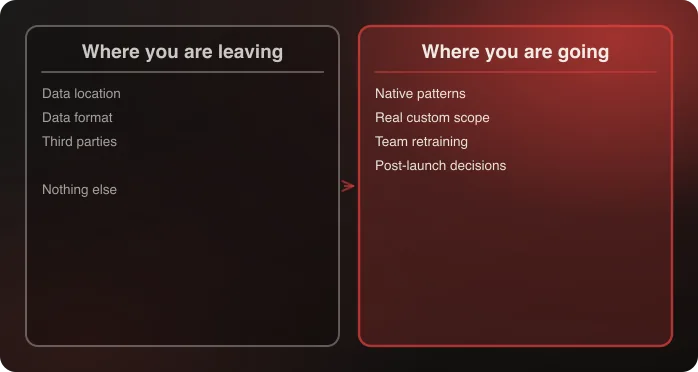
Whichever of these five moments started your search, the same mistake waits on the other side of it: treating the trigger as a reason to deeply document and preserve everything about your current platform, rather than as the moment to seriously evaluate where you're going.
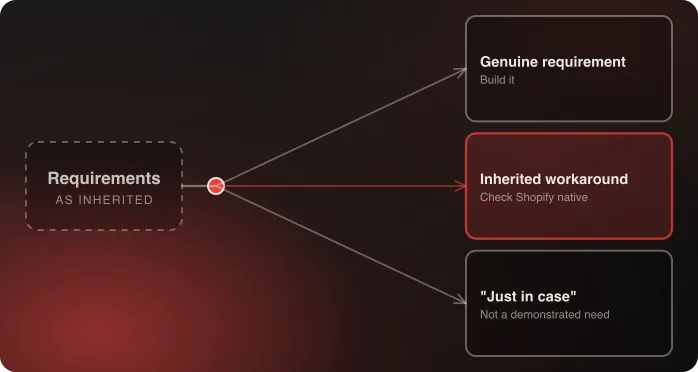
A security breach doesn't make your current platform's custom checkout logic worth rebuilding faithfully. A renewal deadline doesn't mean years of accumulated workarounds need replicating in the new system. See the custom-to-custom trap for why this instinct is so costly, and the full migration thesis for why the destination platform — not the one you're leaving in a moment of fear — is where the expertise you need actually lives.
Why urgency and rigor aren't actually in tension
A common assumption: a fear-driven trigger means you have to move fast, and moving fast means skipping the discipline a calmer, scheduled migration would get — a real extract-transform-load method, a custom-to-custom audit, a clear-eyed look at which third parties survive. This is false. Those disciplines don't take dramatically longer to apply. They take a decision to apply them at all, under pressure, instead of skipping them because the moment feels urgent.
The fastest real migration in our own portfolio is the proof. buybuy BABY stood up a full Shopify Plus storefront in 31 days — 30,000+ SKUs, 8.3 million customer records off Oracle ATG, 14 integration points live at launch, and four physical stores reopened with POS before BFCM. That wasn't fast because discipline got skipped. It was fast because the discipline was applied efficiently, under real time pressure, by people who didn't confuse urgency with an excuse to be careless.
What this looks like when it goes wrong. A team facing an outage-driven trigger skips discovery entirely and signs with whoever can start Monday, without checking whether that partner has a real ETL method or is simply moving fast on promises. The migration often ends up slower than a properly scoped one would have been, because problems discovery would have caught surface mid-project instead, at a point where fixing them costs real schedule time. Fear made the decision feel urgent; skipping discipline made it slower, not faster.
What this looks like when it goes right. The same outage-driven trigger, handled with urgency but not carelessness: a compressed but real discovery phase, a genuine audit of what's custom by necessity versus custom by habit, and a partner who can demonstrate a repeatable method rather than enthusiasm about the timeline. Discovery, week by week shows what gets compressed and what doesn't — the sequence stays the same, only the calendar shortens.
Frequently Asked Questions
Is it bad to start evaluating a new platform because of fear or a bad experience?
No — it's one of the most common and legitimate starting points. The risk isn't the emotional trigger, it's letting that trigger produce a rushed, under-scoped decision instead of a fast but still disciplined one.
Which of the five triggers is most common?
Renewal deadlines and rising costs, because they're the most predictable. Every merchant on a contract-based platform faces a renewal eventually, and cost trends are visible well before they become urgent.
Should I rush a migration decision after a security breach?
Move with real urgency, but don't skip the discipline. A rushed, careless migration can introduce new security gaps during the transition itself, which defeats the purpose of moving.
Does a platform deprecation always mean it's time to switch entirely?
Not automatically, but it's a fair moment to ask the bigger question. A platform willing to deprecate one thing you depend on is likely to do it again. Use the forced moment to evaluate the whole relationship, not just patch the specific gap.
Can a migration be done quickly without cutting corners?
Yes, by running the same work in parallel with more people rather than skipping steps. buybuy BABY's full rebuild ran 31 days including discovery, and every discipline still happened — the calendar compressed, the sequence didn't.
Whichever trigger brought you here, the next step is the same: find out what an honest audit would surface. Talk to an architect, or read how we scope a systems replatform.
Whatever brought you here, let's talk about what's actually next.

Related