












Feature Parity Is a Trap
August 16, 2026
Not every feature on your old platform deserves to be rebuilt on the new one. Some features exist only because the old platform made the right solution hard. Auditing for that before scoping a replatform is one of the highest-leverage ways to control budget without losing anything customers actually value.
Last verified: September 6, 2026.
The same audit applied to custom development rather than to features is the custom-to-custom trap — why rebuilding your old platform's bespoke logic inside Shopify relocates the maintenance problem instead of solving it.
Why "just replicate everything" is the wrong default
A feature audit conducted honestly usually finds that some meaningful share of "must-have" features were workarounds for a limitation of the old platform specifically — not things customers would miss if a better native solution existed instead. Rebuilding those on the new platform preserves a workaround's complexity without preserving any real value.
The default persists because it feels safe. Nobody was ever criticized for keeping a feature, and removing one requires an argument. But the cost of the default isn't zero, it's just deferred: every unnecessary rebuilt feature is development time now and maintenance surface for the life of the platform.
A simple audit framework
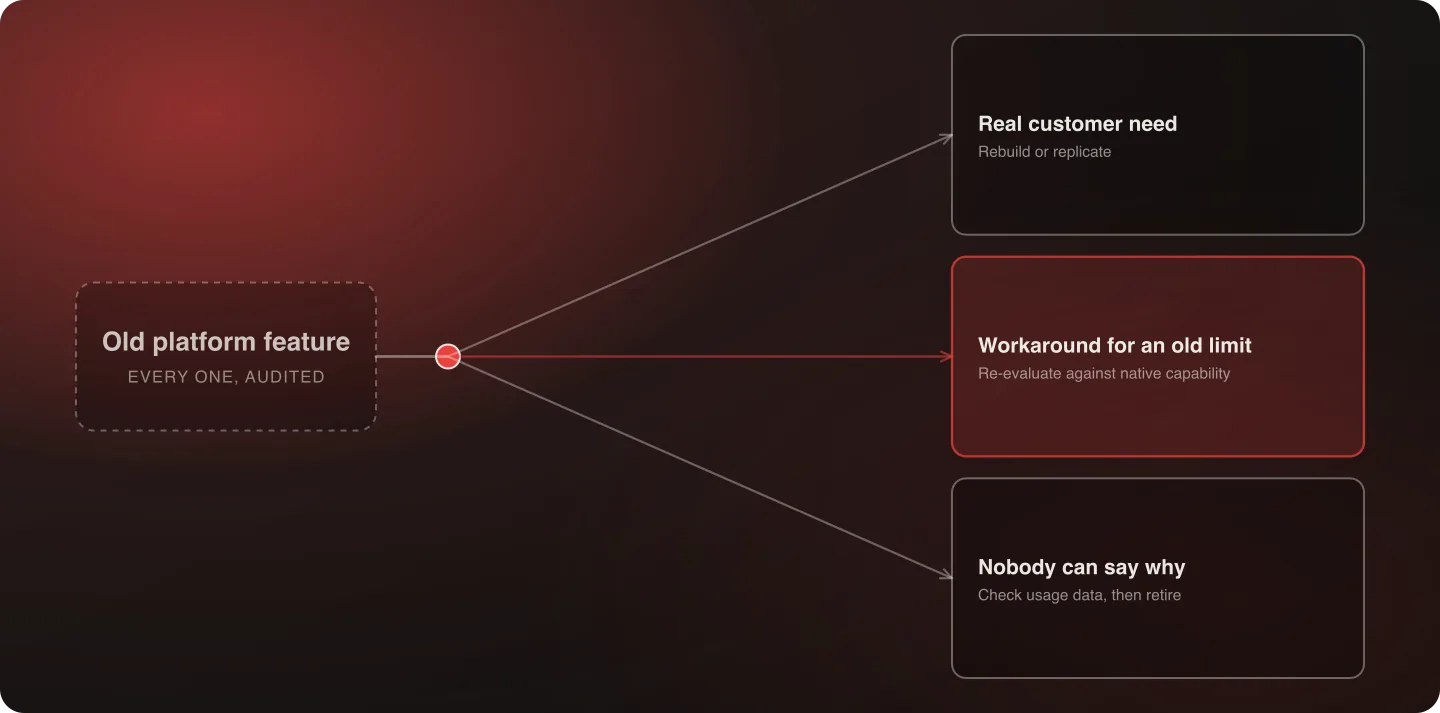
For each feature on the current site, ask one question: does this exist because customers need it, or because the old platform made a better approach difficult or expensive?
- Real customer need → rebuild or replicate. The work is justified.
- Workaround for an old limitation → re-evaluate against the new platform's native capability before assuming it needs rebuilding at all.
- Nobody can say why it exists → check usage data before deciding. This category is usually larger than teams expect, and it's where the fastest savings are.
Usage data settles most arguments faster than opinion does. A feature that three people used last quarter is a different conversation from one that touches a third of orders, and the conversation is much shorter once the number is on the table.
A concrete pattern to watch for
Custom-built account or checkout functionality is one of the most common places this trap shows up. A feature built years ago to work around a platform limitation may address a problem that no longer exists — either because the new platform handles it natively, or because the destination platform's current version does something the version you last evaluated didn't.
Rebuilding it as originally specified, rather than re-evaluating against current native capability, is how unnecessary custom code gets carried forward into a brand-new system. Nuts.com's migration is the counter-example worth studying: the parts genuinely worth keeping were kept — five custom product builders that the business actually ran on — while overall custom code fell by 85%. Read the case study.
What the audit is not
It isn't an excuse to drop things quietly. A feature-parity audit produces a documented decision per feature, including the ones being retired and why — because the alternative is a stakeholder discovering at launch that something they relied on is gone, which costs more trust than the feature cost to build.
It also isn't a one-way exercise. Some features the current platform can't do well should get more investment on the new one, not less. The audit's job is to move budget from workarounds to capability, not simply to reduce the total.
How to run the audit in practice
The framework is simple; getting a room full of stakeholders through it is the actual work. A process that holds up:
- Inventory everything first, without judging it. Every feature on the current site, including admin-side functionality and anything running as a customization or an app. Judging while inventorying makes the list shorter and less honest.
- Attach usage data to each line before any discussion. How many customers touched it, how many orders involved it, how many times an admin used it last quarter. Most disagreements dissolve once the number is visible, and the ones that survive are the real ones.
- Name an owner per feature — the person who would argue for keeping it. A feature nobody will claim is already answered.
- Sort into rebuild, re-evaluate, and retire, with a written reason on every line, including the keeps.
- Check the re-evaluate pile against the destination platform's current capability, not its capability the last time anyone looked. This is where the savings are, and it needs somebody who knows the new platform well.
- Circulate the retire list before it's final. Someone will object to one item nobody expected, and hearing that now costs a conversation; hearing it at launch costs trust.
Run it in discovery, before the RFP goes out. Its output is the customization section of that document, and an RFP written without it asks vendors to quote against a wish list.
What the audit tends to find
Patterns that recur across projects, offered as places to look rather than as a rule:
- Admin-side tooling built to work around a slow or awkward interface, where the new platform's native admin does the job.
- Custom promotion or discount logic built before the old platform supported what the business needed, often reproducible natively now.
- Reporting and exports built because the old platform's reporting was inadequate, frequently replaceable by the new platform's own or by a tool already in the stack.
- Features with a single internal user — worth keeping if that user's job depends on it, worth a conversation if it was built for someone who left.
- Duplicated capability, where two features solve the same problem because the second was built when nobody remembered the first.
The budget impact
Every feature rebuilt that could have been replaced by native capability is both direct development cost now and ongoing maintenance cost for the life of the platform. A rigorous feature-parity audit at the start of a replatform is one of the highest-leverage cost-control activities in the entire project — and it's the one that has to happen before the RFP goes out, because the customization section of that document is exactly where its conclusions land.
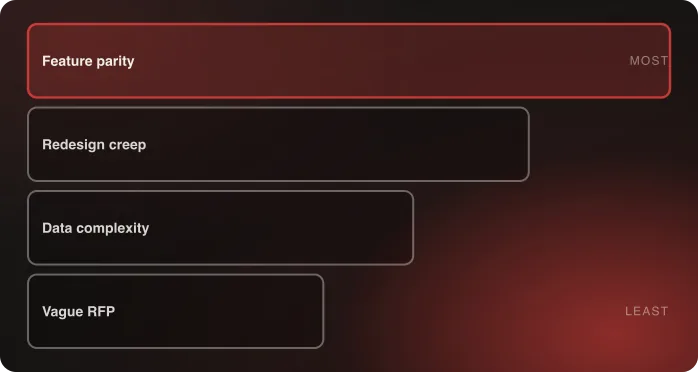
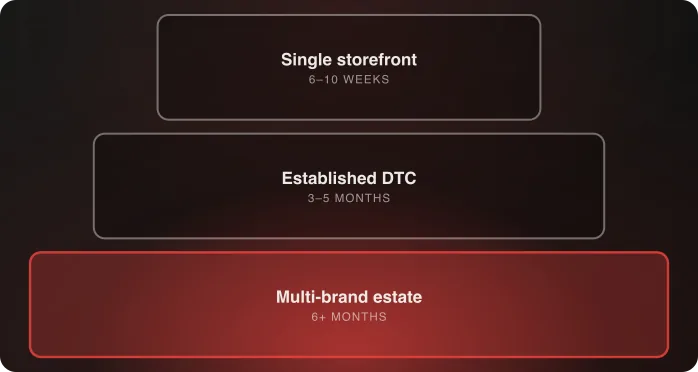
Unexamined feature parity is the single most common cause in why replatforms go over budget. It's also one of the seven disciplines in Anatta's replatforming method, and it shortens the schedule directly — see replatforming timelines by complexity, where custom functionality is one of the four real drivers.
Frequently Asked Questions
What is the "feature parity trap"?
Assuming every feature on the old platform needs to be rebuilt on the new one, without auditing whether each feature exists because customers need it or because the old platform made a better solution hard.
How do I know which features are actually necessary?
Ask, for each feature: does this exist for a real customer need, or as a workaround for an old platform limitation that may not exist on the new platform? Where nobody can answer, check usage data before deciding — that category is usually larger than teams expect.
When should a feature-parity audit happen?
Before the RFP goes out. Its conclusions are exactly what the customization section of an RFP needs, and without them vendors quote against a wish list rather than a scope.
Does a feature-parity audit just mean cutting features?
No. Some capabilities the old platform handled badly deserve more investment on the new one. The audit moves budget from workarounds to real capability rather than simply reducing the total, and it produces a documented decision per feature so nothing disappears without anyone noticing.
How do you run a feature-parity audit without it becoming an argument?
Inventory without judging, then attach usage data to every line before any discussion begins. Most disagreements dissolve once the number is visible, and the ones that survive are the real ones worth having.
When should the audit happen?
In discovery, before the RFP goes out. Its output is the customization section of that document — an RFP written without it asks vendors to quote against a wish list rather than a scope.
Talk to an architect about a feature-parity audit.

Related