












Shopify Plus vs. Salesforce Commerce Cloud in 2026: Pricing & Fit Compared
September 2, 2026
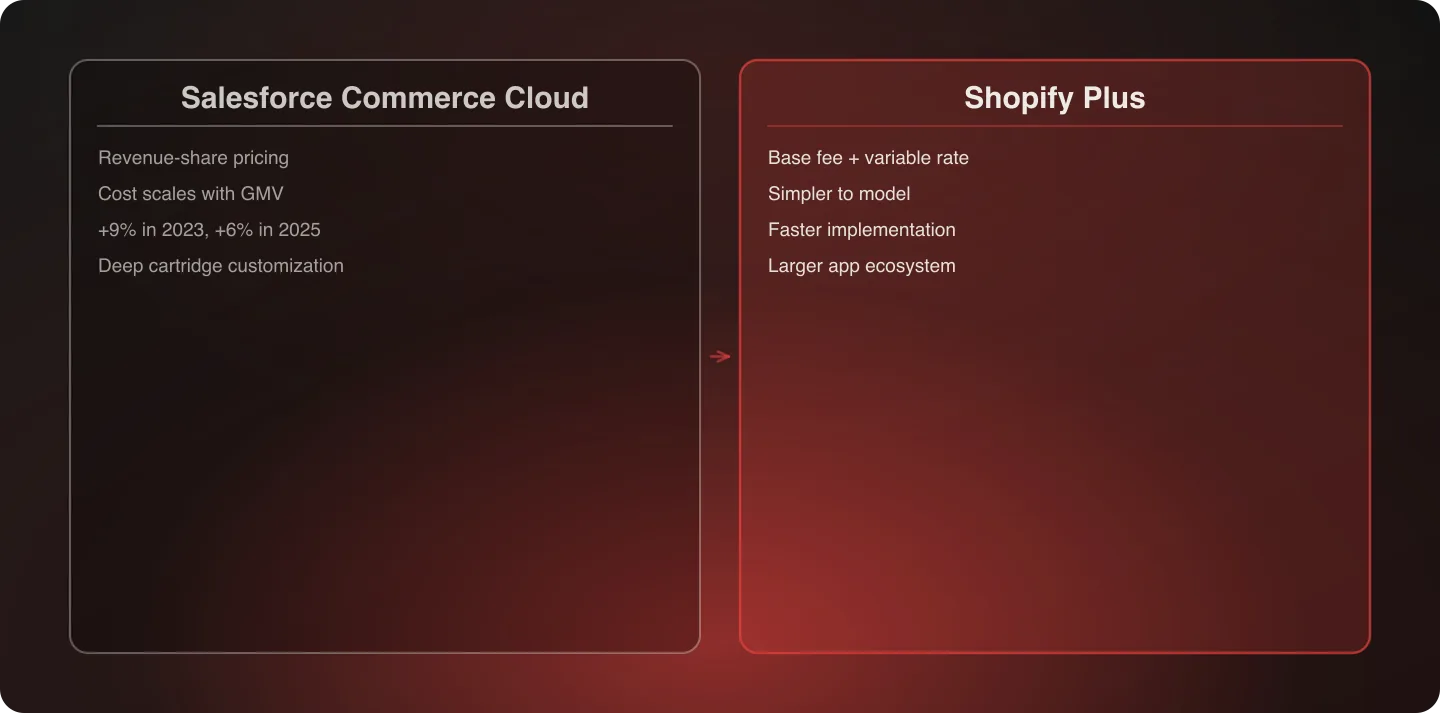
Salesforce Commerce Cloud (SFCC) is priced on a revenue-share model tied to GMV, layered with recent, real list-price increases — 9% in 2023, another 6% in 2025 — across Salesforce's broader Enterprise/Unlimited product tiers. Shopify Plus uses a base-fee-plus-variable-rate structure. Neither publishes exact figures, but SFCC's revenue-share model means cost scales directly with your growth in a way Shopify Plus's structure doesn't.
Last verified: September 6, 2026.
The Pricing Model Difference Matters More Than Any Specific Number
SFCC's pricing is fundamentally revenue-share-based — cost is tied to a percentage of GMV processed through the platform. This means SFCC's cost structure scales automatically as your business grows, for better and worse: no renegotiation needed to “unlock” capacity, but also no natural ceiling the way a flat licensing model has. Shopify Plus's base-fee-plus-variable-rate structure behaves differently — see the full breakdown.
Real, Documented Price Increases Worth Knowing About
Salesforce has announced two list-price increases in roughly two years, on its broader Enterprise/Unlimited product portfolio. Whether Commerce Cloud specifically is affected by a given announcement depends on your specific product bundle, but the pattern — two increases in two years — is real and worth raising directly in any renewal conversation.
| Date | Increase | Scope |
|---|---|---|
| July 2023 | Average 9% | Across Salesforce's product portfolio |
| August 1, 2025 | Average 6% more | Enterprise and Unlimited editions |
A structural note on SaaS renewal pricing generally, which applies to SFCC as much as any enterprise vendor: industry analysis of large SaaS renewals consistently finds that discount levels negotiated at initial signing often aren't preserved at renewal — meaning the effective increase for a specific account can run higher than any published average once a renegotiated discount is factored in.
What to actually do with this information at renewal time. Don't treat a renewal quote as a fixed number to accept or reject — treat the pattern of two documented increases in two years as leverage to ask specific questions: what's driving this specific increase for our account, is our current discount level being preserved or reduced, and what would a genuine platform alternative cost us to model against this renewal. Even if you ultimately stay on SFCC, having done that comparison work changes the renewal conversation from accepting a number to negotiating one from an informed position.
Where Each Platform Genuinely Wins
SFCC's real strengths: deep enterprise-scale catalog management, a long track record with the largest, most complex retail deployments, and native integration with the broader Salesforce ecosystem (Marketing Cloud, Service Cloud) if you're already invested there.
Shopify Plus's real strengths: substantially faster typical implementation timelines, a much larger third-party app ecosystem, and a cost structure that's simpler to model even though it isn't fully published either.
The Feature-Parity Trap Is Especially High Here
Per the feature-parity trap, SFCC implementations at the enterprise level are almost always extensively customized through SFCC's cartridge system. The temptation to treat “replicate our current cartridges” as a migration spec is strong precisely because SFCC deployments are so consistently customized — which makes the honest audit more valuable here than on almost any other platform in this comparison set.
Frequently Asked Questions
Is Salesforce Commerce Cloud more expensive than Shopify Plus?
It depends heavily on your GMV, since SFCC's revenue-share model means cost scales directly with growth. Salesforce has also announced two list-price increases in the past two years (9% in 2023, 6% more in 2025) worth factoring into any long-term comparison.
How is SFCC's pricing structured differently from Shopify Plus?
SFCC uses a revenue-share model tied to a percentage of GMV. Shopify Plus uses a base fee plus a variable rate above a revenue threshold. Neither publishes exact figures, but the underlying models scale differently as your business grows.
Should I expect our SFCC renewal price to match the last quoted rate?
Not necessarily — negotiated discounts at initial signing frequently aren't preserved at renewal across the SaaS industry generally, and Salesforce has announced list-price increases in both 2023 and 2025.

“Following Anatta’s work, our conversion rate went from 4.1% to 6.2%, which is insane in the e-commerce industry.”
Tran Ngo, VP Digital & Growth
Read now
Talk to an architect about your Salesforce Commerce Cloud evaluation.

Related