












Shopify vs. Commercetools: Which Commerce Model Fits Your Business?
August 29, 2026
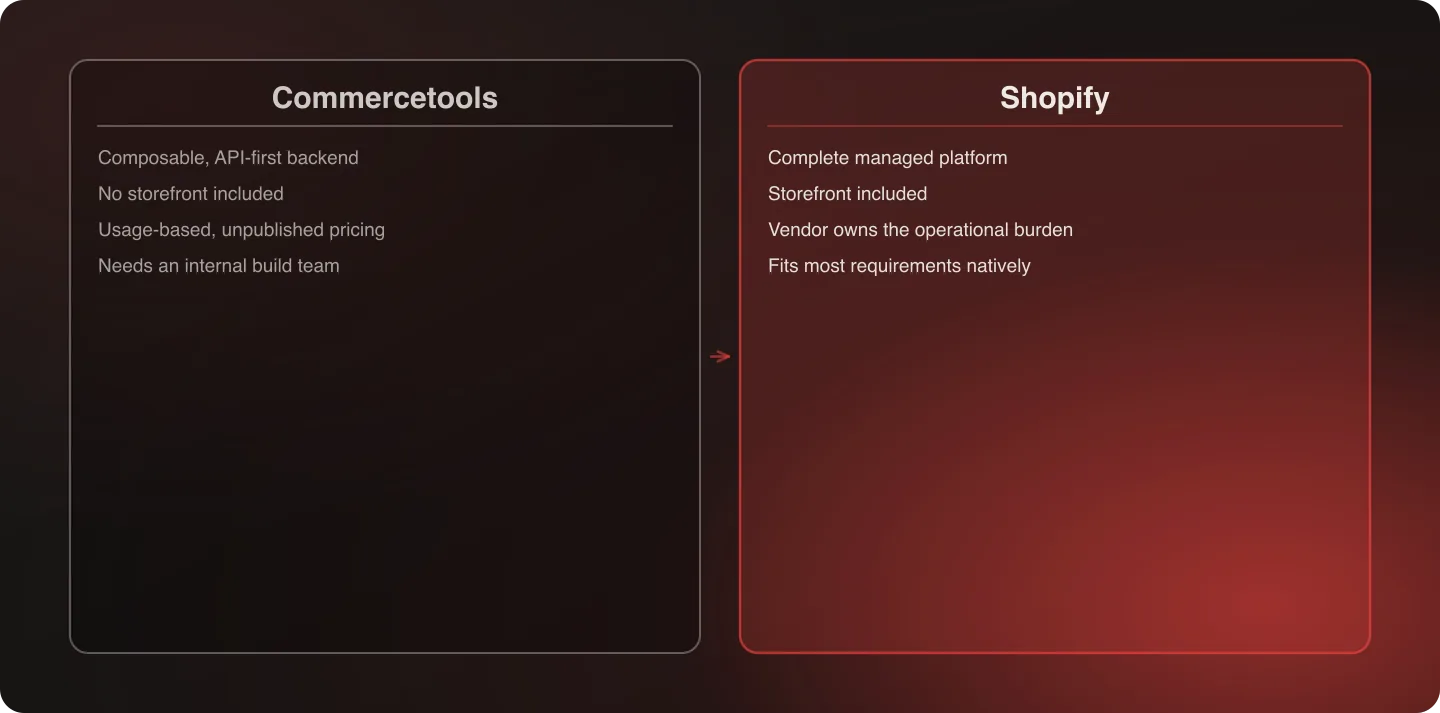
Shopify and Commercetools represent fundamentally different philosophies — Shopify is a complete managed commerce platform; Commercetools is a fully composable, API-first backend with no storefront at all, meant to be assembled with separately-chosen front-end and other components. Commercetools doesn't publish pricing; no reliable independent estimate exists, so this comparison focuses on which model actually fits your situation rather than cost.
Last verified: September 6, 2026.
These Aren't Really Competing for the Same Decision
This is worth stating plainly before any other comparison: Shopify and Commercetools solve different problems for different buyers. Shopify is right for a business that wants a complete, managed platform. Commercetools is right for a business that wants to assemble its own composable stack from independently-chosen best-of-breed components, with an internal engineering team capable of owning that assembly. If you're comparing these two head-to-head, it's worth confirming which of those two models you actually want before comparing features or cost.
On Pricing: Genuinely No Reliable Public Benchmark Exists
Commercetools uses usage-based pricing with no published list price, and unlike the Adobe Commerce comparison in this series, there isn't a body of converging independent estimates to cite here either. Any specific number you find online for Commercetools pricing should be treated with real skepticism unless it comes directly from Commercetools or a documented customer disclosure.
Where Each Genuinely Fits
Commercetools fits when: you have a genuinely composable requirement — an existing tech stack you want to keep and add specific commerce capabilities to, an internal engineering team capable of assembling and maintaining a headless architecture, and requirements too specific or unusual for a managed platform's native capability, even Shopify's expanding native flexibility.
Shopify fits when: you want a managed platform that handles the operational burden — hosting, security, platform updates — for you, and your requirements, even complex enterprise requirements, fit within a managed platform's native and Plus/Enterprise-tier capability, which for the large majority of merchants evaluating this comparison, they do.
The Honest Test for Which One You Actually Need
Ask directly: do you want to own the assembly and maintenance of your commerce stack's components, or do you want a vendor to own that for you? This is a genuinely different question from “which platform has more features,” and it's the question that actually determines fit here more than any specific capability comparison.
A pattern worth naming: composable architecture as an aspiration rather than a genuine requirement. It's common for a team to be drawn to Commercetools' composable model because it sounds more modern or sophisticated, without a genuinely composable requirement actually driving the decision — no existing tech stack that needs preserving, no internal team specifically staffed to own the assembly. This is a version of the feature-parity trap covered elsewhere in this content: choosing complexity because it feels more serious, rather than because the situation genuinely requires it. If your honest answer to the ownership question above is “we'd rather a vendor handled this,” that's a real answer pointing toward Shopify, not a lesser one.
When Commercetools is the clearly right call. A large retailer with a genuinely extensive, working proprietary tech stack — a custom OMS, a bespoke pricing engine, existing front-end infrastructure — that needs specific commerce capabilities added without replacing that investment is the clearest fit. This is a meaningfully different starting situation from most mid-market and even many enterprise brands evaluating this comparison.
Frequently Asked Questions
How much does Commercetools cost compared to Shopify?
There's no reliable way to answer this — Commercetools doesn't publish pricing and no credible independent estimate exists. Shopify Plus has a base-fee-plus-variable-rate structure that, while also not fully public, has considerably more available benchmarking than Commercetools does.
Is Commercetools a Shopify competitor?
Not directly — they serve different buyers. Commercetools is a composable, API-first backend meant to be assembled with other components; Shopify is a complete managed platform. The comparison is really about which model fits your situation, not which platform “wins.”
Do I need a large engineering team to use Commercetools?
Generally yes — since Commercetools has no storefront and requires assembling a full commerce stack from separate components, an internal team capable of owning that assembly and its ongoing maintenance is a practical requirement, not optional.

“Following Anatta’s work, our conversion rate went from 4.1% to 6.2%, which is insane in the e-commerce industry.”
Tran Ngo, VP Digital & Growth
Read now
Talk to an architect about which model fits your business.

Related