




















Agentic commerce on Shopify
AI agents can now shop online for your customers. Shopify has made it easy for agents to find your products. The real challenge is getting the agent to choose your products.
Here’s what you’ll find on this page:
- How Shopify puts your store in front of ChatGPT, Gemini, Copilot, and Meta
- Which platforms check out inside the agent, and which send the shopper to you
- Shopify’s published data, and what’s still a forecast
- Why being present is not the same as being chosen
- What a Shopify brand should fix first, and how to measure it
* For the term itself, how an agent buys on any platform, and the industry-wide numbers, see the agentic commerce hub. This page assumes you run a Shopify store and want to know what is already happening to it.
How does agentic commerce work on Shopify?
Shopify Catalog syndicates your product data to most of the AI platforms, the Agentic channel in admin controls which platforms receive that data and which may check out, and checkout either returns the shopper to your store or runs inside the agent over an open protocol.
Shopify does not send your store to the AI platforms. It sends your products into a central feed, the platforms read that feed, and you stay the merchant of record (the business the order is placed with) whichever way the order completes. Agentic commerce on Shopify has four layers:
Shopify Catalog is every eligible product on every Shopify store, normalized into one structured catalog: title, description, images, price, inventory, shipping, variants, policies. Shopify runs inference over the catalog to add attributes a merchant never typed, and the description an agent reads may be Shopify’s own (how to check it). It updates continuously.
Agentic Storefronts is the Agentic channel in admin, under Sales channels, launched in the Winter ’26 Edition on 10 December 2025 and on by default for eligible stores. One default setting, “Allow Shopify to manage for me”, shares the catalog, turns on direct checkout, and enrolls the store in new platforms as they launch. Every setting, and how to change one platform.
The AI platforms in the Agentic channel are ChatGPT, Google AI Mode and Gemini, Microsoft Copilot, Meta, and Shopify’s own Shop app. Google takes your products through the Google & YouTube channel or Merchant Center rather than through Catalog, and Perplexity sources Shopify product data through its own integration, outside the channel. Each ranks its own way, but the inputs Shopify names are data quality, relevance, availability, price, and engagement.
The Universal Commerce Protocol (UCP), which Shopify co-developed with Google and announced at NRF on 11 January 2026, is how an agent creates a cart, passes payment, and gets order status from a Shopify store without a browser. Shopify serves it for every eligible store, so there is no protocol to choose. Two open checkout protocols exist and have not merged: the other, the Agentic Commerce Protocol (ACP) from OpenAI and Stripe, which Meta has co-maintained since April 2026, is the one ChatGPT was built around, and ChatGPT sends the shopper to your own checkout instead.
Full guide: UCP vs ACP, and which protocol your store is on →
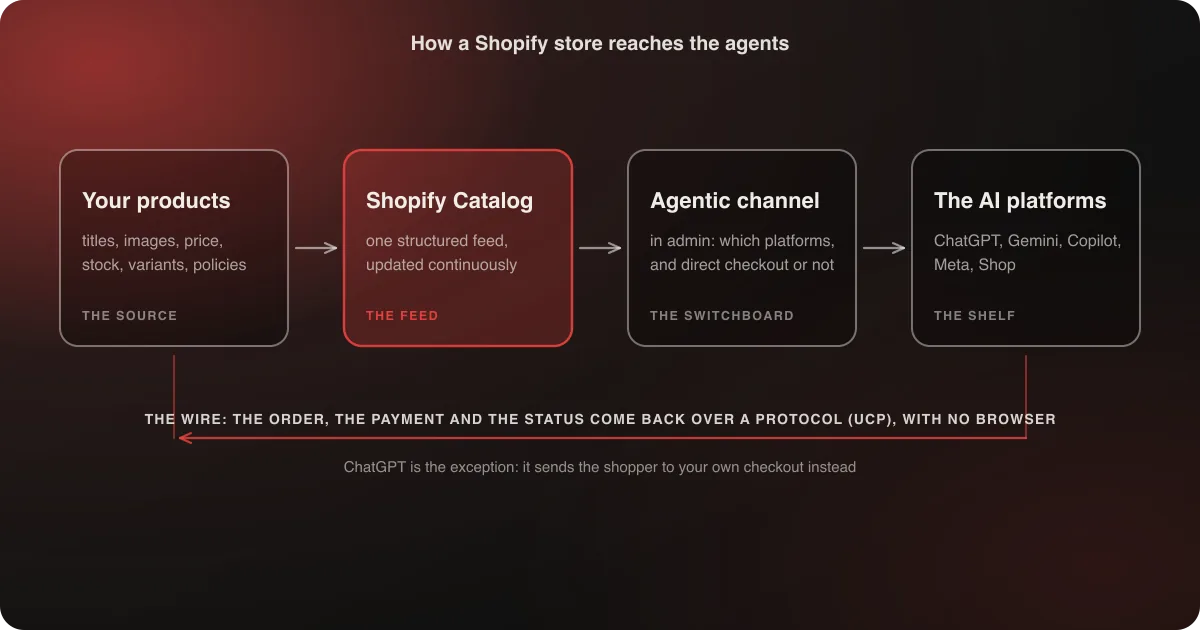
Checkout works differently on each platform
ChatGPT sends the shopper to your own checkout, in its in-app browser or a new tab. Google AI Mode and Gemini, Microsoft Copilot, and Meta complete the order inside the agent on a Shopify-powered checkout, and that direct checkout is on by default for every eligible store; Google’s is still rolling out to shoppers. Each platform sells to its own markets.
Google’s in-agent checkout runs on the Universal Commerce Protocol, and Shopify says Copilot’s does too (which protocol each platform uses, and who says so). Orders from every platform land on the normal Orders page with channel or referrer attribution. Payment, tax, and fraud screening run through Shopify in all four cases, though that is not chargeback protection: who bears a disputed agent order follows the card networks’ rules (who carries a disputed agent order). Refunds are processed in admin. If you fulfill outside Shopify you write the status back to Shopify, because the agent reports shipping updates to the shopper from Shopify’s order status.
Full guide: Shopify Agentic Storefronts, setup, eligibility, and every setting →
Is agentic commerce on Shopify real yet, or still a forecast?
On Shopify, discovery through agents is live, growing fast off a small base, and converting better than the traffic it displaces. Autonomous checkout is partly live and partly retreated, and the two checkout protocols underneath have not merged.
Agentic commerce has moved fast and partly backwards inside twelve months, which is why every figure on this page carries its date. The figures below are Shopify’s own, about its own platform. The industry-wide figures from Adobe, Salesforce, and Bain are on the hub.
Shopify’s data, as published
AI-driven traffic and orders to Shopify stores, year over year, in the second quarter of 2026.
Harley Finkelstein, Shopify Q2 2026 earnings call, 5 August 2026. Platform-wide, off a small base.
Shopify says AI searches on its structured feed convert at twice the rate of AI searches on scraped data.
Shopify, June 2026. Shopify’s own figure, published without a method, and the case for the feed.
New-buyer orders from AI channels come in at nearly twice the rate of other channels. Half of AI-referred sessions land straight on a product page.
One figure from the Shopify Q2 2026 call matters more to a direct-to-consumer brand than the headline: 75% of AI-attributed orders in the quarter came from outside Shopify’s top 100 categories. Agents are not concentrating demand in the biggest categories. They are answering specific questions, and a specific product with a specific answer wins those orders.
Read alongside the industry figures on the hub, the shape is clear: volume is still small, growth is steep, and the visitor an agent sends arrives further down the funnel than the average visitor. The forecast everyone quotes, McKinsey’s $3 to $5 trillion of agent-touched consumer commerce by 2030, counts anything an agent touches anywhere in the chain. It is a projection, not measured revenue, and it should not be read alongside the measured figures above.
The timeline on Shopify
| When | What happened |
|---|---|
| September 2025 | OpenAI and Stripe publish the Agentic Commerce Protocol. Instant Checkout launches inside ChatGPT with Etsy sellers. |
| 10 December 2025 | Shopify launches Agentic Storefronts and Shopify Catalog in the Winter ’26 Edition. |
| 11 January 2026 | Google and Shopify announce the Universal Commerce Protocol at NRF. |
| March 2026 | OpenAI scales back Instant Checkout. ChatGPT keeps discovery; purchases complete on the merchant’s own store. |
| 11 May 2026 | The Agentic channel gets its own page in admin: performance by AI platform, the queries your products rank for, and recommendations. |
| June 2026 | Shopify’s Spring ’26 developer Edition opens the Catalog API to any developer without approval, and adds image and multimodal search. |
| 8 September 2026 | Meta joins the Agentic channel, with products shared by default. |
| 6 October 2026 | Meta and Sierra announce the Personal Agent Protocol, with Shopify among its partners: how a personal agent signs in and acts at a store. Payments are left to the checkout protocols. |
| 9 October 2026 | Shopify starts sharing compare-at prices with agents, with a merchant toggle. |
What nobody has published yet is a year-one figure for a single brand: what share of orders arrived through an agent, at what margin, against what it cost to get there. When someone quotes you a year-one figure, ask which of the figures above it came from.
Why is being present not the same as being chosen?
An agent answers with a handful of products instead of a page that lists 40 products. Inclusion is binary, ranking runs on data quality, relevance, availability, price, and engagement, and none of those five inputs is changed by the Agentic channel toggle.
Shopify made turning the channel on the easy part, on purpose. Everything that decides whether a brand actually wins orders from agents sits on the other side of that toggle.
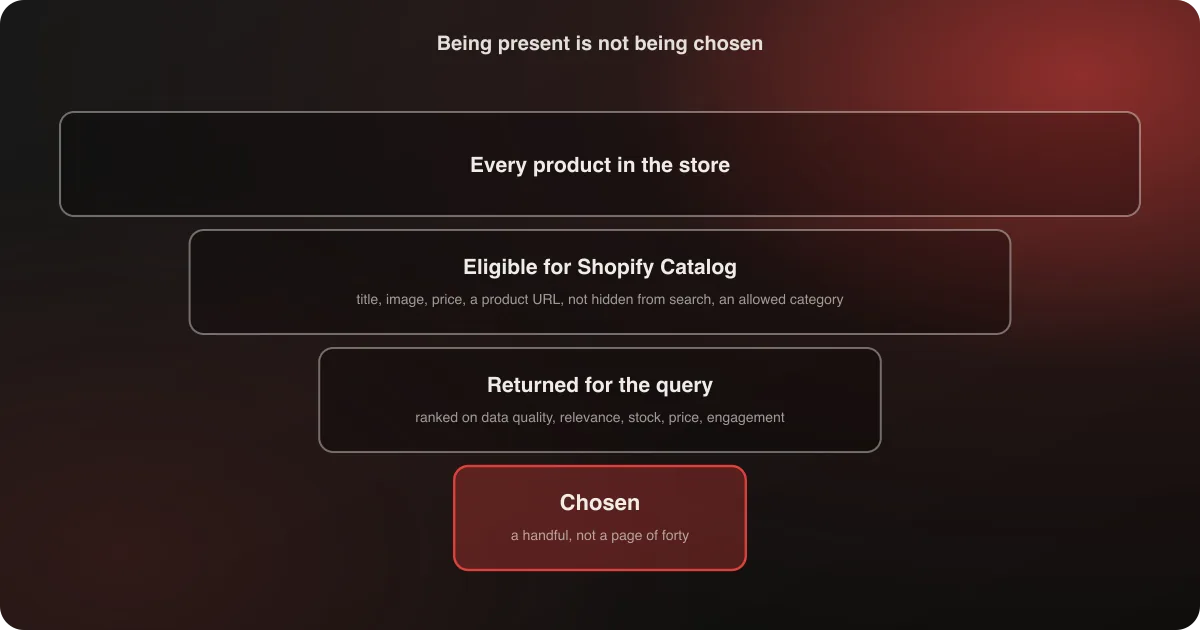
A product reaches Shopify Catalog only if it clears a short list of requirements (a title, an image, a price above zero, a product URL, not unlisted or hidden from search) and falls outside sixteen excluded categories, CBD supplements and anything Shopify classifies as Uncategorized among them, and only if the store clears gates of its own: Starter or above, no storefront password, not B2B-only, and good account standing. Every requirement and excluded category.
Miss one requirement and the product never reaches an agent through Shopify Catalog; at most an agent finds its page on the open web, without the structured data. No alert says so; the gap only shows if someone opens the Agentic channel and counts, in Shopify Catalog and in Google Merchant Center. A brand with three thousand SKUs can be “live on Agentic Storefronts” with a large share of its range invisible and nobody aware of it.
Titles tuned for Google, descriptions written as brand copy, attributes in free text, variants modeled three different ways, metafields nobody standardized. An agent asked “is this safe for sensitive skin” cannot answer from a lifestyle paragraph or a theme tab, so it answers from a competitor who stated it plainly in the product description (what reaches the agent).
The agent quotes your return window and shipping terms to the shopper inside the comparison, so a vague or outdated policy loses the sale before a click. Store answers belong in Shopify’s Knowledge Base app, which Shopify documents as a way to give agents accurate answers and has not said affects ranking, and product facts belong in the product description: where each one goes.
An agent weighs landed cost across merchants on every question it answers. Pricing and promotion built for a shopper who sees one store at a time stop working, and since 9 October 2026 agents can see your markdowns too.
The Agentic channel carries a search preview that shows the raw Shopify Catalog ranking for a buyer’s query, with five listing signals on each of your products. It is the closest a brand gets to watching itself being chosen or passed over, and Shopify calls it directional: each platform re-ranks the results its own way. How to run the test.
The work moved from the storefront to the catalog, and most brands have spent ten years investing in the storefront.
Full guide: how to optimize your Shopify catalog for AI agents →
Should you leave direct checkout on?
Shopify turns direct checkout on by default for eligible stores, so the decision is whether to leave it on. Leave it on only once you have decided what happens to upsells, subscriptions, loyalty capture, and post-purchase flows for orders that never reach your site.
Direct checkout in Google, Copilot, and Meta completes the order on your Shopify checkout without the shopper opening your store. Subscriptions, bundles, customizable products, local delivery, a required sign-in, and custom pixels do not come with it; Google and Copilot may drop checkout blocks such as upsells, loyalty, and consent collection, and Meta runs none. Discounts and Shopify Functions do run. ChatGPT needs no decision: it only sends the shopper to your own checkout. Switching “Allow Shopify to manage for me” back on turns direct checkout on again everywhere.
Full guide: Should you turn off direct checkout on Shopify? →
What should a Shopify brand do first?
A Shopify brand should first count what the agents can see, then rewrite its product data for a machine reader, publish what the agent will quote, decide direct checkout per channel, and make agent-sourced orders a reportable line. This is work beside the storefront, not instead of it.
Products in Shopify Catalog against products in the store, and, for Google AI Mode and Gemini, the products Google Merchant Center has approved. Then the search preview, with the ten queries your best customers would actually type.
Standard taxonomy, with product information that agrees with it. Attributes in fields and stated in the description, where agents read them. One variant model. How to optimize your Shopify catalog for AI agents, step by step.
Returns, shipping, warranty, ingredients, sizing, compatibility. Policies in Shopify, product facts in the product description, store answers in the Knowledge Base. If a human on your support desk answers it weekly, the agent needs it in writing: where each one goes.
In writing, with the retention and margin owners in the room. It is already on, so this is a review rather than a launch. See “Should you leave direct checkout on?” above, the settings, step by step, and the test orders to run first.
Agent-sourced sessions and orders as their own line, in Shopify and in analytics, so that in six months the question “what did this do for us” has an answer. How to build that line.
On a theme store none of this is theme or page work, and none of it replaces the storefront. On a headless build two pieces are: the product URL format Catalog requires, and the cart and checkout links agents hand shoppers to (what a headless store must answer). For now the agent sends most of its shoppers there to finish. What makes the catalog work worth doing first is its cost: it is the cheapest line on the roadmap, with the steepest curve behind it, and a catalog that reads well to an agent also reads better to Google and to a person.
What does agentic commerce do to measurement?
An order placed inside an agent fires only Shopify’s server-side checkout events, so the GA4 tag and custom pixels never fire on it. The Agentic channel in admin reports each platform, ChatGPT referrals included, and attribution for agent orders is still partial everywhere.
The Agentic channel in admin reports sales, orders, online store sessions, and online store conversion for each AI channel it lists: ChatGPT, Google AI Mode and Gemini, Copilot, Meta, and Shop. Its sales figure combines referral orders, which is how every ChatGPT order arrives, with orders placed through direct checkout, which never reach your pages, so Shopify and GA4 will not show the same number. That report is not yet available for headless stores, which have to build the line themselves (what else a headless store loses). The practical move is to make agent-sourced orders a reportable line now, while the numbers are small, so the baseline exists when they are not.
Full guide: How to track AI traffic and agent orders on Shopify →
More on agentic commerce
This page is the overview. Each guide below is the full answer to one question it raises.
Across the cluster: the agentic commerce hub, for the term and the industry data on any platform; what changed in eCommerce when the agents arrived, for the brand’s side of the store; and the best AI agents for ecommerce, for the agents a brand runs itself in its support queue and sales chat.
Common questions
Is agentic commerce the same as Agentic Delivery or AOS?
No. Agentic commerce is when an AI agent shops online on a person’s behalf: ChatGPT, Gemini, Copilot, Perplexity, or a retailer’s own assistant discovers, compares, and ultimately buys a product. Agentic Delivery, powered by Anatta Operating System (AOS), is how Anatta builds and runs the store those agents shop. The two, in one frame.
Do I need to install an app to sell in ChatGPT?
No. You do not need to install an app to sell in ChatGPT: Agentic Storefronts is on by default for eligible Shopify stores, and Shopify Catalog sends eligible products to ChatGPT without an install. The work is in making more of your products eligible and better described.
Does agentic commerce depend on my Shopify plan?
Any store on Starter or above, in good standing and with products in Shopify Catalog, qualifies for product discovery, and each AI platform then sells to its own markets. Shopify also offers an Agentic plan for brands whose online store runs on another platform: no monthly fee, and their products reach Shopify Catalog without a migration. Markets by platform, and every other requirement.
Does agentic commerce work on a headless or Hydrogen store?
Yes. Shopify Catalog reads your Shopify product data whatever the front end, as long as products are published to the Headless or Hydrogen channel and your storefront answers Shopify’s product URL format. What changes for a headless store.
Does Shopify charge extra for orders from AI agents?
Not today. Shopify does not charge extra for orders from AI agents: its President said on the Q2 2026 earnings call that agentic transactions carry the same economics as an online store transaction, with no new fees and no separate pricing, and its help pages say you pay only your standard payment processing fees. Its Agentic Storefronts terms (updated 6 October 2026) do reserve the right to charge a fee on transactions for some platforms, set out in admin. The platforms themselves have not announced placement fees as of Q4 2026. What the terms reserve, and what turning a platform off can forfeit.
What about subscriptions and bundles?
Shopify lists subscriptions and product bundles, with customizable and B2B-only products, as unsupported in direct checkout. If they carry your revenue, turn direct checkout off for Google, Copilot, and Meta, so the shopper finishes on your store where the subscription app runs. ChatGPT already sends every shopper there. What else direct checkout drops, app by app.
Can I keep agents away from some of my products?
Yes, but not from agents alone: unlisting a product or hiding it from search engines keeps it from every agent, Shop included, and also takes it out of Google and your own store search. Channels can be switched off one by one once “Allow Shopify to manage for me” is off, and turning off Catalog access altogether takes up to seven days to stop the sharing. Every way to opt out, and what each leaves running.
Will agents see my sale prices?
Yes, since 9 October 2026. Shopify shares compare-at prices with agents so they can tell a shopper a product is marked down, and there is a toggle in the Catalog mapping settings to turn that off.
What about Perplexity and Amazon?
Perplexity is not a channel in the Agentic section of admin, but it sources product data through integrations that include Shopify, and its in-chat buying runs on PayPal. Amazon sits on the Universal Commerce Protocol’s Tech Council but has no Shopify channel; Amazon’s own agent shops Amazon.
Find out what an agent sees when it reads your store.
Bring us your storefront URL and we’ll read it the way an agent does: the structured data on your product pages, the policies it would quote, and the questions your catalog cannot answer. Give us collaborator access to the Agentic channel and we add the inside view, which products Catalog carries and what the search preview ranks for your ten best queries. A written preview, not a proposal.
If you would rather read first, Shopify’s own documentation of the channel is the place to start.
Who publishes this
Anatta is a Shopify Plus agency based in Austin, Texas, a Shopify Platinum Partner, and Shopify-only since 2014. We build and run storefronts for direct-to-consumer brands including Rothy’s, AG1, Dollar Shave Club, Mack Weldon, and True Botanicals. This page is kept against Shopify’s own documentation and re-read quarterly, because the subject reversed itself once already in 2026.