




















Agentic commerce on a headless Shopify store
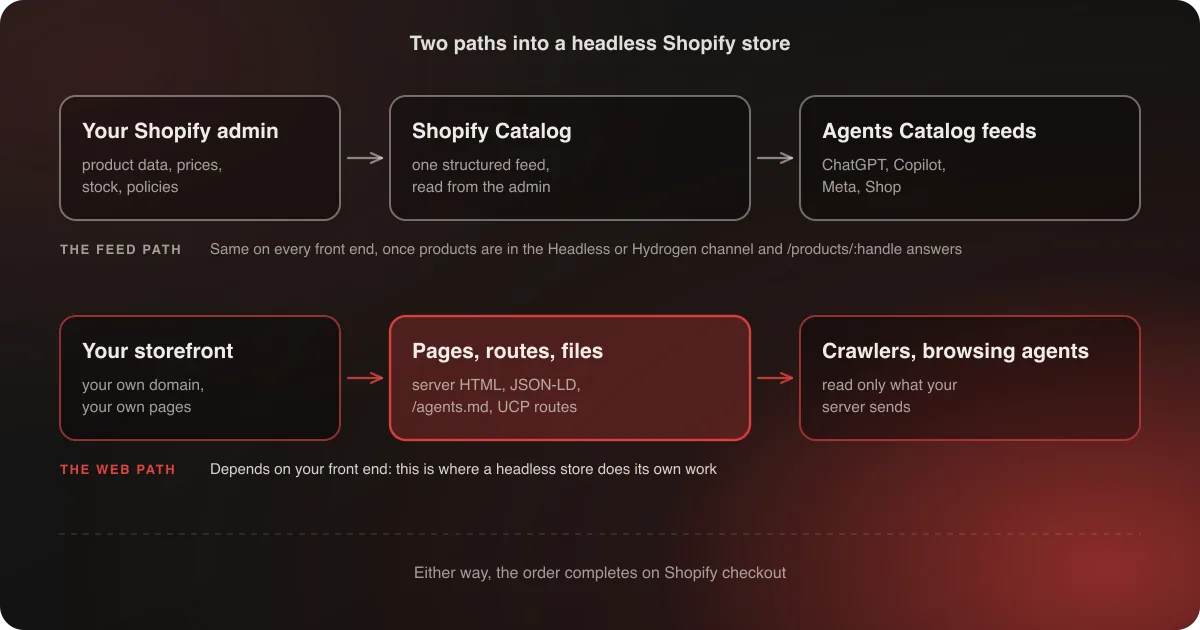
AI agents reach a Shopify store by two paths. Shopify Catalog reads your Shopify back end, not your storefront, so a headless store’s products reach the agents Catalog feeds on the same terms as a theme store’s. The second path runs through your own domain and your own pages, and that is where headless changes what an agent finds. New to the subject? Start with agentic commerce, explained.
Here’s what you’ll find on this page:
- The two paths into a headless store, and the three kinds of headless store
- What Shopify Catalog needs, and the password question Shopify has not answered
- The routes agents send shoppers to, and what your storefront must answer
- What Hydrogen 2026-10 handles, and what other stacks build
- What a headless store loses in Shopify’s Agentic channel
- Whether agents change the headless decision, and what to check first
* For how Shopify Catalog, Agentic Storefronts, and checkout work on every Shopify store, see agentic commerce on Shopify. This page covers only what changes because your storefront is headless.
Do AI agents see a headless Shopify store at all?
Yes, by two paths. Shopify Catalog reads your Shopify product data, not your storefront, so a headless store’s products reach ChatGPT, Copilot, Meta, and Shop on the same terms as a theme store’s. On the second path an agent loads your own pages, and there the front end decides what it finds.
Most of what ranks for this question says either that headless stores are invisible to agents or that they are better placed. Both are half right, about different paths.
- The feed path. Shopify Catalog is built from your Shopify admin, and its responses to agents carry a
/products/{handle}URL and a cart permalink on your shop domain. Shopify’s December 2025 Hydrogen update said headless storefronts “can now be discovered by AI shopping tools like ChatGPT and Perplexity” this way. - The web path. A crawler or a browsing agent loads your pages. Vercel and MERJ measured that “none of the major AI crawlers currently render JavaScript”, among them OpenAI’s, Anthropic’s, Meta’s, and Perplexity’s; Gemini, through Googlebot, does (Vercel, 17 December 2024, the most recent measurement we found). Browsing agents are a third kind of visitor: ChatGPT agent arrives as a Chromium browser.
So a headless store is neutral on the feed path, once its channel and routes are right, and exposed on the web path only where it renders on the client. And on every front end “checkout stays on Shopify” (shopify.dev), so direct checkout carries the same limits as on a theme store.
Three kinds of headless store
Since October 2026 the useful split is no longer Hydrogen against a custom build, because Hydrogen 2026-10 runs inside Next.js and other frameworks. What matters is whether your front end runs its request handlers.
| Your front end | Shopify Catalog (the feed path) | Agent routes on your own domain | Shopify’s WebMCP storefront tools |
|---|---|---|---|
| Hydrogen 2026-10 handlers, on any framework, Next.js included | Same as a theme store, given the channel and the URL format | Served by handleShopifyRoutes(): the UCP profile, the UCP MCP endpoint, /buy, and /cart | On by default where the page renders Shopify’s scripts |
| Classic Hydrogen, 2026-04 and earlier | Same | Not provided by the framework | Not covered |
| No Hydrogen: a custom Storefront API stack | Same | None by default; only what you build or proxy | No documented route |
On all three, checkout is Shopify’s, and Shopify’s Agentic performance report is not available. As of 25 October 2026.
What does a headless store need for Shopify Catalog to carry its products?
A headless store needs its products published to the Headless or Hydrogen channel, a storefront that answers Shopify’s /products/:handle URL or redirects it, and the store gates every Shopify store meets. Whether a password on the unused Online Store is one of those gates, Shopify has not documented.
Shopify’s Catalog requirements add a condition only headless stores meet: “If you’re using Hydrogen or Headless channels, then you must use the correct format for routes to be included in Shopify Catalog.” The format is defined on shopify.dev: “The standard format for product URLs is /products/:handle. If your storefront uses a different structure, then provide a server-side redirect (3XX) from the expected /products/:handle path to the product page.” That is the whole specification: no locale-prefixed variant, and no word on how or when Shopify checks it.
The Hydrogen channel is for “You build with Hydrogen and deploy to Oxygen.” The Headless channel covers “Hydrogen storefronts that you deploy somewhere other than Oxygen, like Vercel” (shopify.dev). So Hydrogen inside Next.js on Vercel publishes to the Headless channel. No Shopify source says Catalog treats the two differently.
Shopify excludes B2B-only products and “Products that require your customers to authenticate themselves on your store before viewing them” (Help Center). A logged-in catalog, a common headless pattern, never reaches an agent through Catalog.
The open question: a password on the Online Store.
Shopify’s requirements say a store “can’t be in private mode”, and list “Your store is password protected” as an ineligibility reason, described as “Your storefront is in private mode, so products can’t be included in Shopify Catalog”, with the action “Remove the online store password.” Headless builds often password-protect the Online Store so the unused theme cannot be browsed or indexed. Shopify has not documented whether that password, on an Online Store no shopper uses, takes a headless store out of Catalog. Beside it sits a documented limit: “Cart permalinks cannot bypass storefront passwords” (shopify.dev), and Catalog’s checkout link is a cart permalink on your shop domain.
What to check: in Sales channels > Agentic, look for an ineligibility reason beside Sources > Shopify Catalog, where Shopify says it shows one. Compare the Catalog product count with the products published to your Headless or Hydrogen channel. Then follow a /cart/{variant}:1 link on your shop domain to its end and see whether it stops on /password. A public UCP profile on the shop domain proves nothing either way.
Every other gate is the same as on a theme store.
Full guide: Shopify Agentic Storefronts, setup, eligibility and every setting →
Is product data in your CMS invisible to agents?
To Shopify Catalog, yes, if it lives nowhere else. Catalog is built from your Shopify product data, so an ingredient list, size guide, or comparison held only in a headless CMS such as Contentful or Sanity does not travel with the product, however well it renders on the page.
No Shopify page says this in so many words, so treat it as a check rather than a rule. On a theme store the same effect shows up in tabs. In one independent test of 50 skincare products (No Hacks, 16 October 2026), the merchants’ pages showed an ingredient list for 36, and Catalog’s text carried one for 5, all of them from the description, because “the catalog does not carry the tab.” A CMS is the headless version of the tab.
The check: list the questions buyers ask about your ten best-selling products, and answer each one from a Shopify field, the description, a metafield, a variant option. Any answer that exists only in the CMS is one an agent reading Catalog cannot give. It is why our composable commerce page warns that moving product data elsewhere changes what AI agents can read.
Full guide: what to put in which field, and how to test what Catalog carries →
Where do agents send shoppers, and what must your storefront answer?
Agents hand shoppers to a product page at /products/{handle}, a cart permalink at /cart/{variant}:{quantity}, or a UCP buy link at /buy/{items}. Checkout stays Shopify’s, so what a headless front end can break is the link that gets the shopper there.
A theme store answers all of these by default. A headless store answers whatever its router was built to answer, and a link that lands on a 404 loses the order before checkout loads.
| Link | Where it comes from | What your storefront must do | The headless catch |
|---|---|---|---|
/products/{handle} | The product URL in every Catalog response | Answer 200, or 3xx to your own product path | Also a Catalog condition. Pages that exist only under a path like /en-us/p/…, with no root redirect, are at risk. |
/cart/{variant}:{quantity} | Catalog’s checkout link, on your shop domain | Hand the shopper on to Shopify checkout | “Selling plans don’t work with cart permalinks” and “Cart permalinks cannot bypass storefront passwords” (shopify.dev). |
/buy/{items} | UCP buy permalinks, declared in your store’s UCP profile | Forward to Shopify, path and query untouched | Shopify documents no answer on whether a buy link carries a selling plan. |
/products/{handle}?variant={id} | Liquid-style variant links | Resolve to the right variant | Hydrogen 2026-10 redirects these for you; a custom router has to. |
continue_url | An agent’s checkout session over UCP, when the buyer has to finish | Pass it on if it lands on your domain | Shopify does not document which domain it uses on a headless store: yours, a checkout subdomain, or myshopify.com. |
Our reading: the safe pattern is an unprefixed /products/{handle} answering 200 or 3xx at the root of your primary domain, with /cart/{variant}:{quantity} handed on from the same root. Locale prefixes are the usual way to miss it, and in Hydrogen’s own source, as of 24 October 2026, the cart-permalink pattern accepts none. Subscription brands need one more check: a cart built through the Storefront API with a selling plan survives a cart-token checkout link, but an agent or link builder that falls back to a variant permalink drops the subscription. That is true on a theme too; headless subscription builds lean on Storefront API carts more than most.
What does Hydrogen 2026-10 handle for you?
Hydrogen 2026-10, released in October 2026, is a library rather than a framework of its own. One call, handleShopifyRoutes(), serves the UCP profile, the UCP MCP endpoint, the /buy and /cart permalinks, and Shopify’s WebMCP tools, inside Next.js, Nuxt, Astro, React Router, or any JavaScript server.
The package reached npm on 9 October and Shopify announced it on 14 October 2026. Hydrogen now “works with frameworks that run server code, like Next.js, React Router, Nuxt, Astro, and SvelteKit, leaving routing, rendering, and UI to them”, and its core “depends only on fetch and other web platform APIs” (shopify.dev). The two templates are React Router 7 on Oxygen and Vercel Shop, a Next.js 16 storefront. “You can host it anywhere, including Oxygen, which is still free.”
| Route | What Hydrogen 2026-10 does |
|---|---|
/.well-known/ucp | “Proxies your store’s UCP discovery profile”, so an agent that starts at your domain finds it |
/api/mcp, /api/ucp/mcp | “The storefront’s MCP endpoints for agents” |
/buy/{itemId}:{quantity} | “Buy permalinks for agentic commerce”, forwarded with a 303, path and query untouched |
/cart/{variantId}:{quantity} | “Cart permalinks that redirect to your store’s domain” |
/products/{handle}?variant={id} | “Redirects Liquid-style variant URLs to option parameters” |
/__shopify/*, AJAX cart URLs, /api/{version}/graphql.json | The URLs Shopify’s browser modules, theme apps, and storefront actions call |
Source: Wire Hydrogen request handlers and the Hydrogen changelog, read 25 October 2026.
Three details matter in practice. Route templates map Shopify’s standard paths onto your own, so a store whose product pages live at /p/{handle} still answers /products/{handle}. On Next.js, Shopify says to keep the proxy’s matcher broad: “Don’t narrow it to a list of Hydrogen paths, because that list goes stale when Hydrogen adds routes.” That is Shopify telling you it will keep adding them. And WebMCP is on by default on “Hydrogen 2026-10 storefronts that render ShopifyScripts or call initializeShopifyScripts”, though “agent support for WebMCP is currently limited to Chromium-based browsers” (shopify.dev). When we checked on 25 October 2026, Vercel’s own template answered /.well-known/ucp, /api/ucp/mcp, and /buy live.
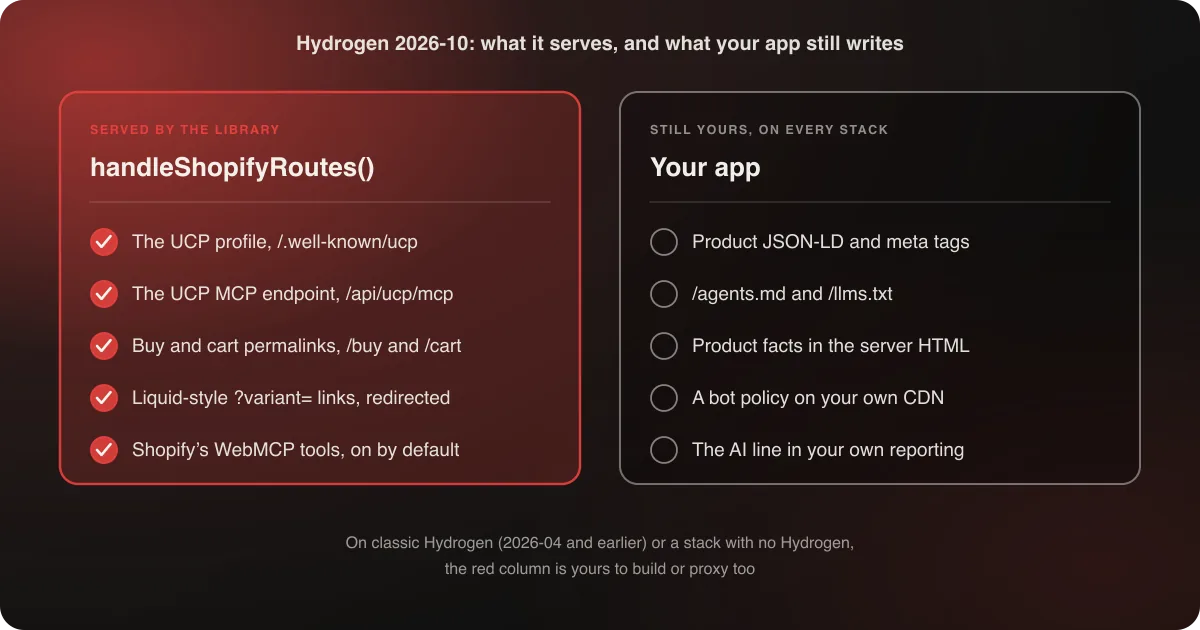
What it leaves to the app, in Shopify’s words: “Meta tags, Open Graph tags, and structured data”. It does not serve /agents.md or /llms.txt: the only well-known files it passes through are Apple Pay’s domain file and the collector WebMCP analytics use. Its packaged “agent skills” teach coding agents to build with it; they are not a shopping-agent feature.
What if you’re on classic Hydrogen, or no Hydrogen at all?
Classic Hydrogen, 2026-04 and earlier, does not provide the UCP routes from the framework, and a stack with no Hydrogen serves none of them by default. Shopify still serves your UCP profile on its own domains, but an agent that starts at your domain finds nothing there.
Classic Hydrogen, and what happened to /api/mcp
The only agent route the 2026-04 line ever had came in 2026.1.4, in April 2026: “Hydrogen now automatically proxies requests to /api/mcp to Shopify’s Storefront MCP server.” No later entry in that line, through 2026.4.8 on 21 October 2026, mentions UCP, /.well-known/ucp, /buy, or WebMCP (2026-04 changelog). Shopify then took the tools away from that endpoint: the Storefront MCP catalog and cart tools “were removed. Use the Universal Commerce Protocol (UCP) instead” (shopify.dev), the cart tools after 31 August 2026. So those tools moved to /api/ucp/mcp; the /api/mcp path is still routed, and Shopify’s Customer Accounts MCP server is unchanged. (Shopify’s own classic demo store does answer the UCP routes, and nothing public says what supplies them, so the precise claim is that the classic framework does not.)
The upgrade is documented: a Remix store moves to React Router 7 on the way, the Storefront and Customer Account APIs move to 2026-10, and the analytics API changes. Know one patch before you touch anything: 2026.10.2 restored an export because “Projects on 2026.4 whose ^2026.4.0 range resolved to 2026.10 previously failed at ESM link time.” Pin ~2026.4.0 until the migration is planned.
No Hydrogen at all
None of Shopify’s bring-your-own-stack libraries is described as providing agent routes, and Shopify staff have been clear about the limits: “you shouldn’t need to host your own UCP profile or MCP server… there isn’t currently a supported way to edit or replace that profile, or add custom tools and endpoints to Shopify’s MCP server” (27 July 2026). Discovery through Catalog, or through your Shopify domains, survives on any stack. What a custom origin loses is the agent that starts at your own domain.
| Priority | What to build |
|---|---|
| Must | /products/{handle} answering 200 or 3xx; /cart/{variant}:{quantity} handed on to the shop domain, from the root |
| Should | Proxy /.well-known/ucp unmodified and /api/ucp/mcp; forward /buy/{items} the way Hydrogen does; resolve ?variant=; write /agents.md and /llms.txt; server-render product facts with JSON-LD; set a bot policy that admits signed agents |
| Can’t, today | Load Shopify’s storefront WebMCP tools by any documented route; customize the UCP profile; get the Agentic performance report |
Shopify documents no proxy contract outside Hydrogen, for headers, caching, or authentication, so Hydrogen’s source is the working specification. That is the strongest argument for importing the library rather than rebuilding it, and any JavaScript server can.
Can agents read and use your headless pages?
They read what your server sends. Most AI crawlers, as last measured in December 2024, do not run JavaScript, so product facts, structured data, and discovery files have to be in the HTML your origin serves, and on a headless store your app writes all three.
The pillar calls the open web the fallback for a product that misses Catalog. On a client-rendered headless store even that fallback fails for the crawlers that do not render. Four things decide it.
The same study says it directly: “Prioritize server-side rendering for critical content” (Vercel, 17 December 2024). Hydrogen renders on the server, so the risk sits in single-page apps and in widgets that load price, stock, or reviews in the browser, not in Hydrogen itself.
The Storefront API returns data, not markup. Product JSON-LD is the app’s job on every headless stack, Hydrogen 2026-10 included.
On a theme store “Shopify manages an agents.md file by default for every store”, and /llms.txt mirrors it (shopify.dev). On a headless store that managed file describes the Shopify-hosted domain, not your front end, and where the Online Store is password-protected it redirects to /password. Your headless origin serves neither file until someone writes it.
Shopify tells agents that “hosted or remote browsers must use Web Bot Auth”, and its own bot handling covers “Shopify-hosted online store pages” (shopify.dev). The bot rules on your own CDN are yours, and they can block a signed agent a theme store would admit.
For browsing agents, WebMCP turns the page into actions in the shopper’s own tab. Its storefront tools need Liquid or Hydrogen 2026-10. Shopify’s WebMCP checkout tools, added on 28 September 2026, “run inside checkout-web… don’t expose a new API or require merchant configuration” (shopify.dev), so they reach headless stores too, because checkout is Shopify’s. Shopify publishes no usage figures for WebMCP, so treat it as early infrastructure.
What does a headless store lose in Shopify’s Agentic channel?
A headless store loses the Agentic performance report. Shopify says “Agentic storefronts performance analytics aren’t yet available for headless stores”, so a headless brand builds its AI line from channel attribution, Shopify’s analytics events, and the parameters agents pass into checkout.
On a theme store the Agentic channel reports sales, orders, sessions, and conversion for each AI platform (Help Center). On a headless store, as of 25 October 2026, it does not. Three sources remain:
- Channel attribution. “Sales attributed to the Headless channel are displayed as the name of the Storefront through which the sale was made” (shopify.dev).
- Shopify analytics events, where Hydrogen’s scripts render: “Hydrogen sends the same events that Liquid themes send” (shopify.dev).
- The attribution fields agents pass. Agents may “Append query parameters to
continue_urlfor attribution, such as UTM tags”, and a UCP checkout accepts a referring domain and UTM fields (shopify.dev).
Two traps are specific to headless. Hydrogen forwards /buy links with Referrer-Policy: no-referrer, so a buy-link handoff arrives with no referrer and the source has to ride on query parameters. And a single-page app that records only the first page’s referrer, or a consent gate that holds analytics back, undercounts AI referrals with no Shopify report as a backstop. Orders placed inside an agent fire only Shopify’s server-to-server checkout events on every front end, headless or not.
Full guide: measuring AI traffic on Shopify, and reconciling it with GA4 →
Should agentic commerce change whether you stay headless?
Not on its own. Agents are no reason to go headless, and on their own no reason to leave. They add a recurring cost at the edges of a headless store, which Hydrogen 2026-10 now mostly absorbs for JavaScript stacks.
This is our reading of the evidence above. Two facts frame it. The inputs Shopify names for ranking, data quality, relevance, availability, price, and engagement, do not depend on the front end. And no brand we know of has said publicly that it left headless because of AI agents; the exits on record were about content operations and cost. So architecture changes the cost of the edges, not whether a brand is chosen. Every option shares a floor: the channel, the routes, the password, and agent orders as a reportable line. Above it, the choice is three-way.
The must-do set is small: the product route and the cart handoff. Against it: Shopify ships no agent-route library outside Hydrogen and documents no proxy contract, there is no supported route to the storefront WebMCP tools, and every protocol change lands on your engineers. In 2026 that meant the Storefront MCP tools moving to UCP and UCP 2026-08-25, both absorbed by theme stores with no merchant action. Right for a back end that is not JavaScript, or a team that declines the dependency.
One handler call covers the agent routes and WebMCP, and Shopify rather than your team absorbs the next route change. A Next.js team keeps its pages. Against it: an API-version bump, analytics changes, a move off Remix for older stores, and a library a few weeks old. The obvious move for a server-rendered Next.js or classic Hydrogen store whose headless reasons still hold; check the current version the day you start.
Every agent surface arrives without configuration: the managed discovery files, UCP on your own domain, WebMCP storefront tools on every Liquid storefront since 5 August 2026, and the Agentic report. Against it: it is a front-end replatform, it gives up whatever headless was for, and it does not make you likelier to be chosen. A tiebreaker for a brand whose content, cost, or ownership reasons already argue for leaving.
One concession, because it makes the rest credible. We have long argued that most direct-to-consumer brands do not need headless, and the agent lag modestly strengthens that. But “headless means rebuilding everything yourself” is much less true for JavaScript stacks in October 2026 than it was a year ago, because Shopify and Vercel have turned the agent plumbing into a library. Anatta runs headless Shopify builds where the reasons hold, and has taken others off headless.
The general decision, performance, total cost, and who owns what, is argued in the pros and cons of headless commerce and on our composable commerce page. If you have already decided to leave, start here.
What should a headless brand check first?
Six checks, in this order: the channel count, the password, the routes on your primary domain, your Hydrogen version, the facts that live only in your CMS, and what a product page sends before any JavaScript runs. Most take minutes, and the first two decide whether your products reach Catalog at all.
Products published to the Headless or Hydrogen channel against active products, then the Shopify Catalog count in Sales channels > Agentic. The gap is the first number.
If the Online Store is password-protected, look for an ineligibility reason beside Shopify Catalog in the Agentic section, and follow a cart permalink to its end. See the open question above.
/products/{handle}, /cart/{variant}:1, /buy/{variant}:1, /products/{handle}?variant={id}, and /.well-known/ucp, each checked for its status code and where it ends up.
@shopify/hydrogen at 2026.10 or later, or not. If you are on 2026.4, check that your version range cannot resolve onto the rewrite by accident.
For your ten best-selling products, answer every buyer question from a Shopify field. Whatever only the CMS holds, an agent reading Catalog cannot say.
On a product page, title, price, availability, and description present in the initial HTML, with product JSON-LD beside them.
More on agentic commerce
This page covers the headless differences. The pillar covers the rest, and the guides below go deeper on what this page summarizes.
Common questions
Do I need Hydrogen for my headless store’s products to appear in ChatGPT?
No. Shopify Catalog needs your products published to the Headless or Hydrogen channel and your storefront answering Shopify’s /products/:handle URL format, or redirecting it. Hydrogen only saves you building the agent routes on your own domain.
Does Hydrogen work with Next.js now?
Yes, since Hydrogen 2026-10 in October 2026. It is a library that runs inside Next.js, Nuxt, Astro, React Router, and other JavaScript servers, and Vercel Shop is a Next.js 16 storefront built on it. A Hydrogen store hosted on Vercel publishes to the Headless channel, not the Hydrogen channel.
Is Shopify’s Agentic performance report available for headless stores?
No, not as of 25 October 2026. Shopify’s Help Center says agentic storefronts performance analytics are not yet available for headless stores, so the AI line has to be built from channel attribution and your own analytics.
Can my headless store’s Online Store stay password-protected?
Shopify has not documented the answer. Its Catalog requirements list “Your store is password protected” as an ineligibility reason, but do not say whether that covers a password on the Online Store of a headless build. Check Sales channels > Agentic for an ineligibility reason beside Shopify Catalog, and compare its product count with what your Headless or Hydrogen channel publishes.
Can I customize my store’s UCP profile or add my own MCP tools?
No. Shopify staff said on 27 July 2026 that there is no supported way to edit or replace the UCP profile Shopify generates, or to add custom tools to Shopify’s MCP server.
Where does /.well-known/ucp come from on a headless domain?
Shopify generates it. Hydrogen 2026-10 serves it from your own domain; without Hydrogen your domain serves nothing at that path unless you proxy it, though the profile stays live on your shop’s Shopify domains.
What happened to /api/mcp?
Its Storefront MCP catalog and cart tools were removed in favor of UCP at /api/ucp/mcp. The path itself still exists, Hydrogen 2026-10 routes both, and classic Hydrogen, from 2026.1.4, proxies only the old one.
Does going headless make a store better for AI agents?
No. The inputs Shopify names for ranking, data quality, relevance, availability, price, and engagement, do not depend on the front end, and a headless store has more to build to match what a theme store gets by default.
Find out what an agent sees when it reads your store.
Bring us your storefront URL and we’ll read it the way an agent does: the structured data on your product pages, the policies it would quote, and the questions your catalog cannot answer. On a headless store we also walk the routes agents send shoppers to. Give us collaborator access to the Agentic channel and we add the inside view, which products Catalog carries and what the search preview ranks for your ten best queries. A written preview, not a proposal.
If you would rather read first, Shopify’s own guide to headless storefronts is the place to start.
Who publishes this
Anatta is a Shopify Plus agency based in Austin, Texas, a Shopify Platinum Partner, and Shopify-only since 2014. We build and run storefronts for direct-to-consumer brands, on themes and on headless builds, and we move brands between the two when the reasons change. This page is kept against Shopify’s own documentation and the Hydrogen changelog and re-read quarterly, because Shopify rebuilt Hydrogen the month this page was written.