




















What changed in eCommerce when the agents arrived
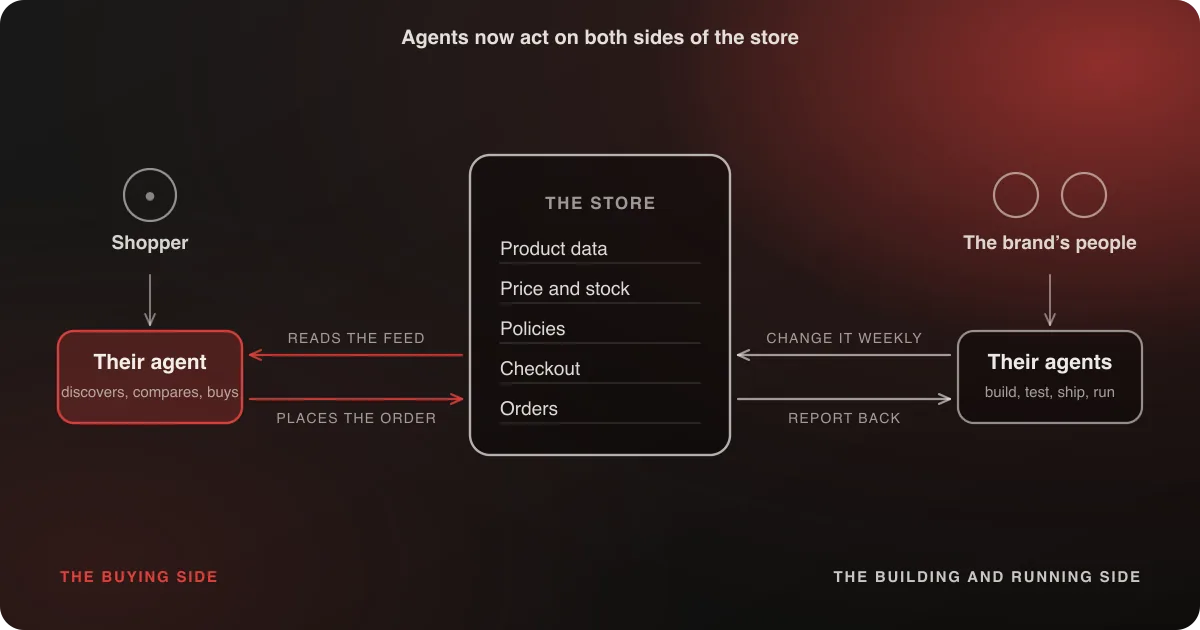
AI now acts on both sides of a store. An agent shops it for your customer. Agents build and run it for you. The two halves arrived together, and they meet in the same place: your product data.
Here’s what you’ll find on this page:
What are the two halves?
The two halves are the buying side and the building side. On the buying side, agentic commerce: an AI agent discovers, compares, and buys on the shopper’s behalf. On the building side, Agentic Delivery: agents and senior people scope, build, test, change, and run the store the shopper’s agent buys from.
The industry’s term, agentic commerce, names the first half, and that is how this site uses it too. The second half has no industry name yet, because it is not a market, it is a way of working. What this page argues is that the two arrived together, meet in the same place, the product data, and are planned for together or badly: a brand that prepares for one half and not the other prepares for half a shift.
For fifteen years eCommerce meant a human visiting your pages, and everything a brand built existed to get that person to a checkout. Now the visitor is often software, and so is the builder.
“Agent” defined
An agent is software given a goal rather than an instruction; on its own, it works out the steps needed to complete a goal, and carries out those steps across systems. An agent reads, decides, acts, checks the result, and runs through the process again. Whereas a chatbot answers a user’s question, an agent acts on the user’s behalf. “Agentic” describes anything that’s built to help agents complete their goal. The shopper’s assistant that finds and buys a product is one agent. The system that drafts, tests, and ships a storefront change is another.
| The buying side | The building side | |
|---|---|---|
| Who acts | An AI agent, on a customer’s behalf | AI agents and senior people, on the brand’s behalf |
| What it does | Discovers, compares, buys, tracks the order | Scopes, builds, tests, ships, iterates, reports |
| What it reads | Product data, price, stock, policies, reviews, checkout | Requirements, the theme, the data, the backlog |
| What changes for a brand | Being chosen, not just present | Weeks instead of quarters, and continuous change |
| Where it is explained | Agentic commerce on Shopify | Agentic Delivery |
How did we get here?
The buying side arrived in four steps: assistants that could talk (2022), assistants that could shop (2024), rails that let them pay (2025), and platforms that put every store in front of them (2025 to 2026). The building side ran on a parallel track and arrived at the same time.
None of this history started with ChatGPT. Voice assistants took spoken reorders in the mid-2010s and code assistants were finishing developers’ lines by 2022. What changed in the last two years is that the assistant stopped answering and started acting: shopping, paying, and on the other side of the store, building.
| When | Buying side | Building side |
|---|---|---|
| 2014 to 2016 | Voice assistants take the first spoken reorders. Novelty, not a channel. | |
| 2022 | ChatGPT, November. The assistant everyone talks to arrives. | Code assistants finish developers’ lines in the editor. |
| 2023 | Shopify puts an assistant, Sidekick, in the merchant admin. | |
| 2024 | Amazon’s Rufus and Perplexity’s shopping start recommending and buying. The Model Context Protocol gives agents a standard way to reach other systems. | Coding agents move from suggesting lines to doing tasks. |
| April 2025 | Visa and Mastercard launch agent payment rails: tokenized card credentials an agent can use within limits the shopper sets. | Shopify Horizon ships with AI-generated theme blocks. |
| September 2025 | OpenAI and Stripe publish the Agentic Commerce Protocol; Google publishes AP2. Instant Checkout launches inside ChatGPT. | |
| December 2025 | Shopify launches Agentic Storefronts and Shopify Catalog: every eligible store syndicated to the agents by default. | |
| January 2026 | Google and Shopify announce the Universal Commerce Protocol at NRF. | |
| March 2026 | OpenAI pulls back Instant Checkout. Discovery stays in ChatGPT; the order completes on the merchant’s store. | |
| 2026 | Agents can see compare-at prices (October). Direct checkout in Google, Copilot, and Meta, on by default for eligible stores. | Agentic Delivery ships Dose Daily in 30 days, Dropps in four weeks, and Good Ranchers in eight. |
Two things in the table above matter more than the dates. The protocols arrived before the behavior: the rails exist, and about half of consumers still will not let an agent finish a purchase. And the first retreat came inside six months of the first launch. This is a subject that revises itself, which is why every page in this cluster carries the date it was last read.
What changed for the shopper?
The shopper no longer browses. They state what they want to ChatGPT, Gemini, Copilot, or Perplexity, and the agent reads the catalogs, compares products, surfaces the most relevant options, and then either makes the purchase itself or hands back a cart ready for payment.
The shopper never sees your homepage, your hero banner, or your pop-up. The agent sees your product data, your prices, your stock, your shipping terms, your policies, your reviews, and your checkout. An agent answers with a handful of products instead of a page that lists 40 products, and it ranks them on data quality, relevance, availability, price, and engagement.
The plumbing is arriving platform by platform. Every agent needs the same three things from a store: a feed of its products it can read, a way to place the order, and a way to follow the order afterwards. The open checkout protocols (UCP from Google and Shopify, ACP from OpenAI and Stripe, now co-maintained with Meta) are standardizing the order and the follow-up; the feed is what each commerce platform now ships, and it is furthest along on Shopify, where Shopify Catalog syndicates every eligible product to agents by default. On other platforms the same job is assembled from merchant feeds and protocol integrations.
Whatever the platform, being present got easy and being chosen did not. The work that decides whether a product is chosen is in the catalog, the policies, and the product data, not on the page.
How it works on Shopify, channel by channel, with the data →
What changed for the team that builds the store?
The repetitive engineering moved to agents and the decisions stayed with people, so a storefront is scoped in weeks, shipped in days, and changed continuously instead of in quarterly releases.
The old shape of a storefront project was a quarter of discovery, a quarter of build, a launch, and a backlog nobody got to. What agents take off the table is the part that made it slow: the drafting, the regression testing, the migration scripts, the theme work that is the same on every store, the QA pass that was never thorough because it was manual. What they do not take is the judgment about what to build, and the accountability for it. That is Agentic Delivery, and it is how every Anatta project ships now.
What that looks like in shipped work
A Horizon rebuild, header to checkout, and a deployment pipeline, against a three-month plan.
Dose Daily, 2026.
A rebrand and a catalog rebuild, shipped together.
Dropps, 2026. How the theme migration ran.
Speed is the visible change. The one that matters more is what happens after launch: a store that can be changed every week is run differently from one that is changed every quarter. Merchandising stops waiting for a release. Tests run continuously instead of before a launch. The backlog stops being a graveyard.
What changed for the team that runs the store?
Less changed than the vendors say and more than the skeptics admit: the work of running a store is being rewritten one function at a time, and the functions closest to data have moved furthest.
Eight functions run a store once it is built. Here is where the agents have reached in each, said as plainly as the evidence allows.
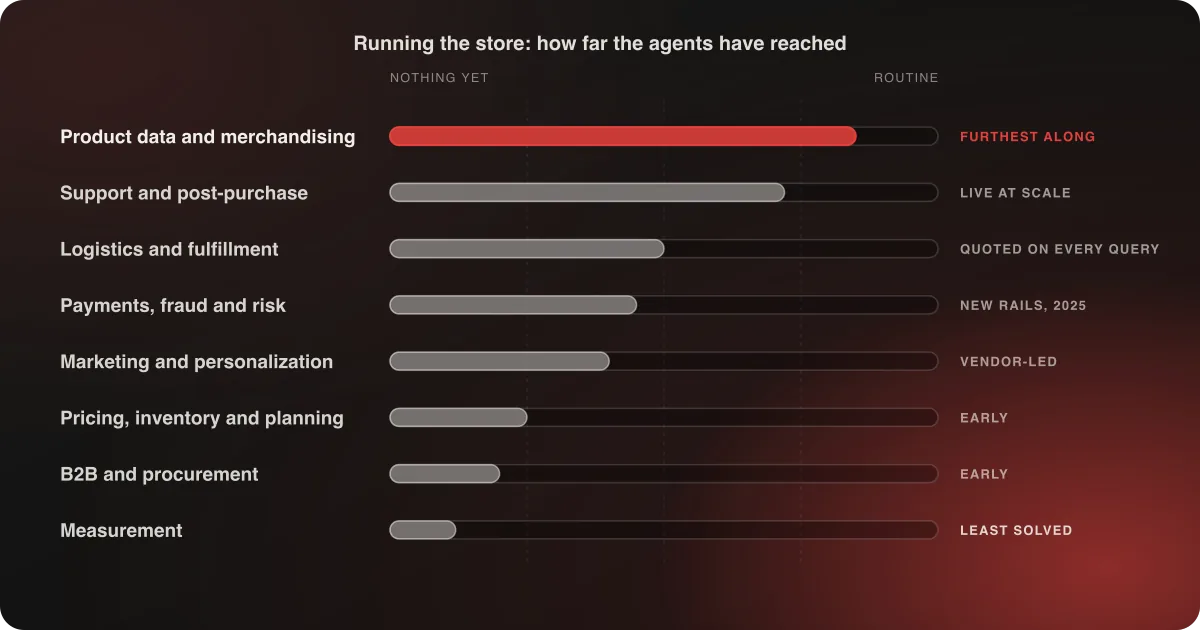
Product data is the furthest along, because it is where both sides meet. Attributes, taxonomy, variants, and metafields are now written for two readers, the shopper and the shopper’s agent, and agents are good at the rewriting. The discipline, written for a replatform.
Returns, shipping updates, and order questions are the first customer-facing tasks agents took on at scale. Across the 2025 holiday season Salesforce counted retailers’ agents handling 142% more such tasks than in the two months before it. The brand’s policies become the script, which is why they now need to be written for a machine to quote. The support and sales agents, compared for Shopify Plus.
The shopper’s agent weighs the delivery promise and the landed cost on every query, and reads order status back from the platform to tell the customer where the parcel is. So the fulfillment data, estimated dates, carrier status, return windows, is now quoted by a machine, and a promise the warehouse cannot keep loses the next sale. Inside the warehouse, agent-run planning is still mostly vendor claims.
Payment rails arrived in 2025: Visa and Mastercard launched agent credentials that work within limits the shopper sets, and the checkout protocols tie each payment to one merchant and one basket. The open problem is on the brand’s side of the ledger: fraud models built to spot a bot now have to tell a customer’s agent from an attacker’s. Who carries the chargeback on Shopify.
Creative, segmentation, and testing are being automated fast, and the evidence is mostly vendor-published. What has clearly changed is the channel mix: an agent-referred visitor converts better and spends more than the average visitor, which moves budget whether or not anyone automates anything. Where personalization stood before agents.
Pricing, inventory, and planning are early. What has changed already is transparency: an agent compares landed cost across merchants on every question, so pricing built for a shopper who sees one store at a time stops working. Agent-run demand planning and replenishment are in pilots and vendor decks, not yet in results a brand can check.
B2B and procurement are early. The protocols were written for consumer checkout first, and a buyer’s procurement agent running reorders and quote requests exists in pilots. The same product-data work applies, with price lists, terms, and account rules added, and the brands that sell to businesses will meet it next.
Measurement is the least solved. Client-side pixels do not fire on an order placed inside an agent, attribution for agent orders is partial everywhere, and the CRO practice of the last decade assumes a human on your pages. The honest move is to make agent-sourced orders a reportable line now, while they are small. How to measure it on Shopify.
How sure we are differs by card, and the page says so rather than rounding up. Product data, support, and measurement are described from published figures and from the admin screens that show them. Logistics and payments are described from what the agents and the rails demonstrably do today. Marketing, pricing, and B2B are described from pilots and vendor claims, and read accordingly. The pillar pages for the running side will publish as the evidence does.
Are the two halves real yet, or still a forecast?
The building side is simply how work ships now. The buying side is live, growing fast off a small base, and converting better than the traffic it displaces, while autonomous checkout is partly live, partly retreated, and the checkout protocols underneath have not merged.
The data, as published
AI-driven traffic and orders to Shopify stores, year over year, in the second quarter of 2026.
Harley Finkelstein, Shopify Q2 2026 earnings call, 5 August 2026. Platform-wide, off a small base.
Higher conversion rate for AI-referred visits than non-AI visits to US retail sites, for the eleventh straight month in July 2026.
Adobe Analytics. In March 2025 the same traffic converted 38% worse.
More revenue per visit from AI-referred shoppers than from other shoppers.
Adobe Analytics, July 2026.
Of the 2025 holiday season’s $1.29 trillion in global online sales that Salesforce says AI and agents drove: 20% of the total.
Salesforce. “Drove” covers influence anywhere in the journey, not checkout by an agent.
Of US consumers use generative AI to research and compare products before they buy. About half are not ready to let it complete the purchase.
Bain Consumer Lab, March 2026.
Implementation predictability, the figure Anatta publishes on its own delivery, across $4B+ of GMV migrated to Shopify.
Anatta, running figures. The building side, measured on our own work.
The forecast everyone quotes, McKinsey’s $3 to $5 trillion of agent-touched consumer commerce by 2030, counts anything an agent touches anywhere in the chain. It is a projection, not measured revenue, and it should not be read alongside the measured figures above. What nobody has published yet is a year-one figure for a single brand: what share of orders arrived through an agent, at what margin, against what it cost to get there.
What should a brand do this year?
A brand should do five things this year, across both sides, in this order: count what the agents can see, fix the product data, decide direct checkout per channel, change how the storefront ships, and make agent orders a reportable line.
Products in the feed the agents read against products in the store, then whatever preview your platform gives you, with the ten queries your best customers would type. On Shopify that is Catalog and the search preview in the Agentic channel; elsewhere it is the merchant feed and the platform’s own tooling. The gap is the first number, and no platform reports it.
Attributes in fields, one variant model, standard taxonomy, policies and FAQs the agent can quote. A catalog that reads well to an agent reads better to Google and to a person too.
In writing, with the retention and margin owners in the room. Shopify turns it on by default, so the question is whether to leave it on before upsells, subscriptions, and loyalty have an answer for orders that never reach your site. How to decide.
If your store still changes quarterly, the buying side will outrun it. The build model is the half of this shift a brand controls completely, and the one with the shortest path to a result.
Agent-sourced sessions and orders as their own line, in the commerce platform and in analytics, so the baseline exists when the numbers are no longer small.
Where each half is explained
This page is the frame. The depth is on the pages below, and the guides in the cluster are listed on the hub.
Common questions
Is agentic commerce the same as Agentic Delivery?
No. Agentic commerce is when an AI agent shops online on a person’s behalf: ChatGPT, Gemini, Copilot, Perplexity, or a retailer’s own assistant discovers, compares, and ultimately buys a product. It is the industry’s term and the meaning this site uses. Agentic Delivery, powered by Anatta Operating System (AOS), is the brand’s side: how a store is scoped, built, tested, and changed when agents do the repetitive engineering and senior people own the decisions. This page exists because the two arrived together.
Do I need to do anything to appear in ChatGPT?
Whether you need to do anything to appear in ChatGPT depends on your commerce platform. On Shopify, eligible products are already syndicated through Shopify Catalog with nothing to install. On other platforms the products reach the agents through a merchant feed or a protocol integration that someone has to set up. On every platform the work that decides whether an agent picks a product is the same: how many are eligible and how well they are described.
Is this only relevant to Shopify brands?
No. Agentic commerce is not limited to Shopify: agents read every store they can reach, and the protocols are platform-neutral. Shopify is where the buying side is furthest along for a brand of ordinary size, because Catalog and Agentic Storefronts do the syndication; on other platforms the same work is assembled from feeds and integrations. The building side is platform-neutral too: it is a way of working, not a product.
How fast is this actually growing?
Across US retail, Adobe measured AI-referral traffic up 62% year over year in July 2026 and up 1,219% since October 2024. On one platform, Shopify reported AI-driven traffic and orders tripling year over year in the second quarter of 2026. Both are steep growth off a small base.
Should I be worried, or should I be early?
Be early. The catalog work is cheap, it improves the store for every reader, and the numbers are still small enough that few brands are competing for them. The building side is entirely in your control and pays back on the next project.
Bring us one thing an agent should be doing for you.
A catalog you suspect the agents cannot read. A storefront change that has been waiting a quarter. A number nobody can report. We’ll come back with a preview, not a proposal.
If you would rather read first, start with the buying side or the building side.
Who publishes this
Anatta is a Shopify Plus agency based in Austin, Texas, a Shopify Platinum Partner, and Shopify-only since 2014. We build and run storefronts for direct-to-consumer brands including Rothy’s, AG1, Dollar Shave Club, Mack Weldon, and True Botanicals, and every project ships through Agentic Delivery. This page is kept against the publishers it cites and re-read quarterly, because the subject reversed itself once already in 2026.