












Salesforce Commerce Cloud to Shopify Migration
September 3, 2026
Salesforce Commerce Cloud migrations tend to carry the heaviest custom-to-custom risk of any origin platform, because SFCC implementations are almost always extensively customized at the enterprise level. The method doesn't change. The audit matters more here than almost anywhere else.
If a renewal conversation or a price increase is what put this on your calendar, that's the trigger with the most lead time — and the one best positioned to run a rigorous comparison rather than a rushed one.
Last verified: September 6, 2026.
What's actually specific to SFCC
SFCC, formerly Demandware, is built for large enterprise deployments and is almost never run out of the box. Most implementations involve substantial custom cartridges — SFCC's module system — built over years. Extracting data from an SFCC instance requires understanding its specific data model, but that's a much narrower task than understanding everything the custom cartridges do.
That distinction is the whole argument of this page. The data model is finite and documented. The cartridge estate is neither, and treating the second as a prerequisite for the migration is how an SFCC replatform turns into a multi-quarter archaeology project before a single thing gets built.
Why SFCC is where the custom-to-custom trap does the most damage
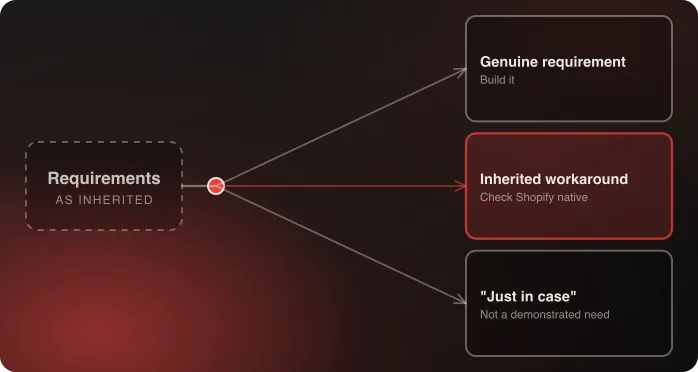
Because SFCC implementations are so consistently heavily customized, the temptation to treat "replicate our current cartridges" as the migration spec is at its strongest here. This is exactly backwards: the more customized the origin platform, the more valuable — not less — the audit that separates genuine requirements from platform-specific workarounds.
Run the full audit before finalizing scope, especially coming from SFCC. A cartridge estate quoted as-is produces an RFP that every vendor prices against the same padded spec, which makes the bids look comparable while guaranteeing that whoever wins builds the wrong thing.
A pattern specific to SFCC merchants
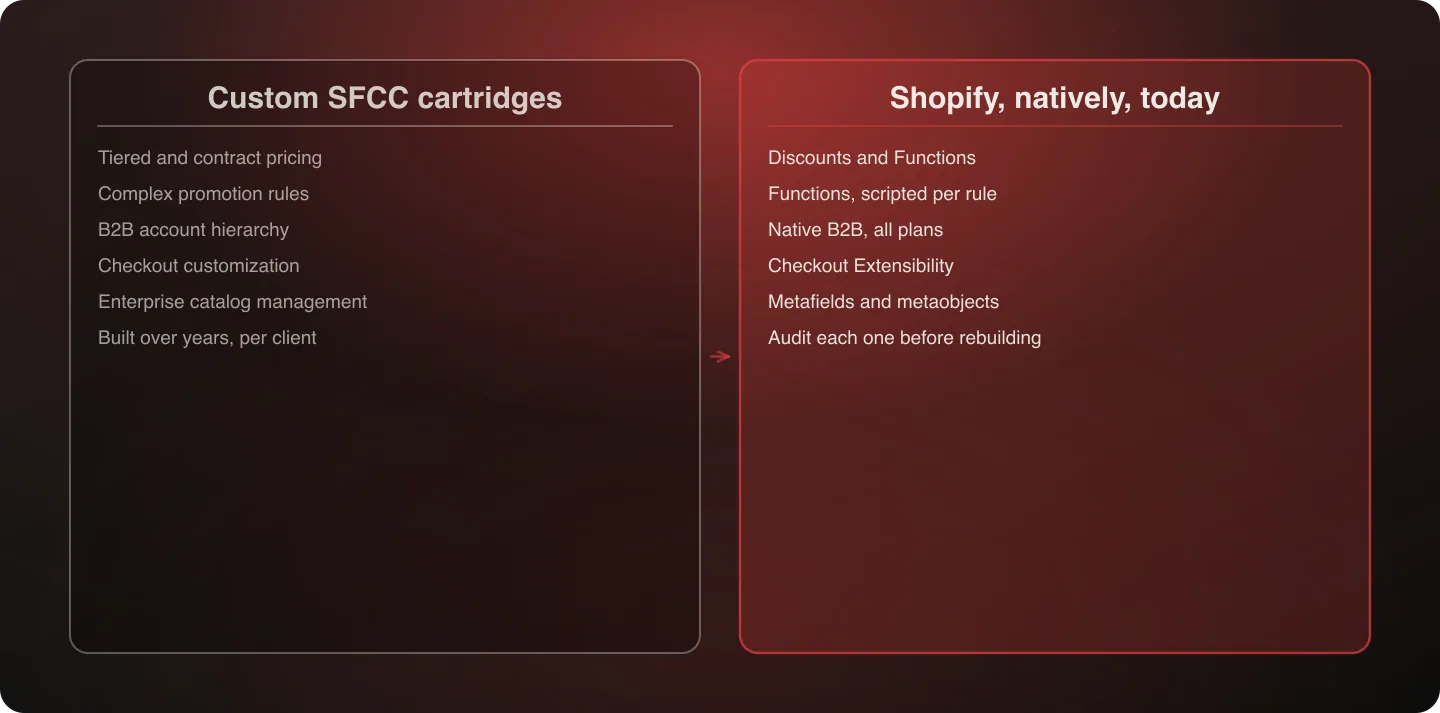
Many SFCC implementations include custom logic for enterprise-scale catalog management and complex promotion rules that predates Shopify's current native capability. Before assuming that logic needs a one-to-one rebuild, check it against Shopify's current Functions and discount capabilities. The platform's ceiling here has risen substantially, and a rule that required custom cartridge development several years ago may not require custom Shopify development today.
The categories worth checking first, because they're the ones most often assumed to need custom work:
- Tiered and contract pricing — check against native B2B price lists and Functions before specifying a custom pricing service.
- Complex promotion stacking — Shopify Functions handle a substantial share of what cartridge-based promotion engines were built for.
- B2B account hierarchy — native B2B was extended to all plans as of April 2026, which changes an assumption many SFCC scoping documents still carry.
- Checkout customization — Checkout Extensibility covers considerably more than the older scripts model did, and considerably more than most legacy specs assume.
- Catalog attribution and merchandising rules — metafields and metaobjects cover a large share of what bespoke catalog structures were built to hold.
Why renewal timing shouldn't drive the decision alone
SFCC licensing is typically structured around multi-year contracts with renewal dates that create their own pressure. A renewal deadline is a timing consideration, not a substitute for the discovery and audit work that determines whether the migration goes well.
Rushing discovery to hit a contract date is a common and avoidable source of exactly the custom-to-custom problems this page warns about, because a compressed discovery phase has less time to separate genuine requirements from cartridge-based workarounds. If the renewal date is genuinely immovable, compress discovery by running its workstreams in parallel with more people — not by cutting the audit. The week-by-week walkthrough shows which parts parallelize and which don't.
Third parties on SFCC migrations
Enterprise-tier integrations connected to SFCC — ERP, WMS, complex tax engines — are frequently sophisticated, purpose-built connections. The integration method changes, but the underlying system is usually a strong keep candidate, following the standard framework. Rebuilding the connector is expected work. Replacing the system behind it usually isn't.
What's actually been happening with Salesforce Commerce Cloud
If rising licensing costs are part of your evaluation, they're well documented rather than a one-off:
- Salesforce announced an average 9% list-price increase across its product portfolio in July 2023.
- A second increase followed in June 2025, effective August 1, 2025 — an average 6% increase on Enterprise and Unlimited editions across Sales Cloud, Service Cloud, Field Service, and select Industries Clouds, which is the tier structure most enterprise Commerce Cloud customers sit within given how Salesforce bundles its enterprise products.
- Discount levels negotiated at initial signing frequently aren't preserved at renewal — a common structural pattern across large SaaS vendors, and one that means the effective increase for an individual account can run higher than the published average once a renegotiated discount is factored in.
Two list-price increases within roughly two years is a real, recent trend rather than a hypothetical risk, and it's worth factoring into a renewal conversation regardless of which direction you ultimately choose. If a renewal is what brought you here, see the five real reasons merchants actually migrate before diving into the how.
What the audit is worth on a heavily customized estate
The closest analogue in our own work isn't an SFCC engagement — it's Nuts.com, which came off a fully homegrown platform where, as with a cartridge estate, everything had been built custom because there was no native alternative to compare against. Catalog, customers, orders, live subscriptions and five custom product builders moved in six months, and reliance on custom code fell 85%, replaced by native Shopify capabilities and Functions. That is the shape of the outcome a cartridge audit is aiming at.
The method, still unchanged
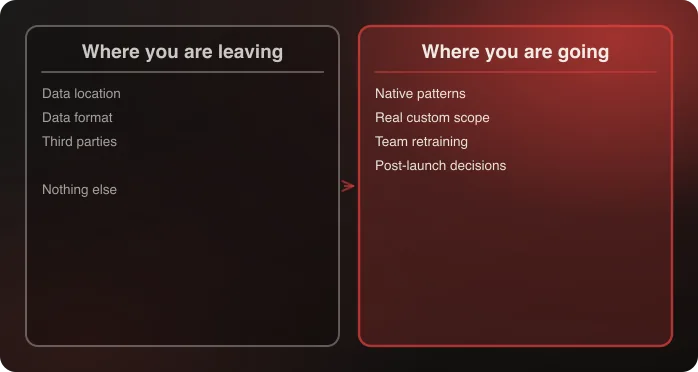
Extract SFCC data with its specific model in mind, transform with a strong bias toward Shopify's native patterns rather than replicating cartridge logic, and load with rigorous parity testing given the typical scale of SFCC deployments. The ETL method and the thesis behind this series apply here without modification.
Frequently Asked Questions
Is migrating from Salesforce Commerce Cloud harder than other platforms?
The data extraction isn't necessarily harder, but the custom-to-custom audit matters more, since SFCC implementations are almost always heavily customized. Skipping that audit is the biggest risk specific to SFCC migrations.
Do our custom SFCC cartridges need to be rebuilt on Shopify?
Not by default. Audit each one against Shopify's current native capability first — a meaningful share of custom cartridge logic addresses gaps that don't exist on Shopify today.
Should a contract renewal date set the migration timeline?
It can set the deadline, but it shouldn't shorten the audit. Compress discovery by running its workstreams in parallel with more people rather than by cutting the work that determines whether the build is scoped correctly.
What about our enterprise ERP and WMS integrations?
The connector has to be rebuilt for Shopify, but the system behind it is usually worth keeping. Rebuilding an integration method is expected work; replacing a functioning enterprise system during a cutover rarely is.
If you're scoping a move off SFCC, talk to an architect about what a cartridge audit would surface — or see how we scope a systems replatform.
Talk to an architect about your SFCC migration.

Related