












WooCommerce to Shopify Migration
September 2, 2026
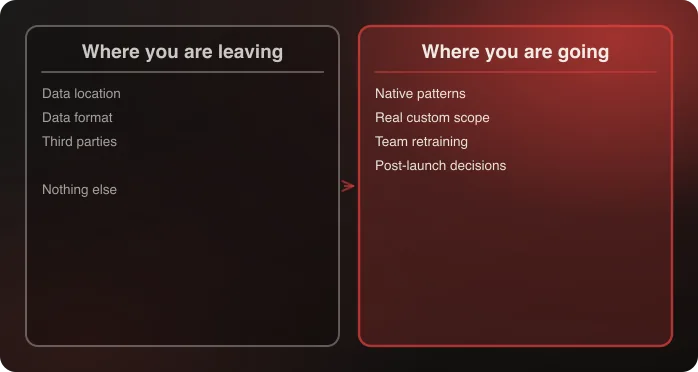
WooCommerce migrations at enterprise scale are less common than at smaller scale, but they follow the identical method: extract the WordPress and WooCommerce data cleanly, adopt Shopify's native patterns, and keep the third-party systems that already work well with both.
If a plugin vulnerability or a hosting incident is what started this, that's a recognized trigger — and one of the two most likely to produce a rushed decision.
Last verified: September 6, 2026.
What's actually specific to WooCommerce
WooCommerce runs as a WordPress plugin, which means commerce data lives inside a WordPress database structure rather than a dedicated ecommerce data model. Extraction has to account for that — separating genuine commerce data from WordPress's broader content-management structure, and resolving records that exist as posts and post meta rather than as first-class order or product entities.
It also means the content side of the site needs its own decision. A WooCommerce store frequently carries years of editorial content in the same database, and whether that content moves to Shopify, stays on a WordPress instance, or gets retired is a scoping question worth settling early rather than at cutover, since it directly affects redirect mapping.
Why enterprise-scale WooCommerce is a specific, real pattern
A WooCommerce store that has grown into real enterprise complexity has usually done so despite the platform rather than because of it. A meaningful share of its custom functionality exists to compensate for a plugin-based architecture reaching its limits.
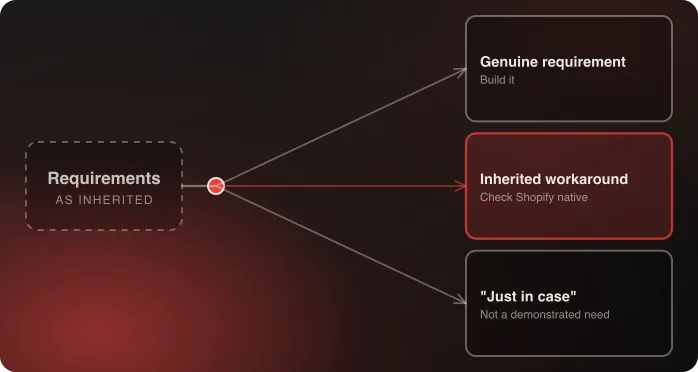
This is the custom-to-custom trap in a particularly clear form: workarounds for a platform straining under scale it wasn't originally built for. Audit before rebuilding, and expect the audit's outcome to be unusually favourable here, because a high proportion of what looks like custom business logic turns out to be infrastructure compensation.
Hosting and performance expertise that doesn't transfer
A large share of WooCommerce's operational challenges at scale — server management, caching configuration, plugin-conflict debugging, database tuning — are infrastructure problems specific to self-hosted WordPress. None of that expertise needs to carry over, because Shopify's managed infrastructure removes the underlying problem rather than requiring it to be solved differently.
Practically: don't budget migration time for "understanding our hosting setup" beyond what's needed to extract data cleanly and to know which scheduled jobs and cron tasks are doing real work. The rest is documentation of a system that's being retired.
A pattern worth naming: plugin sprawl
WooCommerce stores at scale often accumulate a large number of plugins, each handling one function — subscriptions, reviews, inventory sync, shipping rules, tax. Part of the migration's value is consolidating that sprawl into Shopify's native capability or a smaller number of well-supported apps, rather than finding a one-to-one Shopify replacement for every WooCommerce plugin currently installed.
The exercise that makes this concrete: list every active plugin, write next to each one what business outcome it produces, and then group by outcome rather than by plugin. Stores routinely find three plugins producing one outcome, and one plugin nobody can attribute an outcome to at all.
Third parties on WooCommerce migrations
Given the plugin-heavy nature of these stores, this decision deserves real scrutiny. Some plugins genuinely provide unique value and have Shopify-side equivalents from the same vendor worth keeping. Others compensate for a WooCommerce-specific gap that simply doesn't exist on Shopify. See the full framework — and note that a plugin is not the same category of decision as an ERP. The framework's three questions apply, but the operational weight is usually much lower, which means these can be batched rather than decided one meeting at a time.
What's actually been happening on WooCommerce
WooCommerce's security exposure is structurally different from a single-vendor platform's, and the difference is well documented:
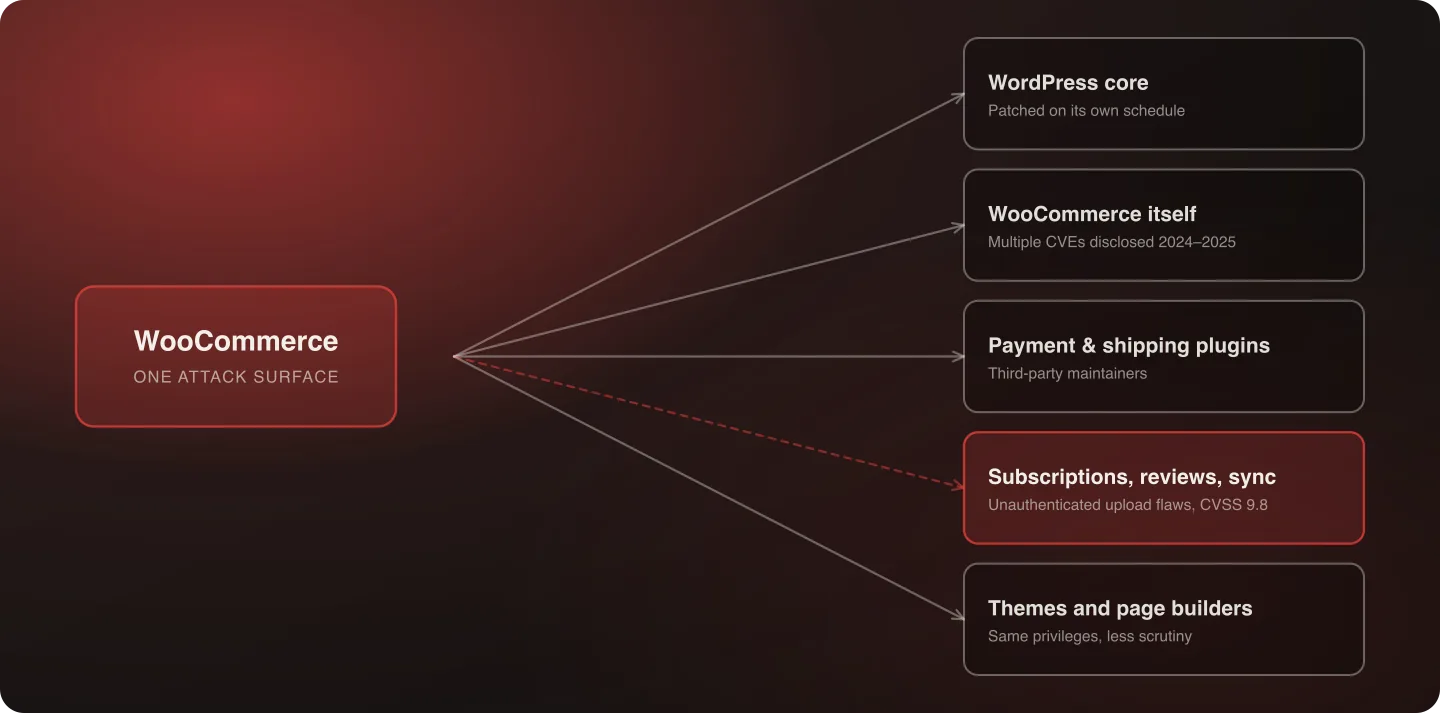
- 2025 saw an unusually high volume of critical, high-severity vulnerabilities disclosed across WooCommerce plugins and themes. Security researchers at Quttera characterized unauthenticated arbitrary-file-upload flaws as the year's most common and damaging vector, frequently carrying CVSS scores of 9.8 — near-maximum severity, requiring no authentication or admin credentials to exploit.
- Because the ecosystem is built on thousands of independently maintained third-party plugins, a single vulnerable plugin — even one unrelated to WooCommerce's own core code — can expose an entire store. WPScan's public vulnerability database lists multiple disclosed WooCommerce-related CVEs across 2024 and 2025 alone, spanning cross-site scripting, SQL injection, and unauthenticated order-creation flaws.
- This is a structural characteristic of the plugin model rather than a one-time lapse. The same reporting described the collapse of authentication as an effective security boundary across 2025's disclosed WooCommerce vulnerabilities: attackers increasingly don't need valid credentials at all, just a vulnerable plugin running unpatched.
The core WordPress and WooCommerce relationship means this risk isn't limited to the main plugin. It scales with however many third-party plugins and themes a store has installed, which for an enterprise-scale deployment is often substantial — and it's the one risk that grows every time someone solves a problem by installing something. If this is your trigger, see the five real reasons merchants actually migrate before diving into the how.
What consolidation is actually worth
The payoff for consolidating plugin sprawl is the same one every migration in this series is chasing: less code and fewer moving parts to maintain. Nuts.com came off a homegrown platform with reliance on custom code down 85% and total cost of ownership down 41% by year two, having replaced it with native Shopify capability, Functions, and a small number of well-chosen partners rather than a like-for-like set of substitutes. A plugin-heavy WooCommerce store is the same exercise, run against a longer list.
The method, unchanged
Extract commerce data out of the WordPress structure, transform toward Shopify's native model rather than replicating a plugin's data shape, and load with parity testing. The full ETL method covers each step, and the guide behind this series covers why the origin platform changes so little about it.
Frequently Asked Questions
Can WooCommerce handle enterprise-scale ecommerce?
It can grow into that scale, but usually accumulates significant custom functionality and plugin sprawl to compensate for its plugin-based architecture along the way — much of which doesn't need to migrate to Shopify.
What happens to all our WooCommerce plugins when we migrate?
Audit each one for whether it provides genuine unique value or compensates for a WooCommerce-specific limitation. Many can be consolidated into Shopify's native capability rather than replaced one for one.
What happens to our WordPress content?
That's a scoping decision worth settling early, because it drives redirect mapping. Content can move to Shopify, stay on a separate WordPress instance, or be retired — but deciding at cutover is how URLs get lost.
Does our hosting and caching expertise transfer to Shopify?
No, and that's the point. Server management, caching configuration, and plugin-conflict debugging are self-hosted WordPress problems that Shopify's managed infrastructure removes rather than relocates.
If you're running WooCommerce at a scale it wasn't built for, talk to an architect — or see how we scope a systems replatform.
Talk to an architect about your WooCommerce migration.

Related