












BigCommerce to Shopify Migration
September 3, 2026
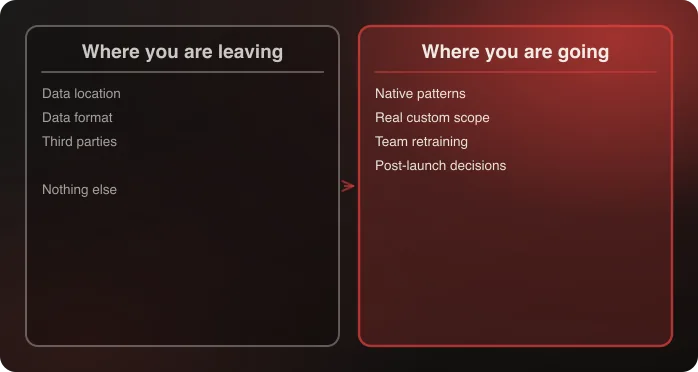
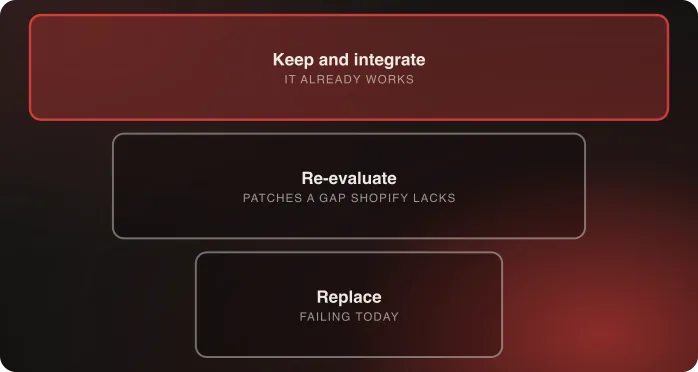
Migrating from BigCommerce to Shopify follows the same method as any other platform migration: extract your data, adopt Shopify's native patterns, and keep the third-party systems that already work. BigCommerce-specific knowledge matters only for the narrow, mechanical question of data extraction.
If what brought you here is a cost trend or a nagging sense that the platform's attention has moved elsewhere, that's a recognized trigger, and it changes what to prioritize once you start.
Last verified: September 6, 2026.
What's actually specific to BigCommerce
BigCommerce's API structure and native feature set — multi-storefront support, built-in B2B features on higher plans — differ from Shopify's, which affects how data maps over. That matters most for merchants using BigCommerce's native B2B catalog features, which need mapping onto Shopify's own B2B model rather than being rebuilt custom.
Note that Shopify's B2B functionality was extended to all plans as of April 2026, which changes the calculus for merchants who assumed a B2B rebuild meant custom development or a Plus-tier requirement. Check current capability before scoping; this is the exact assumption that the audit exists to catch.
Why BigCommerce migrations often carry a lighter custom-code burden
BigCommerce's native feature set sits closer to Shopify's out-of-the-box than Magento's heavily customized norm tends to, which often means a shorter custom-to-custom audit. But "often shorter" is not "unnecessary." Run the same audit regardless of origin platform — the list is shorter, not empty, and the items on it tend to be the ones a team is most confident about, which is precisely when checking pays.
Multi-storefront BigCommerce merchants: a specific mapping decision
Merchants running multiple storefronts on a single BigCommerce account need those storefronts explicitly mapped to Shopify's expansion-store model, a Plus-tier capability. This isn't a straight lift — the two platforms structure multi-storefront management differently, and the differences show up in catalog sharing, pricing, and admin permissions rather than in the storefront itself.
Before assuming every storefront needs a direct equivalent, map which ones genuinely need to remain distinct and which exist as a workaround for a BigCommerce-specific catalog limitation. A storefront that exists because two markets needed different pricing, and nothing else, may not need to be a separate store on Shopify at all.
What a realistic BigCommerce migration timeline looks like
Generally faster than a comparably sized Magento or Salesforce Commerce Cloud migration, given the typically lighter customization burden. The real driver is still integration count and the outcome of the custom-to-custom audit, not the origin platform's name. Timelines by complexity covers what actually moves the estimate.
Third parties that commonly survive
BigCommerce merchants frequently use payment and tax integrations similar to those Shopify merchants use, since both platforms draw from an overlapping app ecosystem. That's a real advantage for keep-versus-replace decisions, because more of these tools already have proven Shopify-side integrations. See the framework for how to sequence the calls.
What's actually been happening at BigCommerce
If cost or platform stability is part of what's driving your evaluation, the concern is grounded in publicly reported events rather than speculation:
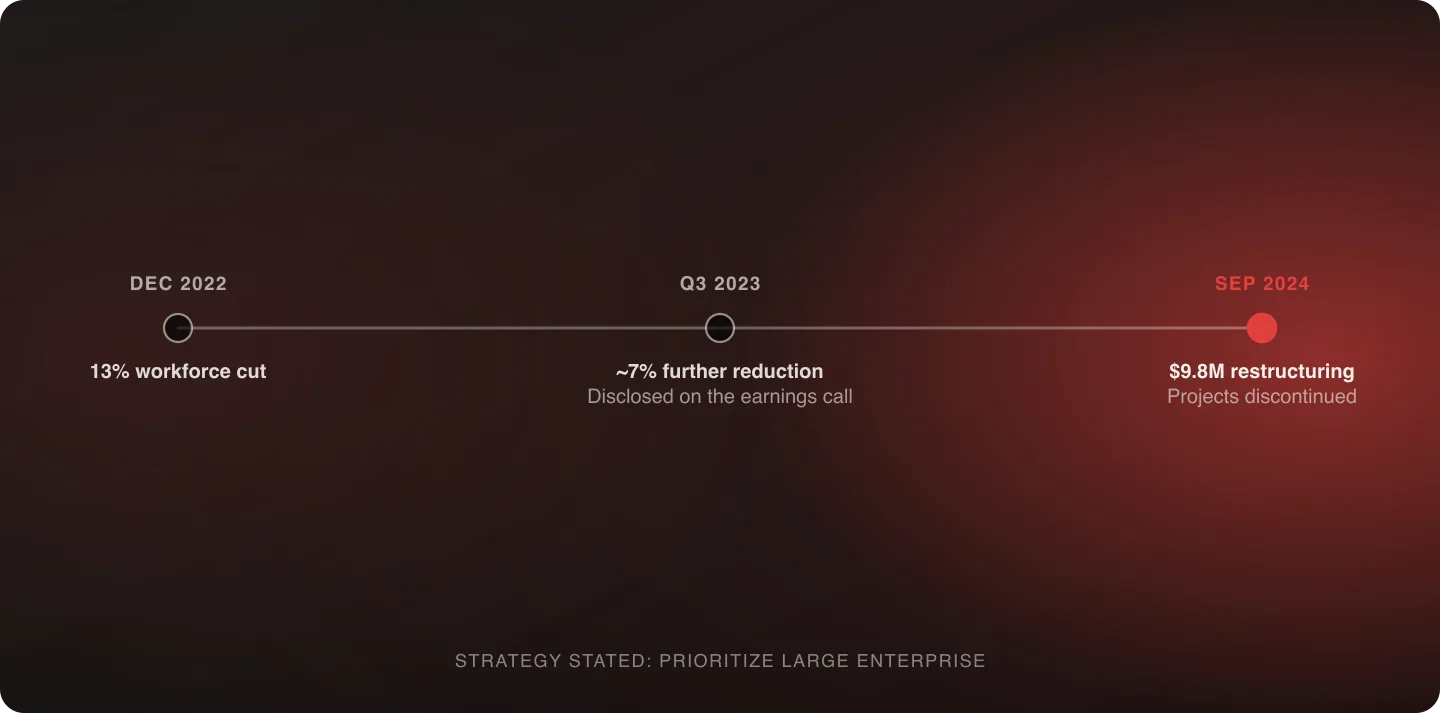
- Three consecutive years of workforce restructuring — a 13% reduction announced in December 2022, a further reduction of approximately 7% disclosed on the Q3 2023 earnings call, and another round announced September 30, 2024 that included workforce cuts, discontinued software development projects, and $9.8 million in restructuring charges.
- The stated strategic reason is a deliberate pivot toward large enterprise customers, explicitly deprioritizing non-enterprise initiatives. Worth knowing if your account isn't in BigCommerce's largest-customer tier, since product investment and support focus tend to follow a company's own stated priorities.
- The stock has declined from a 2021 high near $130 per share to the single digits through 2025 (NASDAQ: BIGC) — a long, sustained decline rather than a short-term dip, and publicly verifiable on any ticker.
None of this means BigCommerce doesn't work for existing customers today. It means the company's own public statements and financial filings describe a multi-year pattern of cost-cutting and strategic narrowing, which is a reasonable thing to weigh in a decision measured in years rather than quarters. If this is your trigger, see the five real reasons merchants actually migrate before diving into the how.
What a disciplined move actually produces
BigCommerce migrations are usually the lighter end of this series, but the outcome worth aiming at is the same one heavier migrations reach. Nuts.com came off a homegrown platform with 85% less custom code and total cost of ownership down 28% in year one and 41% in year two. Coming from a platform whose native feature set already sits close to Shopify's, the equivalent win is usually a shorter app list and fewer bespoke workarounds rather than a dramatic code reduction — but it is the same audit producing it.
The method, unchanged from any other platform
Extract data with BigCommerce's structure in mind, transform into Shopify's model with a bias toward native adoption, load with parity testing. The full ETL method, and the thesis behind it, are the same here as everywhere else in this series.
Frequently Asked Questions
Is migrating from BigCommerce easier than from Magento?
Often somewhat, since BigCommerce's native feature set sits closer to Shopify's baseline than Magento's typically customized norm. The same audit discipline still applies, just potentially with a shorter list to review.
Do BigCommerce's native B2B features transfer to Shopify?
The underlying data and logic need mapping to Shopify's own B2B model, extended to all plans as of April 2026, rather than being rebuilt as a direct replica. Check current native capability before assuming custom work is required.
What happens to multiple BigCommerce storefronts on Shopify?
They map to Shopify's expansion-store model, a Plus-tier capability, but not always one-to-one. Check first whether each storefront exists for a real market reason or as a workaround for a BigCommerce catalog limitation.
If you want a read on what your BigCommerce setup would actually take, talk to an architect — or see how we scope a systems replatform.
Talk to an architect about your BigCommerce migration.

Related