












Magento to Shopify Migration
September 2, 2026
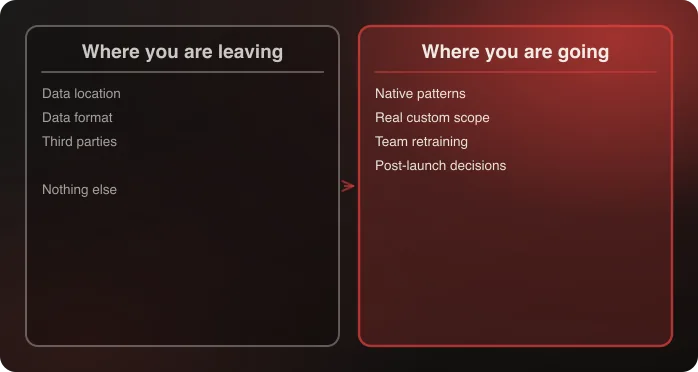
Migrating from Magento to Shopify is a data extraction and native-adoption problem, not a Magento-expertise problem. What matters is where your Magento data lives, how to extract it cleanly, and the discipline to adopt Shopify's native patterns rather than rebuilding Magento's customizations inside them.
If you're here because Adobe just announced another change to the roadmap, or because a CVE landed in your inbox, you're not alone — see the five reasons merchants actually migrate before diving into the how.
Last verified: September 6, 2026.
What's actually specific to Magento, and it's a short list
Magento stores data in a complex relational structure — entity-attribute-value, or EAV — which affects how product and customer data gets extracted, particularly for stores with heavily customized attribute sets. If you're on Magento 1 rather than Magento 2, the extraction specifics differ slightly. That is roughly the extent of what genuinely requires Magento-specific knowledge.
EAV is worth one sentence of explanation because it shapes the extract step: instead of a product row with columns, Magento spreads a product's attributes across several tables, and reassembling them correctly is the actual work of extraction. It is a solved, mechanical problem. It is not a reason to hire for Magento fluency over Shopify fluency.
What doesn't matter: your Magento customizations
Magento is known for extensive customization — custom modules, marketplace extensions, and heavily modified checkout flows. None of it needs to be understood in exhaustive detail to migrate successfully, and very little of it needs rebuilding.
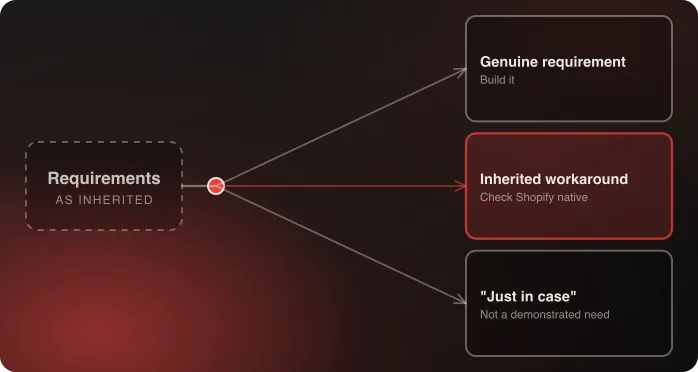
See the custom-to-custom trap for why "we have a lot of custom Magento extensions" is a signal to audit rather than a requirements list to replicate. On Magento migrations specifically, the audit matters more, not less: Magento's ecosystem encouraged the extension-for-everything approach for years, so there is usually more inherited complexity to sort through before determining what's a genuine requirement.
Magento 1 vs. Magento 2 — does it matter?
Magento 1 reached end-of-life years ago, which means any store still running it carries additional risk — no security patches, aging infrastructure — independent of the migration decision. If you're still on Magento 1, that's a reason to move sooner rather than a reason to expect a harder migration. The extraction mechanics are similar to Magento 2's, just against an older and less documented codebase.
What a realistic Magento migration timeline looks like
Timeline depends far more on integration count and custom-extension volume than on catalog size alone. A Magento store with a clean, short extension list and one or two integrations moves faster than a larger store carrying years of accumulated custom modules.
Run the custom-to-custom audit before committing to a timeline. Its outcome — how much genuinely needs rebuilding versus how much gets retired — is usually the single biggest timeline variable, and it's knowable in weeks rather than months. Timelines by complexity covers how the ranges actually break down.
Third parties that commonly survive a Magento migration
Payment gateways and tax engines integrated with Magento frequently have equally solid Shopify integrations already — strong keep candidates. ERP and OMS systems connected via Magento-specific extensions need their integration method rebuilt regardless, since the extension itself won't transfer, but the underlying system is usually still a keep. See the full third-party framework.
What's actually been happening on Magento
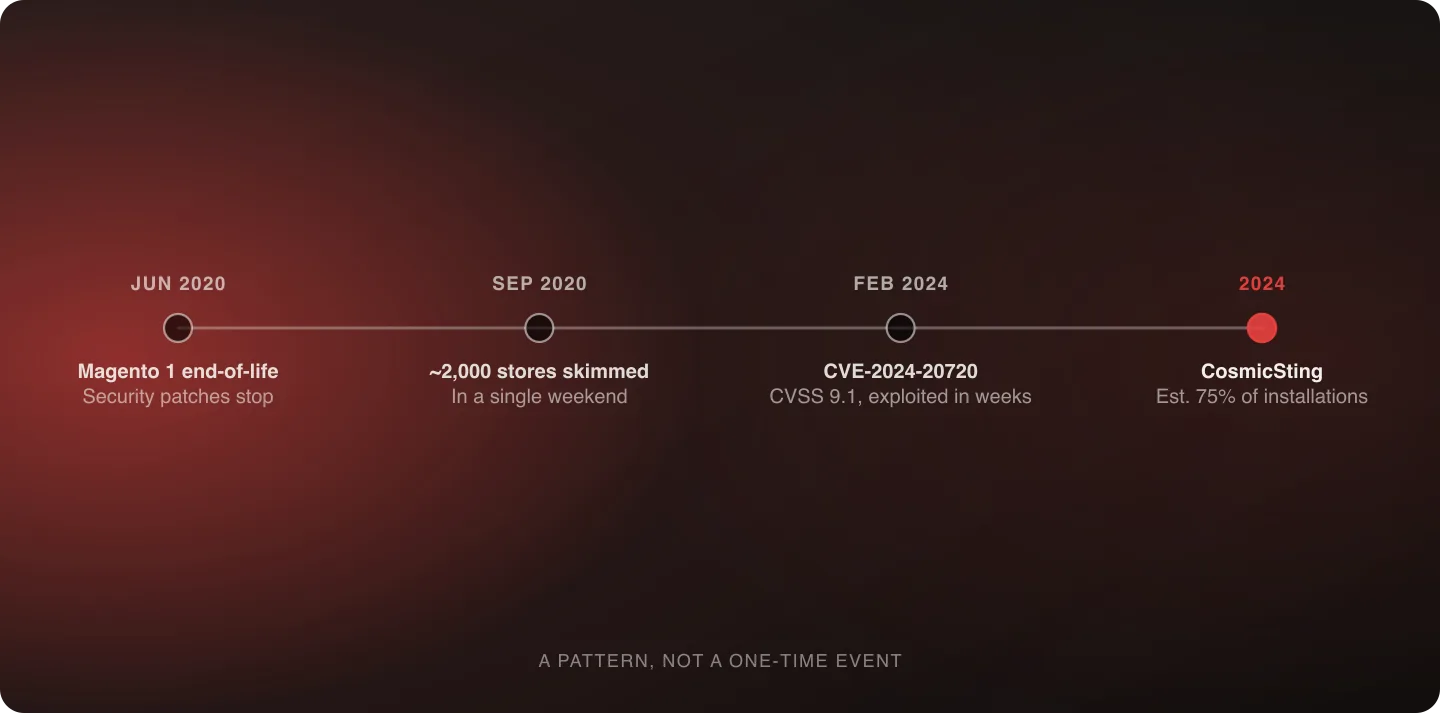
If you're evaluating a move away from Magento right now, you're not being paranoid. A pattern of real, documented events explains why so many merchants are looking elsewhere:
- Magento 1 reached end-of-life on June 30, 2020, and Adobe stopped issuing security patches entirely. Within months, security researchers documented what Sansec called the largest Magecart campaign since 2015: close to 2,000 Magento 1 stores compromised in a single weekend, exposing an estimated 10,000+ customers' payment data.
- CosmicSting (CVE-2024-34102, chained with CVE-2024-2961), disclosed in 2024, was among the most widespread attacks of that year — reported to affect an estimated 75% of Adobe Commerce and Magento installations, and used to compromise thousands of stores.
- CVE-2024-20720, a critical command-injection vulnerability rated CVSS 9.1 and disclosed in February 2024, was being actively exploited within two months, allowing attackers to plant persistent backdoors with no user interaction required.
- Sansec reports identifying over 70,000 Magento and Adobe Commerce stores that have contained a digital skimmer at some point since it began tracking.
None of this means every Magento store is compromised right now. It means the pattern of critical, actively exploited vulnerabilities on this platform is well documented and ongoing rather than a one-time event, and that a store's exposure is a function of how quickly its team can patch — which for a heavily customized instance is rarely as quickly as the patch ships.
There is a licensing dimension too, if you're on Adobe Commerce rather than open source: renewal is the moment the total cost of the platform, including the developers required to maintain its customizations, becomes visible in one number. That's trigger five, and it comes with more lead time than the others.
What this looks like when it goes well
The clearest proof point in this series didn't come from Magento — it came from a homegrown platform, which is the harder version of the same problem. Nuts.com moved catalog, customers, orders, live subscriptions and five custom product builders in six months and came out with 85% less custom code and total cost of ownership down 41% by year two, because the audit ran before the build rather than after it. A Magento estate with a long extension list is the same exercise with better documentation.
The method that actually determines success
Extract your Magento data with the EAV structure in mind, transform it into Shopify's simpler model rather than replicating Magento's complexity, and load with full parity testing. The full ETL method covers each step, and it is the same method that applies to every other origin platform in this series — which is the point of the series.
Frequently Asked Questions
Do I need a Magento expert to migrate to Shopify?
Less than you'd think. You need someone who can extract data cleanly from Magento's structure and who deeply understands Shopify. The second is where the expertise that determines success actually lives.
What happens to my Magento customizations when I migrate?
Most shouldn't be rebuilt as-is. Audit each one against Shopify's native capability first — a meaningful share turn out to be workarounds for Magento limitations that don't exist on Shopify.
Is Magento 1 harder to migrate from than Magento 2?
Not materially. The extraction mechanics are similar, against an older and less documented codebase. The bigger difference is risk: Magento 1 has had no security patches since June 2020.
How long does a Magento to Shopify migration take?
It depends on integration count and custom-extension volume far more than on catalog size. Run the custom-to-custom audit first — its outcome is usually the largest single variable in the estimate.
If you're weighing a move off Magento, talk to an architect about what an audit would surface — or see how we scope a systems replatform.
Talk to an architect about your Magento migration.

Related