












The 8 Principles That Separate a Successful Replatform From an Expensive One
July 17, 2026

There is no shortage of replatforming checklists on the internet. Most of them say the same reassuring things: audit your data, plan your redirects, test thoroughly. All true, all useless as guidance, because they describe tasks rather than the decisions that actually determine whether a replatform succeeds.
We've migrated over $3.14 billion in GMV to Shopify from Magento, WooCommerce, Salesforce Commerce Cloud, and a fair number of custom builds nobody should have written. Along the way we've developed opinions — some of which run against the standard advice. Here they are.
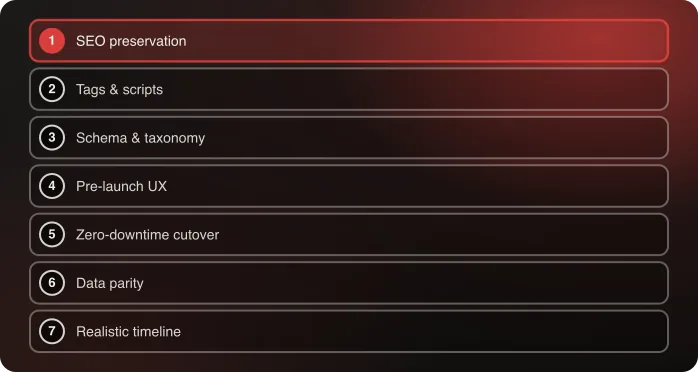
These eight principles are the opinionated half of a broader method. The full framework — SEO preservation, tags and scripts, product schema, pre-launch UX, cutover, data parity, and timelines — is in how to replatform without losing revenue.
There's a prior question these principles assume you've already settled: how much the platform you're leaving should shape the build at all. The enterprise guide to migrating to Shopify argues that the answer is "far less than most teams assume," and it's the framing the principles below sit on top of.
Last verified: September 6, 2026.
Principle 1: Take every upgrade the platform hands you. Defer the ones you have to invent.
Let's kill a bad idea first: "migrate to parity."
It's the standard agency advice, and merchants hate it for good reason. Nobody signs off on a seven-figure replatform to end up with the same store on a different foundation. If you're moving to Shopify and Shopify does something better natively — faster checkout, better mobile performance, native B2B, cleaner subscription handling, a stronger admin experience for your team — you should absolutely take it. Deliberately rebuilding your old limitations on a better platform is not risk management. It's waste.
So the real question isn't improve or don't. It's which improvements come free with the platform, and which ones you're inventing on top of it.
Take the platform-native upgrades. These come with the migration whether you want them or not, they're battle-tested by Shopify across millions of merchants, and skipping them means paying migration costs without collecting the returns. Native checkout. Performance gains. Capabilities your old platform required custom code to approximate. Take all of it.
Defer the discretionary reinvention. New visual design. New product taxonomy. New navigation IA. A feature set your team dreamed up in the kickoff meeting. Each of these is a separate bet that happens to be scheduled at the same time as your migration — and every one you stack on multiplies your risk surface and destroys your ability to diagnose what happened. If conversion moves 8% after launch and you changed the platform, the design, the taxonomy, and the checkout flow simultaneously, you will never know which one did it. Neither will your board.
That's the line. Not "don't improve." Improve where the platform improves you; sequence everything you have to build yourself.
The corollary: don't bundle your redesign into your replatform. We've said this to clients who didn't want to hear it. A replatform and a redesign are both hard, and doing them together doesn't save time — it just makes both harder and makes the results unattributable. Launch on the stronger platform, measure clean, then design deliberately against real data. The full version of that argument, including the cases where bundling is justified, is in should you redesign while you replatform?
Principle 2: Replatforming is a technology consolidation opportunity — use it
Most merchants arrive at a replatform with a stack that grew by accretion. Twelve years of "we needed a thing, so we added an app" produces a technology estate nobody designed, that nobody fully understands, and that costs a fortune in license fees and integration maintenance.
We call the ongoing cost of this a technical debt tax — the compounding drag on velocity, budget, and reliability that a tangled stack imposes on every future project. Our clients see an average 26% reduction in it after the work we do.
The replatform is the one moment when you have organizational permission and budget to actually fix this. Do not waste it by lifting and shifting your existing sprawl onto a new platform.
Practically: before you migrate anything, inventory every tool in the stack and ask three questions of each. Is this still doing something we need? Does the new platform do it natively? If we kept it, would we choose it again today? You will find tools nobody has logged into in a year and still paying for. You will find three apps doing overlapping jobs. You will find integrations built for a workflow that changed in 2022.
Kill them during the migration, not after. After never comes.
Principle 3: Architect for where you're going, not where you are
The most expensive replatform is the one you have to do again in three years.
We see merchants scope the migration around today's requirements and then discover eighteen months later that the architecture can't support B2B, or POS, or a new market, or the subscription model the growth team just committed to. Now they're either bolting on workarounds — rebuilding the technical debt they just paid to remove — or replatforming again.
Before you scope anything, force the conversation about the three-year roadmap. Are you launching wholesale? Expanding internationally? Adding retail? Moving to subscription? Building a mobile app? Your solution architect needs those answers before the data model gets designed, not after.
This is where platform tier and architecture decisions intersect, and where a partner who thinks in systems rather than storefronts earns their fee.
How this squares with Principle 1: these operate on different layers, and conflating them is where most replatforms go wrong. Architecture is a build-once decision — your data model, integration patterns, and extensibility have to anticipate the three-year roadmap, because retrofitting them later means another migration. The experience layer is iterative — design, taxonomy, and merchandising can and should evolve continuously after launch, informed by real data. So: build the foundation for where you're going, and sequence the surface. You're not deferring capability. You're deferring the changes that are cheap to make later and expensive to get wrong now.
Principle 4: Business continuity is a requirement, not an aspiration
Every migration plan claims it will preserve business continuity. Fewer are actually designed for it.
Continuity means specific, testable things: order history and customer accounts intact and accessible. Subscription contracts migrating without lapsed billing or churned customers — which, on a subscription business, is the single highest-risk element of the entire project and deserves disproportionate attention. Inventory accurate at cutover. Fulfillment uninterrupted. SEO equity preserved through comprehensive redirect mapping — not a spot-check of your top 50 URLs, but every indexed page. Analytics continuity so you can actually compare pre- and post-launch performance.
Our own implementation predictability sits at 94.7%, and that number exists because we treat continuity as an engineering requirement with acceptance criteria — not as a hope expressed in a kickoff deck.
Opinionated take: if your agency's migration plan doesn't include a rollback strategy, they're not planning for continuity. They're planning for optimism. What a real rollback strategy specifies — the freeze window, the sync sequence, named go/no-go checkpoints, and a trigger agreed in advance — is in the zero-downtime cutover runbook.
Principle 5: Your data is worse than you think — find out early
Every merchant believes their product data is basically fine. In seventeen years, it has been basically fine approximately never.
Legacy platforms accumulate: duplicate SKUs, orphaned variants, inconsistent attribute naming, products with no images, customer records with malformed addresses, historical orders referencing products that no longer exist. On Magento in particular, years of EAV-model flexibility tends to produce a catalog structure that doesn't map cleanly onto anything.
Audit the data at the start of the project, not during migration. The discovery that 30% of your catalog needs manual remediation is a schedule problem if you find it in week two and a crisis if you find it in week ten. Budget real time for cleanup, and treat the migration as the moment to establish the data governance you should have had all along. And verify the migrated result field by field rather than by record count — what real parity testing involves.
Principle 6: The go-live is the middle of the project, not the end
Here's a pattern we've watched play out repeatedly at other agencies' clients before they come to us: the site launches, the agency celebrates, the team rolls off, and three weeks later the merchant is alone with a new platform, a list of edge cases nobody caught, and no one who knows why anything was built the way it was.
A replatform doesn't end at launch. It ends when the merchant's team is fully operational on the new platform, the post-launch defects are cleared, performance is validated under real traffic, and the improvements you deferred in Principle 1 are actually getting built.
This is why we think about engagements in terms of embedded, end-to-end product teams rather than project handoffs — and why our client relationships average around three years rather than one project cycle. The value of a replatform is realized in the eighteen months after it, and that only happens if someone is still there.
Principle 7: Adoption is part of the deliverable
The most under-discussed failure mode in replatforming isn't technical. It's organizational.
You can build a technically flawless Shopify implementation and still fail if the merchandising team doesn't trust it, the marketing team can't use it without filing a developer ticket for every landing page, and the ops team quietly maintains their old spreadsheet workflow in parallel because nobody trained them properly.
Two implications:
Build for the people who will use it daily. Modular, composable architecture is only valuable if it's genuinely usable by your marketing team without engineering involvement. If every content change requires a developer, you've built a bottleneck and called it a platform.
Treat change management as scoped work. Stakeholder alignment, training, documentation, and internal buy-in aren't soft extras — they determine whether the investment produces returns. We scope technology adoption and change strategy as an explicit part of engagements for exactly this reason.
Principle 8: Choose the partner for the hard parts, not the pretty parts
Anyone can build a homepage. The replatform will be decided by the parts nobody demos: the subscription contract migration, the ERP integration, the redirect map, the checkout logic, the data reconciliation, the cutover plan.
So evaluate partners on those. Ask about the migration that went sideways and what they did about it. Ask who specifically will be on your team and how senior they are — not who's in the pitch. Ask for migrations at your complexity, with numbers attached. Ask what happens in month four after launch.
And ask about experience beyond the storefront. Shopify is the foundation, but your replatform will live or die on how cleanly it connects to your ERP, your subscription platform, your ESP, your OMS, your fraud tooling. An agency that only knows how to theme a storefront will struggle the moment the project touches the rest of your stack — which is roughly week three.
What This Looks Like When It Works
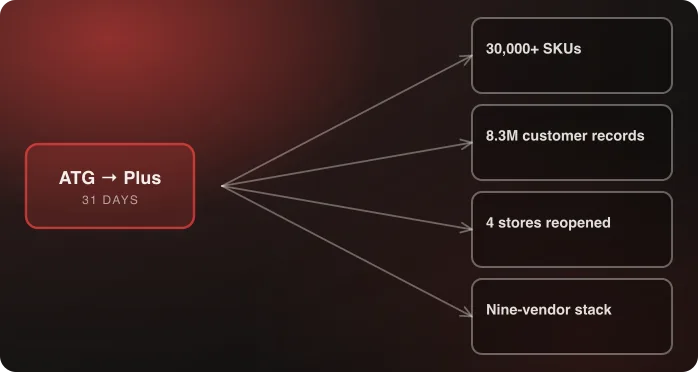
buybuy Baby moved to Shopify Plus in 31 days. Grove Collaborative migrated with subscription logic complex enough that most agencies would have hedged the timeline by a quarter. AG1 came out of their migration with a 31% year-over-year retention lift.
None of those happened because of heroics at the end. They happened because of decisions made at the beginning: architecture designed for the three-year roadmap, platform-native upgrades taken in full, discretionary reinvention sequenced rather than stacked, continuity treated as an engineering requirement, and a senior team that stayed through the part that actually mattered.
Replatforming is not a website project. It's the foundation your next five years of growth sits on. Scope it accordingly.
If you're evaluating a move to Shopify from Magento, WooCommerce, Salesforce Commerce Cloud, or a custom stack — and you want a partner who'll tell you honestly what's hard about your specific situation — chat with our team or explore our success stories.
Frequently Asked Questions
How long does replatforming to Shopify take?
It depends heavily on catalog complexity, integration count, and subscription logic. Straightforward migrations can complete in weeks — we've done enterprise migrations in as few as 31 days — while complex multi-system replatforms typically run several months. Beware of anyone quoting a timeline before auditing your data and integrations. Replatforming timelines by complexity breaks down the four factors that actually drive the number.
Should I redesign my site during a replatform?
We advise against it. Take every upgrade the new platform gives you natively — checkout, performance, native capabilities — but sequence the discretionary changes like a full visual redesign or a new taxonomy. Bundling them multiplies risk and makes post-launch results impossible to attribute.
What's the biggest risk in a replatform?
For most merchants, data and continuity — specifically subscription contract migration, order/customer history, and SEO redirect mapping. For subscription businesses in particular, contract migration is the highest-stakes element of the entire project.
Will I lose SEO rankings when I replatform?
Not if redirects are handled comprehensively. The failure mode is partial redirect mapping — covering top pages but leaving the long tail to 404. A complete URL inventory and redirect map is non-negotiable. See URL redirect mapping for a replatform for the five-step process that closes the long tail.
Is Shopify a downgrade from Magento or Salesforce Commerce Cloud?
It's a different set of tradeoffs. You give up some low-level control and gain substantially in total cost of ownership, release velocity, and operational simplicity. For most merchants that trade is strongly favorable — but it's worth being clear-eyed about what your team genuinely uses today versus what it merely has access to.

“Following Anatta’s work, our conversion rate went from 4.1% to 6.2%, which is insane in the e-commerce industry.”
Tran Ngo, VP Digital & Growth
Read now
Navigating a Complex Platform Migration? Learn how we solved these challenges for AG1.

Related